Artist
Vincenzo Civerchio

Italy
Vincenzo Civerchio is an Italy Early Renaissance artist. 2 works are cataloged here, principally at National Gallery of Art.
Vincenzo Civerchio or Civercio (c. 1470 – c. 1544) was an Italian painter of the Renaissance, born at Crema, and active also in Brescia, where there are some of his alter-pieces. One of his works is at the National Gallery of Art, Washington D.C., others in the Pinacoteca di Brera, Milan, Italy. He is said to be an imitator of Bernardino Butinone, Bernardino Zenale, and influenced by Vincenzo Foppa. Luigi Donato of Como is said to have been a pupil.
Overview
Vincenzo Civerchio, also known as Civercio or Vincenzo da Crema, was an Italian Renaissance painter active from approximately 1470 to 1544. Born and based in Crema, in the province of Cremona, Lombardy, he worked primarily in the region between Brescia and Crema, producing altarpieces, panel paintings, and wood sculptures. Civerchio occupies a significant position in the history of Lombard painting as a member of the so-called "intermediate generation" that bridged the late Quattrocento work of Vincenzo Foppa and the mature achievements of Moretto and Savoldo. His works are held in major collections including the National Gallery of Art in Washington, D.C., the Pinacoteca di Brera in Milan, and the Pinacoteca Tosio Martinengo in Brescia.
Biography & dates
Civerchio was born circa 1470 in Crema and died there around 1544. His earliest documented commission came in 1493, when he was engaged to paint frescoes of the Life of the Virgin for the presbytery of the Duomo Vecchio in Brescia, though these have since been destroyed. In 1495 he produced the Polyptych of Saint Nicholas of Tolentino for the church of Santa Barnaba in Brescia, now in the Pinacoteca Tosio Martinengo. By 1504 he had completed his signed and dated Deposition with Saint Alexander, Adam, and Saint Paul for Sant'Alessandro in Brescia, one of his most important surviving works. The municipal government of Crema commissioned significant paintings from him, including an Annunciation for an organ case and a Saint Mark between Justice and Temperance in 1507, the latter confiscated by the French and subsequently lost. In 1512 he is recorded living in Romano di Lombardia, north of Crema. He continued working into the 1530s and 1540s, with works dated 1539 and 1540 at Lovere, and a polypych of 1525 for Santa Maria Assunta in Palazzolo sull'Oglio. Beyond painting, he also worked as a woodcarver, notably creating a sculpture of Saint Pantaleon for the Duomo of Crema.
Style & movement
Civerchio is traditionally classified as an exponent of the Brescian school, though art historians have long debated the precise character of his style. Roberto Longhi characterized Civerchio and Floriano Ferramola as conservative, pedantic perpetuators of Lombard qualities derived from Vincenzo Foppa, Ambrogio Bergognone, and Bramantino. Civerchio studied Northern prints, as was fashionable in early sixteenth-century northern Italy, yet he remained rooted in a Milanese manner of working. His compositions show careful observation of nature and skillful rendering of human anatomy, typically executed in tempera on panel. The art historian Longhi noted Leonardesque qualities in his Saint Roch, housed in the Musei Civici of Crema, which almost anticipate the manner of Cesare da Sesto. French sources describe him as a "perspectivist," and contemporary critics such as Vasari and Giovanni Paolo Lomazzo confused him with Vincenzo Foppa, suggesting the close affinity of their styles. His Deposition of 1504 relates to a series of comparable works by Bernardino Zenale, Romanino, and Altobello Melone, all indebted to Foppa's documented Deposition of 1498.
Major works
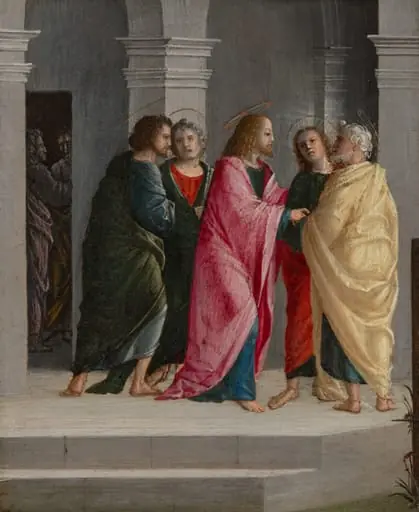
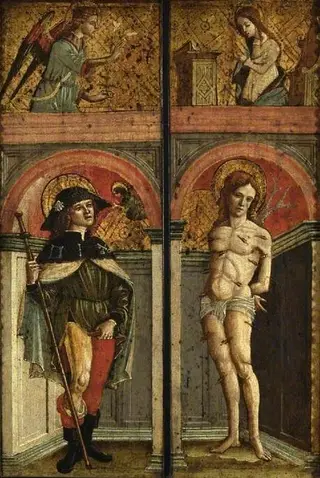
Civerchio's oeuvre includes several significant altarpieces and panel paintings. The Way to Calvary surmounted by the Deposition of 1490 in the parish church of Travagliato represents his first known work. The Polyptych of Saint Nicholas of Tolentino, dated 1495 and originally for Santa Barnaba in Brescia, is now preserved in the Pinacoteca Tosio Martinengo; it was executed in collaboration with Francesco Napoletano and others. His signed and dated Deposition with Saint Alexander, Adam, and Saint Paul of 1504 for Sant'Alessandro in Brescia stands as a major achievement. In the same year, he painted Christ Instructing Peter and Paul to Prepare the Passover, a tempera on panel now in the National Gallery of Art, Washington, D.C. The Nativity with Saint Catherine of Alexandria, derived from Dürer's engravings and dating to the early Cinquecento, is held in the Pinacoteca di Brera in Milan, having come from a church in the Bresciano. The Altarpiece of Saints Sebastian, Roch, and Christopher dates to 1519 and is in Crema Cathedral. His 1525 polyptych of the Virgin for Santa Maria Assunta in Palazzolo sull'Oglio was transported with the assistance of Giovanmaria Carrara. Notable frescoes survive in the Church of Santa Maria dei Campi in Travagliato. Other works include a Baptism of Christ of 1539 and a Madonna between Saints at Lovere.
Influences & students
Civerchio's artistic formation drew upon multiple sources. He is described as an imitator of Bernardino Butinone and Bernardino Zenale, and as influenced by Vincenzo Foppa, with whom the German Wikipedia source specifically connects his training. The French Wikipedia adds Bramantino and Giovanni Bellini as shaping forces on his art. His work also demonstrates the impact of Northern European printmaking, particularly the engravings of Albrecht Dürer, which he studied alongside other northern Italian artists of the early Cinquecento. In turn, Civerchio influenced members of the next generation: Luigi Donato of Como is recorded as his pupil. More significantly, the Italian Wikipedia identifies him as a fundamental figure in the evolution of Brescian Renaissance painting, whose work influenced other "intermediate generation" painters including Floriano Ferramola, Luigi Donato, and Paolo da Caylina the Younger. Giovanmaria Carrara, who assisted in transporting the 1525 polyptych, is identified as Civerchio's pupil and later became the father of Giovan Battista Castello.
Legacy
Civerchio's posthumous reputation has been shaped by historical confusion and gradual scholarly reclamation. Vasari and Lomazzo already mistook him for Vincenzo Foppa, a confusion that testifies to the close stylistic proximity between the two artists while also obscuring Civerchio's individual contribution. For much of modern scholarship, his significance lies in his role as a conduit between generations: the Italian art historical tradition, articulated by Longhi and subsequent scholars, positions him within the "intermediate generation" that transmitted Foppa's legacy to the mature Brescian Renaissance of Moretto and Savoldo. A 1988 exhibition at the Museo Diocesano d'Arte Sacra in Brescia, devoted to Renaissance art featuring Foppa, Civerchio, Vivarini, Piazza, and Romanino, marked an important moment in the reassessment of his place in Lombard painting. His works remain in major public collections, ensuring continued study of his quiet but consequential role in the development of northern Italian Renaissance art.
Works by Vincenzo Civerchio
Collections represented


Artists in a similar vein