Artwork
Still Life with Dead Game
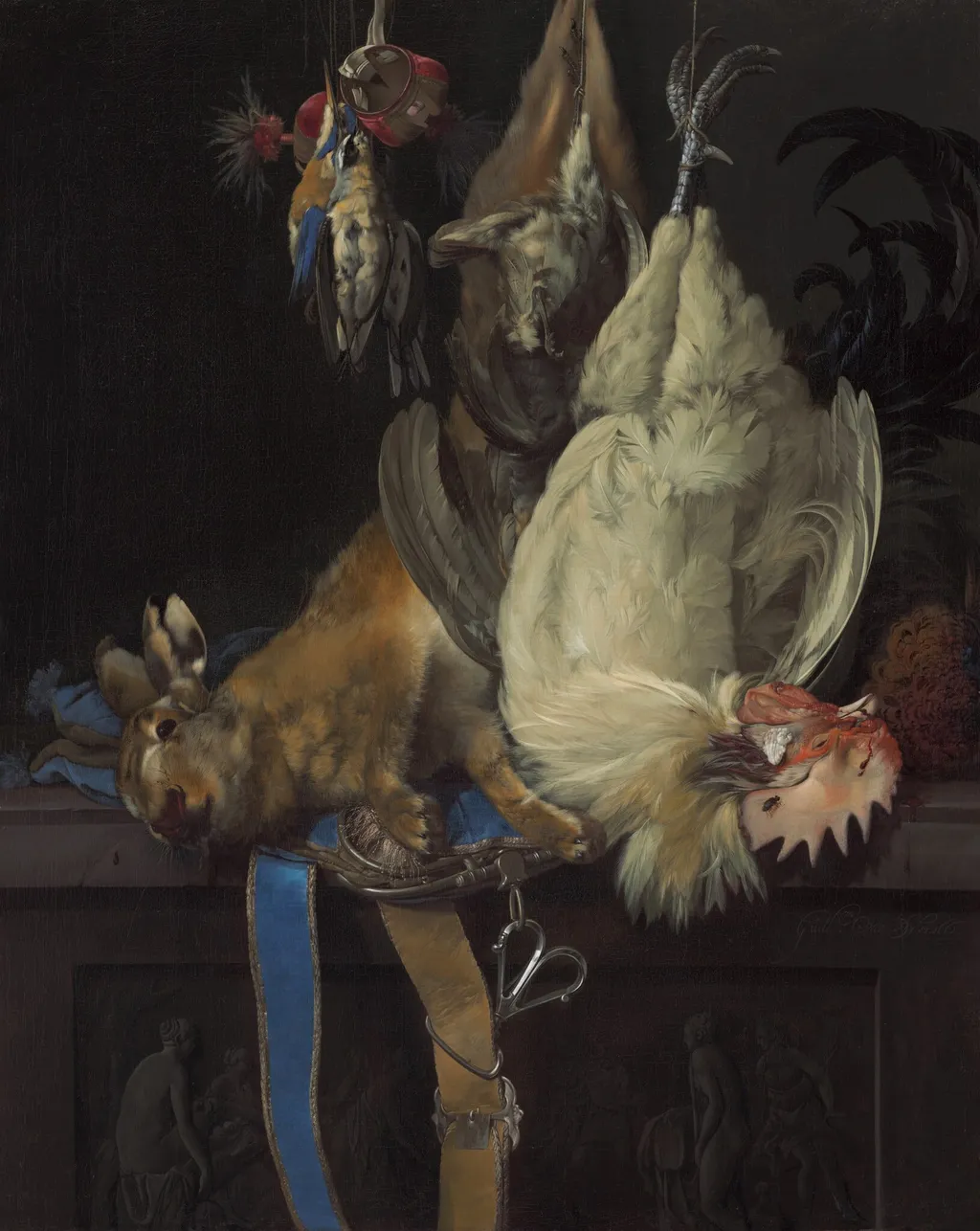
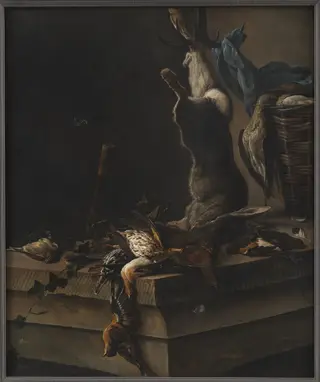
Still Life with Dead Game is an oil painting by the Baroque artist Willem van Aelst. It dates from 1661 and is held in the collection of the National Gallery of Art.
- Inscription
- Inscribed:lower right below table top: Guill.mo van. Aelst. 1661.
About this work
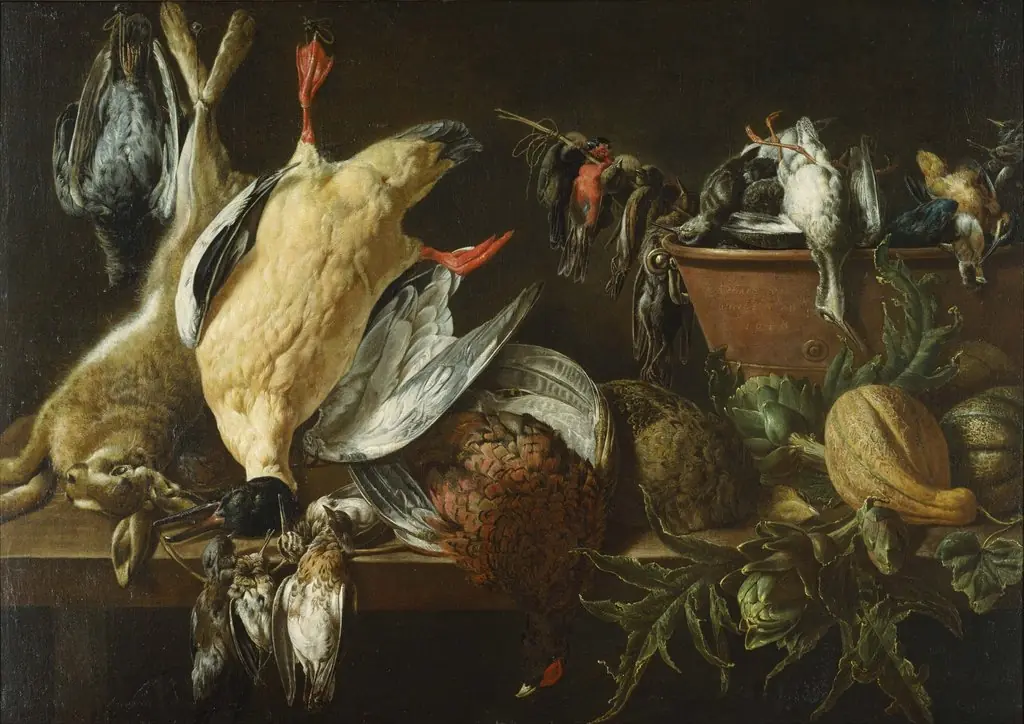
A dead rooster and hare lie against a plain ground, arranged so they seem casually set down. Willem van Aelst caught the light on feather and fur to give the scene depth. Oil on canvas, 1661.
Subject & Meaning
Painted in 1661, this oil on canvas by Willem van Aelst presents a still life composition featuring a dead hare and a rooster.
Painted in 1661, this oil on canvas by Willem van Aelst presents a still life composition featuring a dead hare and a rooster. These specific animals constitute the primary iconography of the work, which is unique within the artist's known oeuvre for depicting both creatures simultaneously. While the painting functions as a display of technical skill in rendering fur and feathers, the inclusion of dead game traditionally alludes to themes of mortality and the transience of life common to the genre.
The work's identification relies on the specific combination of these subjects, distinguishing it from other van Aelst still lifes that might feature only one type of game bird or animal.
Technique & Style
Executed in 1661, this still life by Willem van Aelst is an oil painting on canvas. The work measures approximately 84.7 by 67.3 centimeters. Stylistically, the composition features a dead hare and a rooster, subjects rendered with the artist's characteristic attention to naturalistic detail.
Historical records from a 1749 Amsterdam sale describe the piece as "artfully painted," noting its specific dimensions and original presentation within a black frame with a gilded inner liner. The survival of these early descriptions alongside the physical object confirms the continuity of its material state and subject matter from the mid-eighteenth century to its current location.
History & Provenance
The work titled Still Life with Dead Game was painted by Willem van Aelst in 1661. It first appears in an Amsterdam sale on 14 October 1749 (lot no. 16) and entered the collection of Dr. C.J.K. van Aalst, who kept it at Huis-te-Hoevelaken by 1939. The painting was later sold at Sotheby's Mak van Waay in Amsterdam on 18 May 1981, then handled by Richard Green in London before being acquired by the National Gallery of Art on 8 June 1982.
Willem van Aelst's Still Life with Dead Game (1661) is currently held in the collection of the National Gallery of Art in Washington, D.C. The work entered the museum's inventory on June 8, 1982, following a sale by dealer Richard Green in London. Prior to its acquisition by the gallery, the painting was part of the collection of Dr. C.J.K. van Aalst at Huis-te-Hoevelaken, documented in 1939. Its provenance traces back to an Amsterdam sale on October 14, 1749 (lot 16). The painting depicts a hare and a rooster and measures 84.7 cm by 67.3 cm.
Context
Willem van Aelst's 1661 oil on canvas Still Life with Dead Game exemplifies Dutch Golden Age still-life painting, combining a dead hare and a rooster in a composition noted for its virtuoso handling of texture and light. The work entered the National Gallery of Art through a 1982 acquisition from Richard Green, having previously been owned by Dr. C.J.K. van Aalst and sold at auction in 1981. Scholarship highlights its rarity as the only known van Aelst painting that includes both a hare and a rooster, a point emphasized in contemporary catalogues and later studies of the artist's oeuvre.
Its provenance reflects a documented chain from an 18th-century Amsterdam sale to private Dutch collections, underscoring its significance within the artist's broader corpus.
Overview
Willem van Aelst's "Still Life with Dead Game," painted in 1661, is an oil on canvas work. This painting exemplifies the still life genre, focusing on a carefully composed arrangement of recently hunted animals. It showcases the artist's skill in rendering textures and creating a sense of presence through light.
Own this work as a print
Artist & collection