Artwork
Still Life with a Peacock
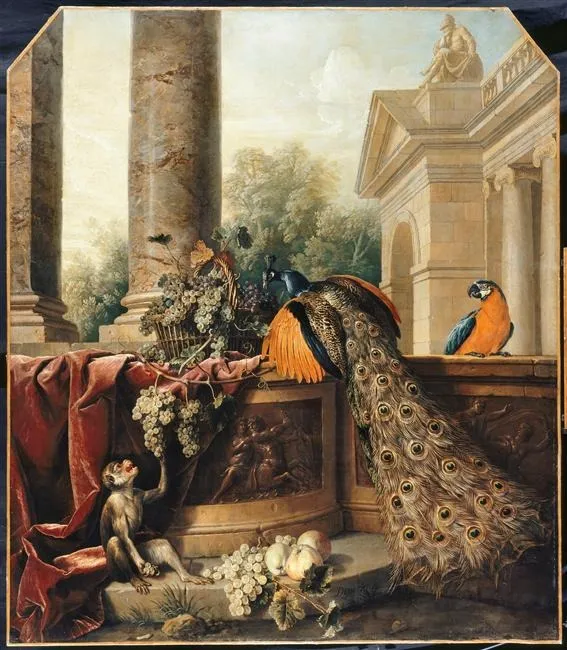
Still Life with a Peacock is an oil painting by the French Classical Baroque artist Alexandre-François Desportes. It dates from 1714 and is held in the collection of the Museum of Fine Arts of Lyon.
About this work
Overview
Measuring 205 by 180 centimeters, the work is now held in the Museum of Fine Arts of Lyon, having been donated to the institution by the French State in 1799.
Still Life with a Peacock is a 1714 oil on canvas painting by Alexandre-François Desportes, a French painter who specialized in animals and decorative compositions. Measuring 205 by 180 centimeters, the work is now held in the Museum of Fine Arts of Lyon, having been donated to the institution by the French State in 1799. Painted during the mature phase of Desportes's career, the picture exemplifies his ability to merge multiple pictorial genres, animal painting, still life, landscape, and architectural elements, into a single grand decorative scheme. It stands as a significant example of early eighteenth-century French still life and reflects the tastes of the aristocratic patrons who commissioned such works for their residences.
Subject & Meaning
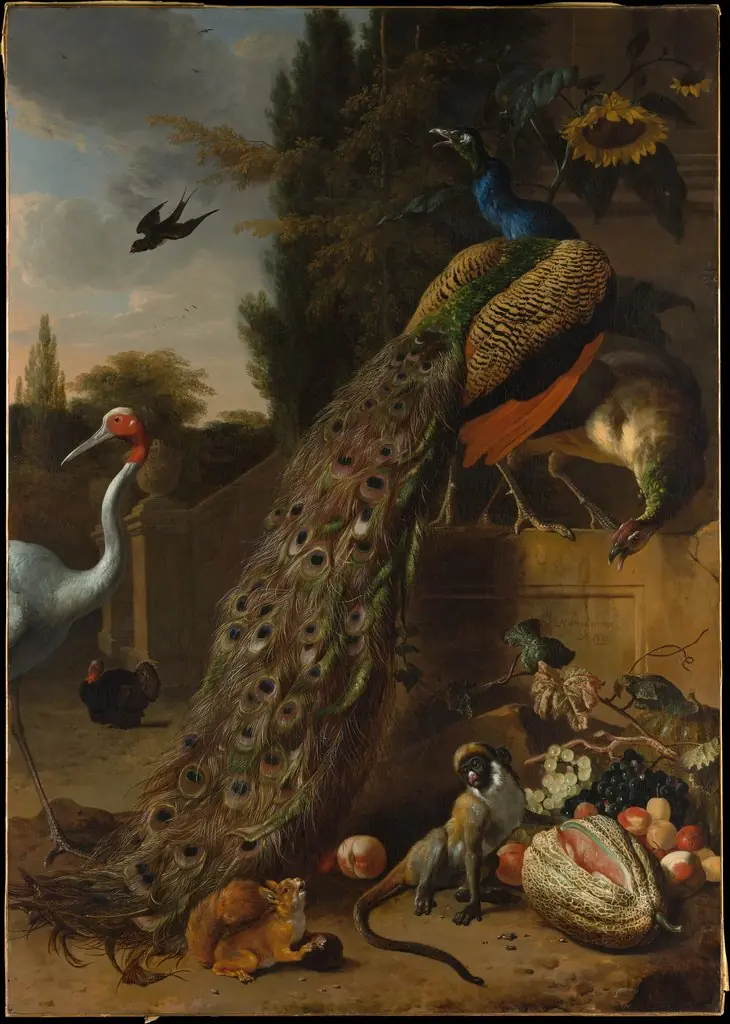
The painting presents a complex assembly of natural and architectural motifs. A peacock with its tail extended downward dominates the right side, perched on a stone ledge beside a blue and orange parrot. A monkey sits lower left, reaching upward toward grapes, while a basket of grapes and foliage rests on a carved stone pedestal at center, draped with crimson fabric. Scattered fruits, including apples and grapes, lie on the ground. Behind these elements, two massive fluted columns rise beside a classical building crowned with a pediment and a statue of a figure who contemplates the scene from above. The background reveals green trees and a pale sky. The work has often been interpreted as an allegory of the five senses, a common theme in Northern European and French still life tradition. The peacock, parrot, and monkey, all exotic creatures, signal wealth and global reach, while the classical architecture elevates the composition beyond mere naturalism into the realm of the ideal. The influence of the Northern School on Desportes is evident in this layered symbolic program.
Technique & Style
Desportes executed the painting in oil on canvas, employing smooth, refined brushwork that renders meticulous detail in feathers, fur, and fruit. Light enters from the left, casting shadows to the right and modeling the forms with a soft naturalism. The palette features warm stone tones, deep red in the drapery, iridescent blues and golds in the peacock's plumage, and soft atmospheric greens in the foliage and sky. The canvas has shaped top corners, suggesting it may have been designed to fit within a specific architectural setting or overdoor arrangement. The composition combines several pictorial styles: Oriental animals, still life, landscape, and sculpture, unified by the balustrade that traverses the full width of the painting and bears elaborate bas-reliefs. This synthesis of genres is characteristic of Desportes's decorative approach, learned in part from his training with Nicasius Bernaerts, a pupil of Frans Snyders, and reflects the Flemish tradition of opulent, large-scale still life adapted to French aristocratic taste.
History & Provenance
The painting was created in 1714 with the specific purpose of decorating the hôtel of the duc d'Antin in Paris, who served as directeur des bâtiments du roi. It functioned as a pendant to another still life by Desportes, Gibier, fruits et chien devant une balustrade, which is now preserved in the Musée des Beaux-Arts d'Angers. This pairing indicates a deliberate decorative program for the duc d'Antin's residence. The French State donated the painting to the Museum of Fine Arts of Lyon in 1799, a transfer that occurred during the revolutionary redistribution of national artistic patrimony. The work is now part of the collection of the Museum of Fine Arts of Lyon, located in the Palais Saint-Pierre in the first arrond resentful of Lyon. It is also listed within the collections of the Department of Paintings of the Louvre, reflecting its status as part of the French national heritage.
Context
Alexandre-François Desportes was born in 1661 in Champigneulle, Ardennes, and trained in Paris with the Flemish painter Nicasius Bernaerts. After a brief period in Poland painting portraits of John III Sobieski and Polish aristocrats, he returned to Paris and committed himself to animal and flower painting. He was received into the Académie de peinture et de sculpture in 1699 and subsequently received numerous commissions for decorative panels for royal châteaux including Versailles, Marly, Meudon, Compiègne, and Choisy. Both Louis XIV and Louis XV commissioned portraits of their favorite hunting dogs from him. Desportes's practice of following the royal hunt with a small notebook to sketch game for later finished paintings, recorded by Saint-Simon, informed his still lifes. His work for tapestry cartoons at the Savonnerie and Gobelins manufactories, as well as his posthumous influence on Sèvres porcelain through the acquisition of his studio stock in 1784, extended his reach across French decorative arts. Still Life with a Peacock belongs to the period when Desportes was at the height of his powers, having already secured royal favor and was executing commissions for the highest echelons of the French nobility.
Legacy
The painting's reputation rests on its value as a document of early eighteenth-century French aristocratic taste and as an prime example of Desportes's synthesis of Northern European still life traditions with French classical decorum. Its pairing with the Angers pendant offers insight into the decorative programs of Parisian hôtels particuliers under the Regency and early reign of Louis XV. The work's presence in Lyon rather than Paris reflects the broader dispersal of national collections during the revolutionary period. While Desportes's influence on tapestry and porcelain design has been more extensively studied, Still Life with a Peacock remains a touchstone for understanding the scale and ambition of French still life painting before Chardin. The painting continues to be accessible to the public at the Museum of Fine Arts of Lyon, where it represents both the artist's achievement and the collecting history of the French state.
Artist & collection
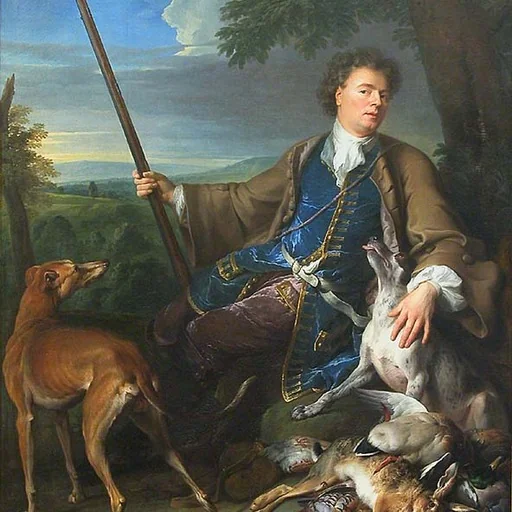
Artist
Alexandre-François Desportes (24 February 1661-20 April 1743) was a French painter and decorative designer who specialised in animals.