Artwork
La mare aux Fées in Fontainebleau
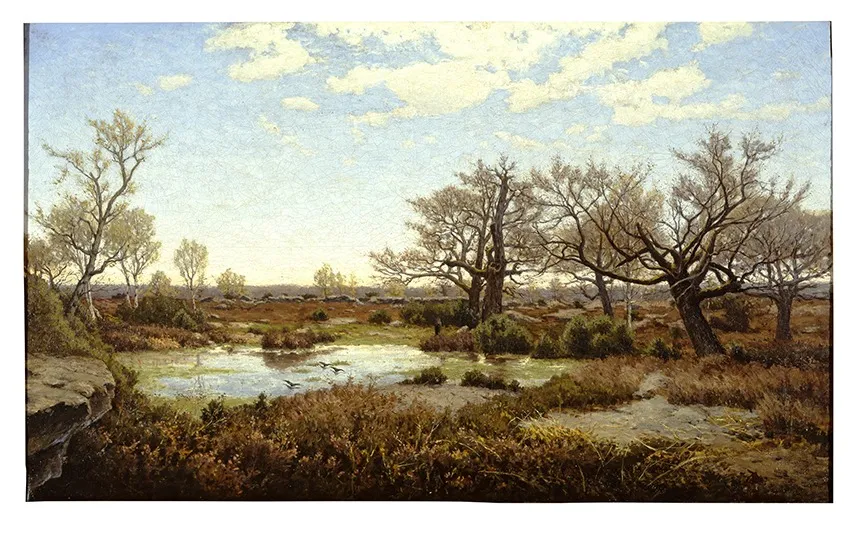
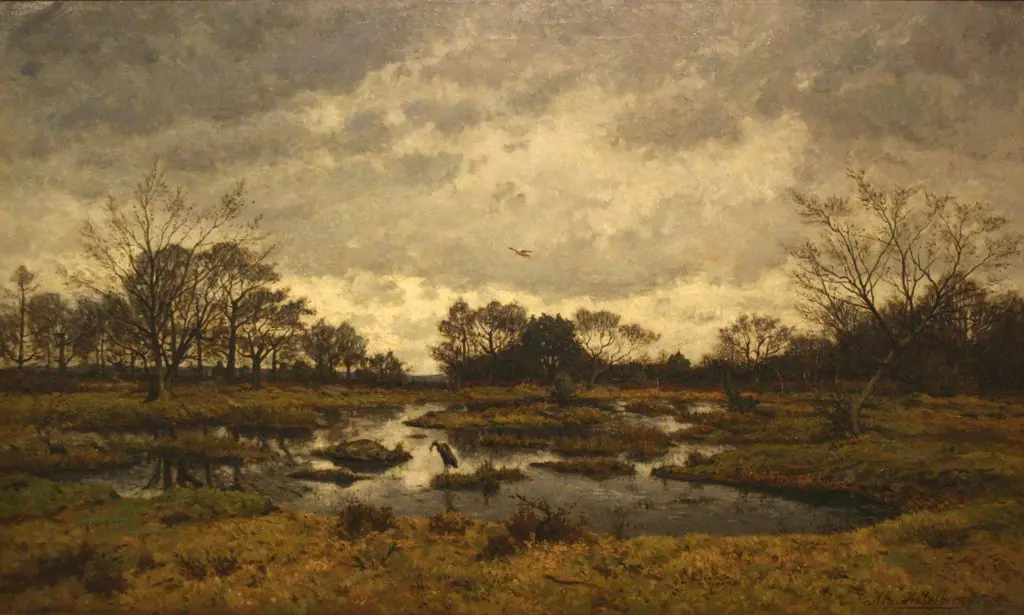
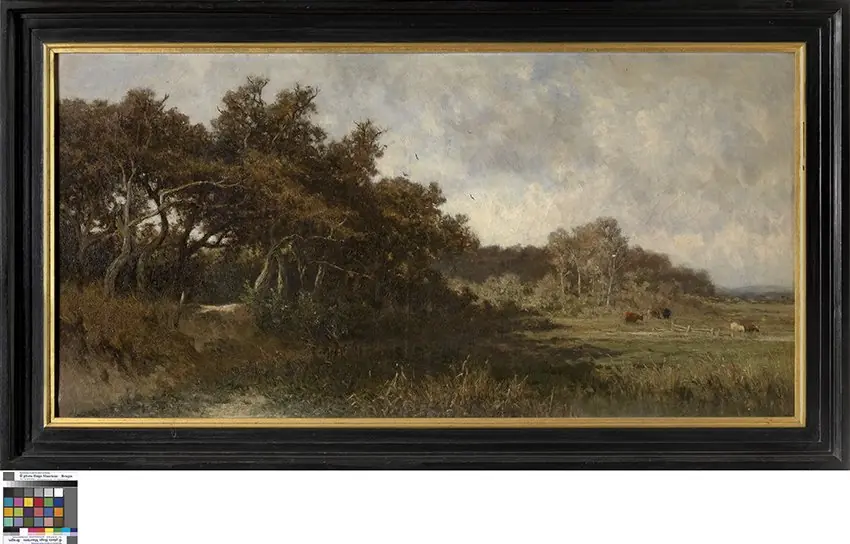
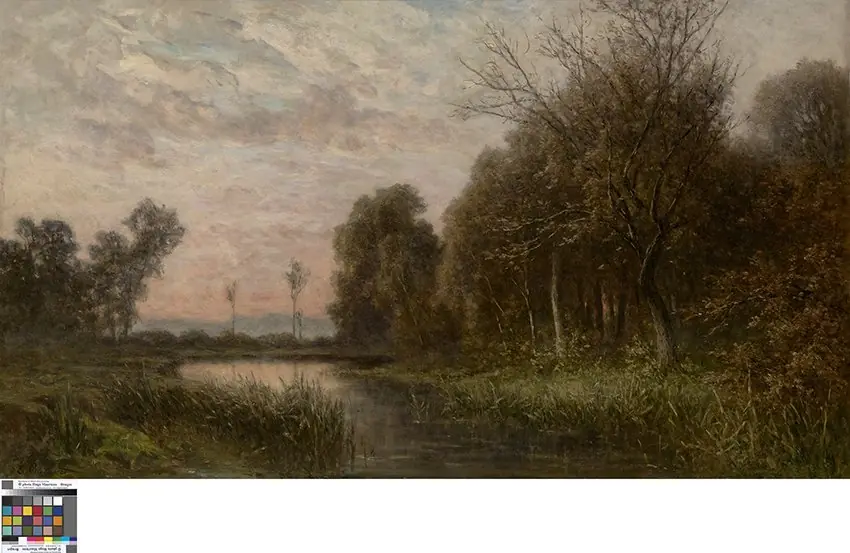
La mare aux Fées in Fontainebleau is an oil painting by the Barbizon school artist Alphonse Asselbergs. It dates from 1888 and is held in the collection of the Groeningemuseum.
About this work
Overview
The painting is held in the collection of the Groeningemuseum in Bruges (Musea Brugge), where it is catalogued under inventory number 0000.
La mare aux Fées in Fontainebleau is an oil-on-canvas landscape painting by the Belgian artist Alphonse Asselbergs, dated to 1876. Measuring 91.5 by 152.5 centimeters, the horizontal composition depicts a marshy pond in the Forest of Fontainebleau near Paris, rendered with the naturalistic, earth-toned palette characteristic of the artist's mature style. The painting is held in the collection of the Groeningemuseum in Bruges (Musea Brugge), where it is catalogued under inventory number 0000.GRO0008.I. The work represents a significant example of Belgian landscape painting influenced by the Barbizon School, demonstrating Asselbergs's commitment to plein-air observation and his engagement with one of the most celebrated sites in nineteenth-century French landscape art.
Subject & Meaning
The painting depicts La Mare aux Fées, a marshy pond located on a plateau in the Forest of Fontainebleau, a site whose name derives from legendary superstitions since lost to tradition. At the center of the composition lies the eponymous pool, surrounded by scattered trees and low vegetation, with several large oaks bearing bare, twisting branches on the right and smaller trees with sparse spring foliage on the left. Two small birds fly low over the water, animating an otherwise humanless scene. The foreground features brown and golden grasses with a rocky outcrop at lower left, while the sky occupies the upper half of the canvas, filled with pale blue and soft white clouds. Light appears to emanate from behind the distant horizon, casting subtle shadows across the terrain. The setting suggests a quiet, slightly wild natural area at dawn or dusk, evoking the serene yet mysterious atmosphere that made this location a repeated subject for artists. The absence of human figures emphasizes the untamed character of the landscape, while the pond's folkloric name hints at narratives hidden beneath the surface stillness.
Technique & Style
Asselbergs executed the work in oil on canvas, employing a fluid pictorial style with natural, earth colors that aligns him with the Belgian landscape tradition. The brushwork appears smooth and detailed in the foliage, broader in the sky, creating a nuanced handling of different natural elements. The palette ranges from earthy browns and muted greens to cool blues and warm cream tones, avoiding brilliant color in favor of subdued atmospheric effects. This restrained chromatic approach reflects the influence of plein-air painting, which Asselbergs had embraced since his first exposure to the practice at the artists' colony in Anseremme during the summer of 1866. The composition's horizontal format, at over 1.5 meters in width, allows for an expansive treatment of the landscape that emphasizes the breadth of the sky and the flat marsh terrain. The painting's condition and specific conservation history are not documented in the available sources, though the work has been digitally reproduced at high resolution for scholarly and public access.
History & Provenance
The painting was created in 1876, during a period when Asselbergs made occasional excursions to the forests of Fontainebleau following his return from Algeria in 1874. The work is closely related to a companion piece titled 'Dag in maart bij 'La Mare aux fées'' (A Day in March at 'La Mare aux Fées'), also dated 1876, which is held in the collection of the Museum voor Schone Kunsten in Brussels. The Bruges canvas was likely painted around the same period as this counterpart. The painting entered the collection of the Groeningemuseum, part of Musea Brugge, though specific details of its acquisition and provenance chain prior to institutional holding are not recorded in the available sources. The work has been made accessible through digital platforms including Wikimedia Commons and the LUKAS - Art in Flanders image database, with high-resolution photographic reproductions available under public domain designation. No extensive exhibition history is documented in the provided sources.
Context
Alphonse Asselbergs (1839-1916) was a central figure in the Tervuren School, the Belgian equivalent of the Barbizon School, which he helped establish through regular stays at the artists' colony in Tervuren from 1867 to 1871. Born in Brussels to a prosperous family in the paper trade, he abandoned commerce in 1866 to pursue art, receiving training from the landscape painter Edouard Huberti and befriending Théodore T'Scharnerotr. His work at Fontainebleau placed him in direct contact with the followers of Théodore Rousseau, the leading master of the Barbizon School, during his stays at Barbizon. By 1868, he had co-founded the Société Libre des Beaux-Arts and was exhibiting to favorable reviews. The painting reflects the broader nineteenth-century European movement toward naturalistic landscape painting, where artists sought to capture specific locations with fidelity to atmospheric conditions and local topography. Asselbergs's Orientalist works from his Algerian sojourn of 1873-1874 proved commercially unsuccessful, but his European landscapes, including this Fontainebleau scene, anchored his reputation. In 1881, he was named an officer in the Order of Leopold, receiving a second commission in 1896.
Legacy
La mare aux Fées in Fontainebleau stands as a testament to the international reach of the Barbizon aesthetic and its adoption by Belgian painters. The Forest of Fontainebleau, and specifically the Mare aux Fées plateau, had become one of the most remarkable and frequently depicted sites in European landscape art by the later nineteenth century, as noted in contemporary descriptions that celebrated its capacity to offer new aspects even to repeated visits. Asselbergs's treatment of this celebrated location demonstrates how Belgian artists contributed to and transformed French landscape traditions. The survival of the companion piece in Brussels alongside this Bruges canvas suggests the subject held particular significance for the artist. Today, the painting's accessibility through digital reproduction and its presence in the Groeningemuseum collection ensure its continued availability for scholarly study and public appreciation, even as Asselbergs's broader reputation has remained somewhat overshadowed by his French contemporaries and by Hippolyte Boulenger, identified as the most important Belgian exponent of landscape painting in this period.
Artist & collection