Artwork
Fruit and Flowers
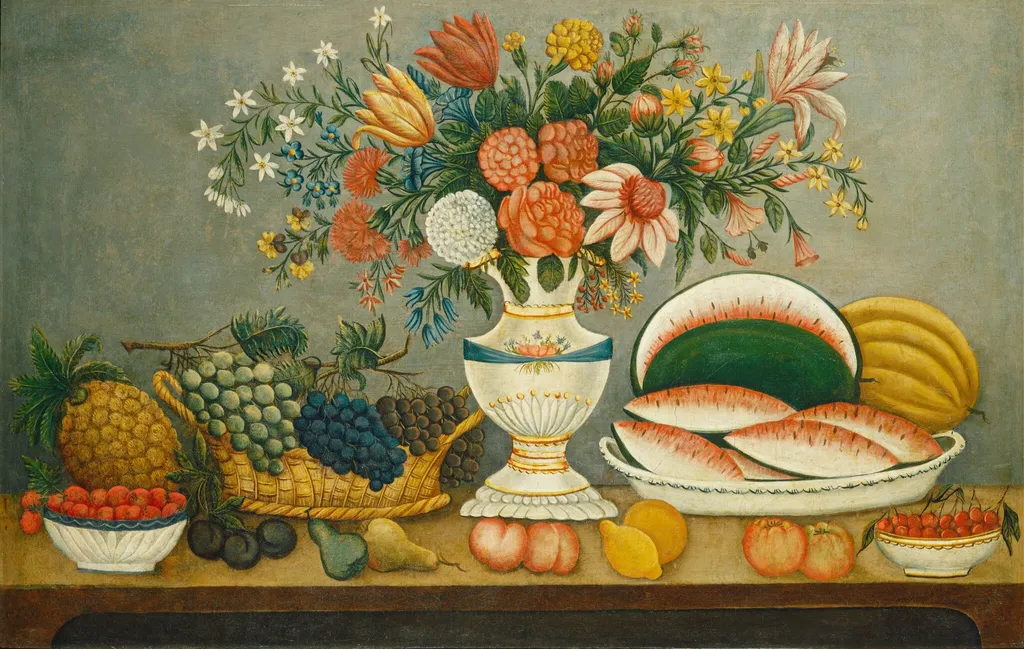
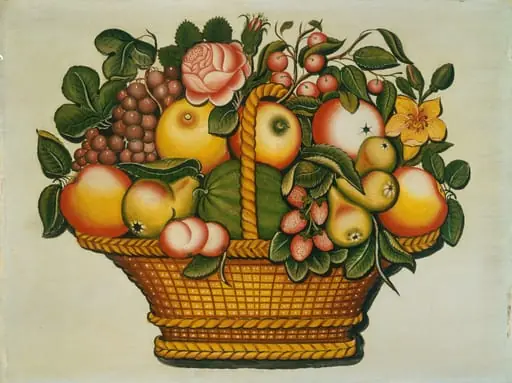
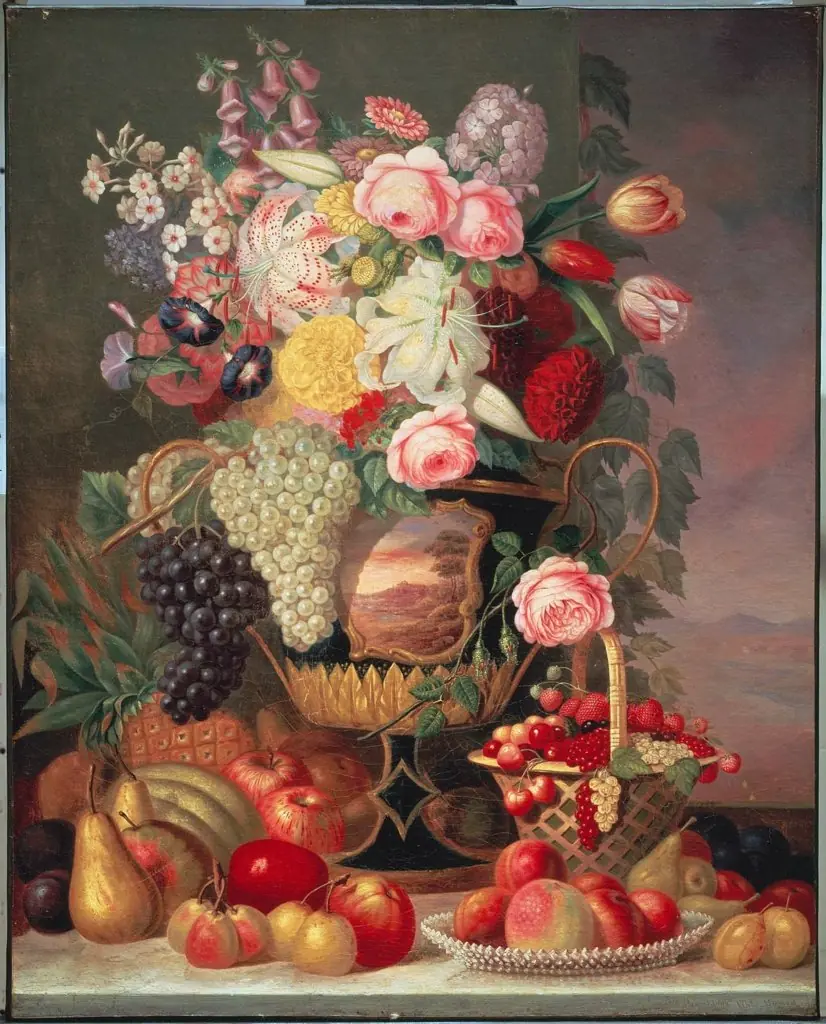
Fruit and Flowers is an oil painting. It dates from 1850 and is held in the collection of the National Gallery of Art.
About this work
Technique & Style
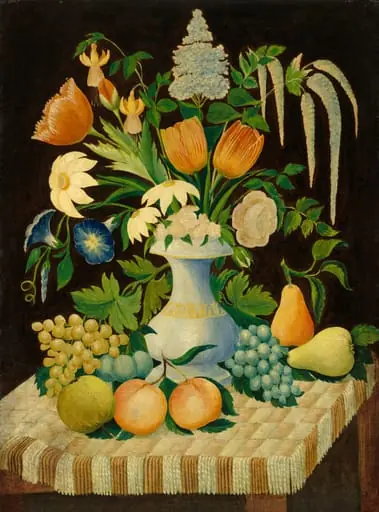
Executed in 1850, this still life utilizes oil paint applied to a canvas support. The work measures 67 cm in height and 105 cm in width, presenting a composition dedicated to floral subjects. Created by an unidentified American artist of the nineteenth century, the piece exemplifies the period's approach to the genre through its specific material choices and dimensional scale.
History & Provenance
The work's recorded provenance begins in Maryland, after which it entered the collection of American Primitive Paintings in New York.
Fruit and Flowers is an oil on canvas still life dated 1850, attributed to an American 19th-century artist. The work's recorded provenance begins in Maryland, after which it entered the collection of American Primitive Paintings in New York. From that dealer it was sold in 1947 to Edgar William and Bernice Chrysler Garbisch, who subsequently gave the painting to the National Gallery of Art in Washington, D.C., in 1966, where it remains held today.
The painting Fruit and Flowers is held in the collection of the National Gallery of Art in Washington, D.C. It entered the museum's holdings in 1966 as a gift from Edgar William and Bernice Chrysler Garbisch. Prior to this donation, the work was sold to the Garbisches in 1947 by the New York dealer American Primitive Paintings, having previously been recorded as originating from Maryland. The provided sources do not list a specific inventory or accession number for the work, nor do they document any exhibition history.
Context
The 1850 oil‑on‑canvas still life titled Fruit and Flowers, attributed to an American 19th‑century artist, exemplifies the domestic decorative sensibility of the period. Measuring 67 cm by 105 cm, the work portrays a modest bouquet of blossoms against a plain background, a motif recurrent in contemporary American household decoration. Its provenance records a sale in 1947 to Edgar William and Bernice Chrysler Garbisch, who later gifted the painting to the National Gallery of Art in 1966, where it remains on view in Washington, D.C. Scholarship situates the piece within the corpus of American primitive painting, highlighting its role in tracing the development of native still‑life practice.
Legacy
Fruit and Flowers entered the National Gallery of Art in 1966 as part of the Garbisch collection, a gift from Edgar William and Bernice Chrysler Garbisch. Its acquisition placed the work within the museum’s American primitive painting holdings, securing its preservation and public accessibility. As a result, the painting continues to be studied and exhibited as an example of mid‑19th‑century American still life, contributing to its enduring reputation within the nation’s artistic heritage.
Overview
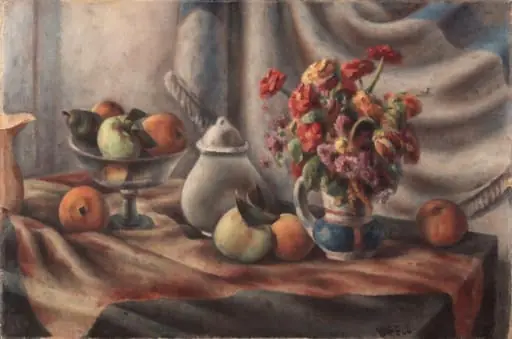
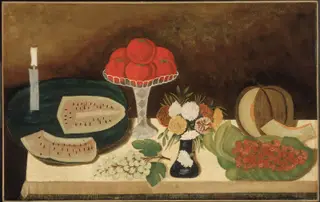
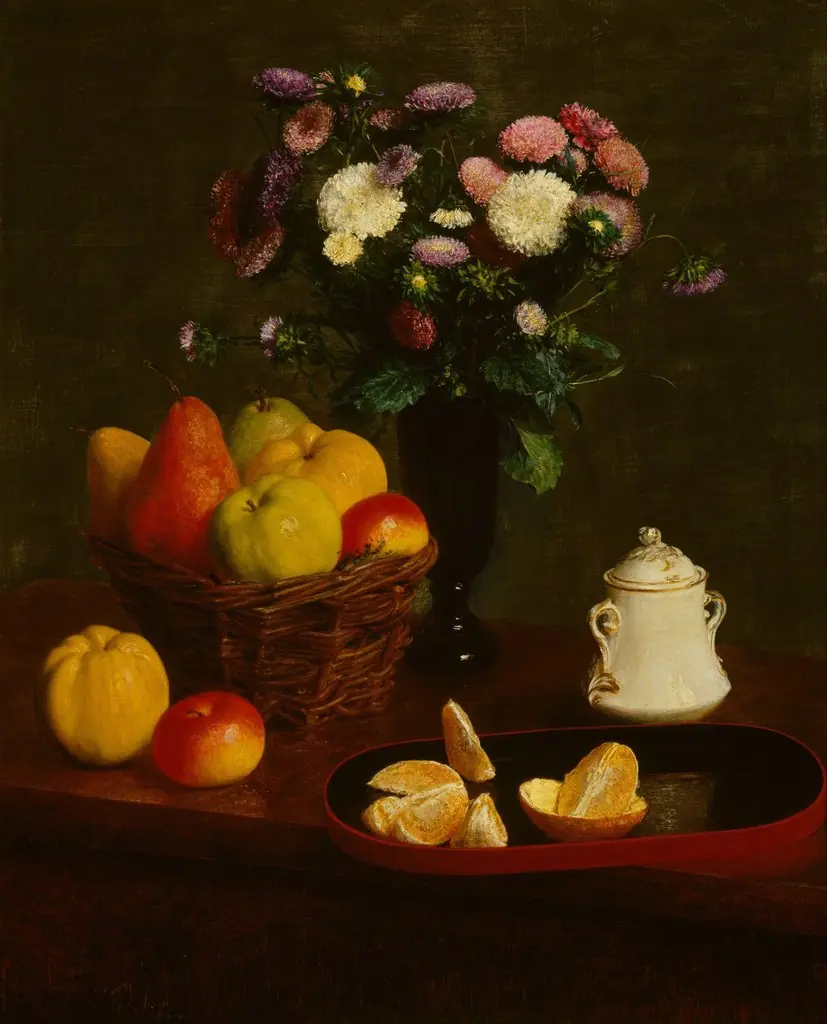
Fruit and Flowers is an oil on canvas painting depicting a vibrant floral arrangement. A diverse bouquet, featuring peonies, roses, and tulips, is presented in a vase. The luminous petals and verdant leaves are rendered with striking detail, set against a deep, contrasting background, highlighting the artist's focus on naturalistic representation.
Subject & Meaning
The composition centers on a richly detailed bouquet, where individual peonies, roses, and tulips are meticulously rendered. The interplay of light emphasizes the texture and apparent moisture on the petals, while the inclusion of small insects suggests a fleeting moment of nature captured. The dark background serves to intensify the vivid hues and intricate forms of the botanical subjects.
Artist & collection