Artwork
Tomatoes, Fruit, and Flowers
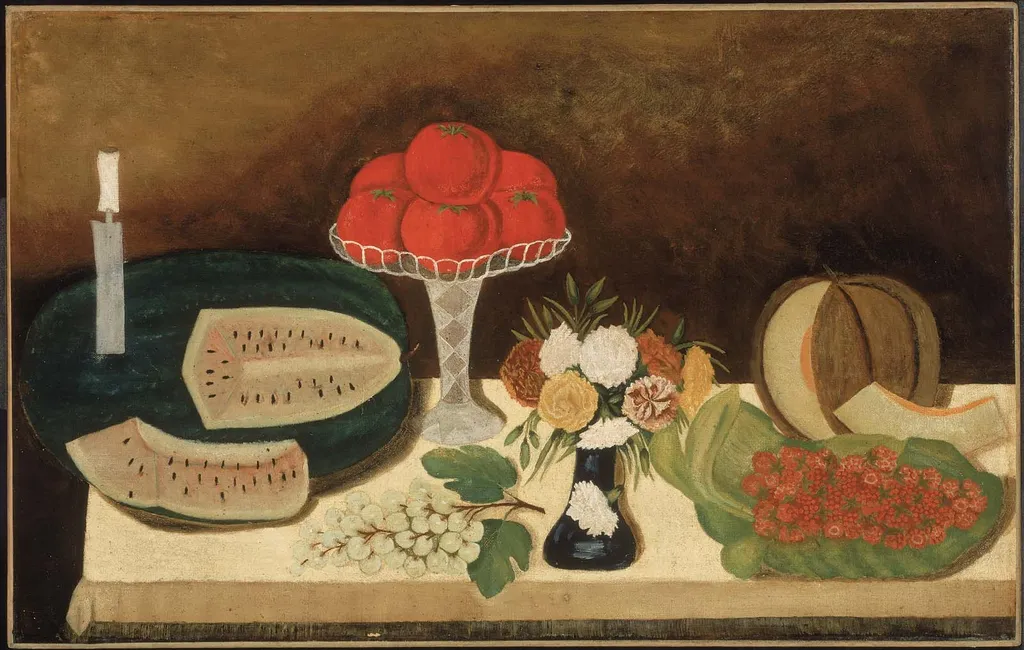
Tomatoes, Fruit, and Flowers is an oil painting by the Realist artist Unknown. It dates from 1860 and is held in the collection of the Museum of Fine Arts Boston. The work presents a carefully arranged still life composed of assorted fruits and blossoms set upon a tabletop.
About this work
Overview
To the left, a halved green watermelon lies on its side, while a sliced cantaloupe rests on the right, its interior exposed.
The work presents a carefully arranged still life composed of assorted fruits and blossoms set upon a tabletop. Central to the composition is a glass bowl brimming with vivid red tomatoes. To the left, a halved green watermelon lies on its side, while a sliced cantaloupe rests on the right, its interior exposed.
A modest cluster of white grapes and a sprig of foliage with white flowers sit before the watermelon, and a small blue vase holds a mixed bouquet of yellow, orange and white flowers.
Subject & Meaning
The juxtaposition of ripe produce and delicate flowers underscores themes of abundance and the fleeting nature of freshness. By placing the tomatoes in a transparent vessel, the artist draws attention to their glossy surface, while the cut melons reveal interior textures, suggesting a moment of consumption. The inclusion of both cultivated fruit and ornamental flora may reflect a celebration of domestic bounty and the visual pleasure of varied colors and forms.
Technique & Style
Executed in oil on canvas, the painting demonstrates a smooth handling of paint that captures the translucency of glass and the sheen of fruit skins. The artist employs a balanced palette of saturated reds, greens, and yellows against a muted background, allowing the subjects to stand out. Careful modeling of light creates subtle highlights on the watermelon rind and the glass bowl, while the brushwork remains refined, emphasizing realism over overt painterly gestures.
History & Provenance
The piece is part of the collection at the Museum of Fine Arts in Boston. Its acquisition details indicate it entered the museum’s holdings through a donation in the early twentieth century, though the exact date and donor remain undocumented in the available records. The work has been displayed in the museum’s American art galleries, contributing to the institution’s representation of still‑life painting.
Context
Created during a period when still‑life compositions were popular among European and American artists, the painting reflects contemporary interests in domestic scenes and the study of light on everyday objects. The inclusion of both fruit and floral elements aligns with the tradition of symbolic still lifes, where each item could convey moral or seasonal references, a practice common in the genre’s evolution.
Artist & collection