Artwork
Fruit on a Tray
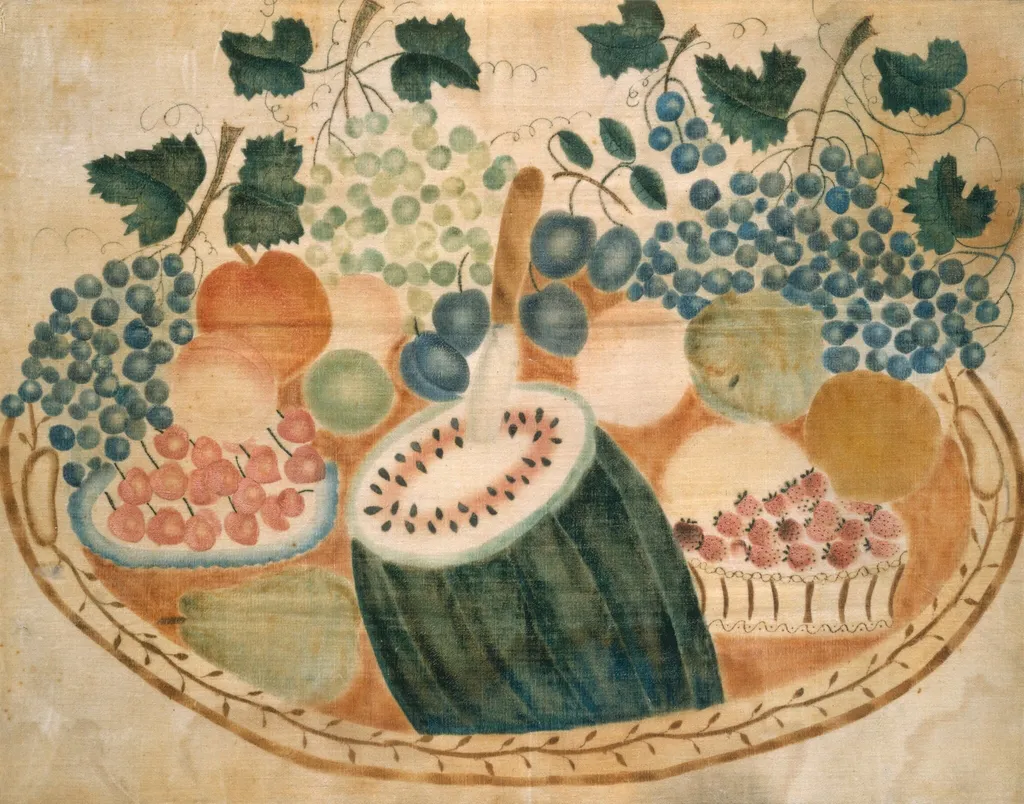
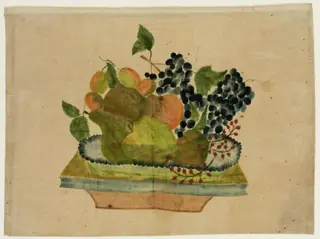
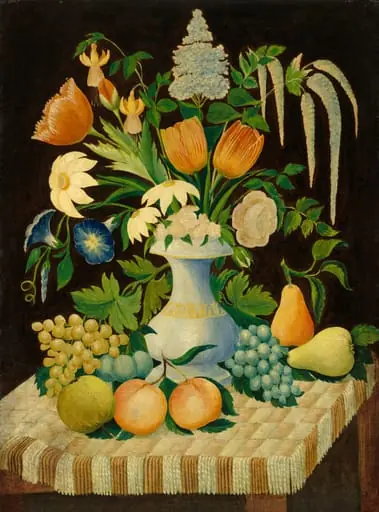
Fruit on a Tray is a watercolor painting. It dates from 1840 and is held in the collection of the National Gallery of Art.
About this work
Technique & Style
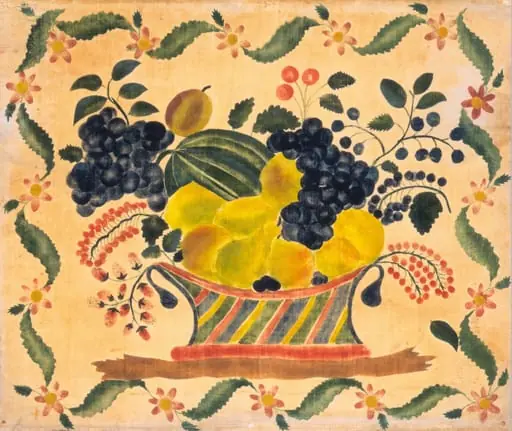
Executed in watercolor on velveteen, Fruit on a Tray exemplifies 19th‑century American theorem painting, a technique that emphasizes flat, decorative surfaces and precise outlines. The work measures 42.6 cm by 54 cm and was created in 1840. Its flat composition and limited palette reflect formal stylistic traits typical of early American still‑life painting, conveying a crisp, decorative quality through careful handling of the medium.
History & Provenance
The provided sources do not contain information regarding specific inventory or accession numbers, nor do they list any exhibition history for the piece.
Created in 1840, Fruit on a Tray is a watercolor on velveteen executed in the theorem painting style by an American artist of the 19th century. The work's early history places its origin in Connecticut, though the specific creator remains anonymous. The painting entered the documented ownership chain in 1947 when it was acquired by Edgar William and Bernice Chrysler Garbisch.
It subsequently became part of the National Gallery of Art's collection in Washington, D.C., following a gift from the Garbisches in 1953.
The watercolor painting Fruit on a Tray is held in the collection of the National Gallery of Art in Washington, D.C. It was acquired by the museum in 1953 as a gift from Edgar William and Bernice Chrysler Garbisch, who had purchased the work in Connecticut in 1947. The provided sources do not contain information regarding specific inventory or accession numbers, nor do they list any exhibition history for the piece.
Context
Fruit on a Tray is a 1840 watercolor on velveteen still life attributed to an American 19th-century artist, classified as a theorem painting. The work entered the National Gallery of Art collection in 1953 as a gift from Edgar William and Bernice Chrysler Garbisch, having previously been recorded in Connecticut. Its dimensions measure 42.6 cm in height and 54 cm in width, documented in the National Gallery of Art's collection records.
Scholarly attention to the painting has been limited, with most publications focusing on its provenance and material technique within the context of early American decorative arts. The work is representative of mid-19th-century American still-life painting, reflecting the period's interest in botanical subjects and domestic arrangements, though it remains less studied compared to contemporaneous works by identified artists.
The painting's placement in the National Gallery of Art's collection underscores its significance as an example of theorem painting, a technique involving the repeated use of stencils to create uniform compositions, which was popular in the United States during the 1800s.
Overview
Fruit on a Tray is a small-scale watercolor work executed on a velveteen surface. The composition presents a simple arrangement of assorted fruit placed upon a shallow tray, rendered with the delicate transparency characteristic of watercolor. The choice of a plush textile as the painting support distinguishes the piece from more conventional paper or canvas supports used in the period.
Subject & Meaning
The work belongs to the still‑life tradition, a genre that allowed artists to explore the visual qualities of everyday objects. By focusing on fruit, the artist engages with themes of abundance, transience, and the sensory pleasures of the domestic sphere, inviting viewers to contemplate the quiet beauty of commonplace items.
Artist & collection