Artwork
The Dancer of Tanjore (La bayadère de Tanjore)
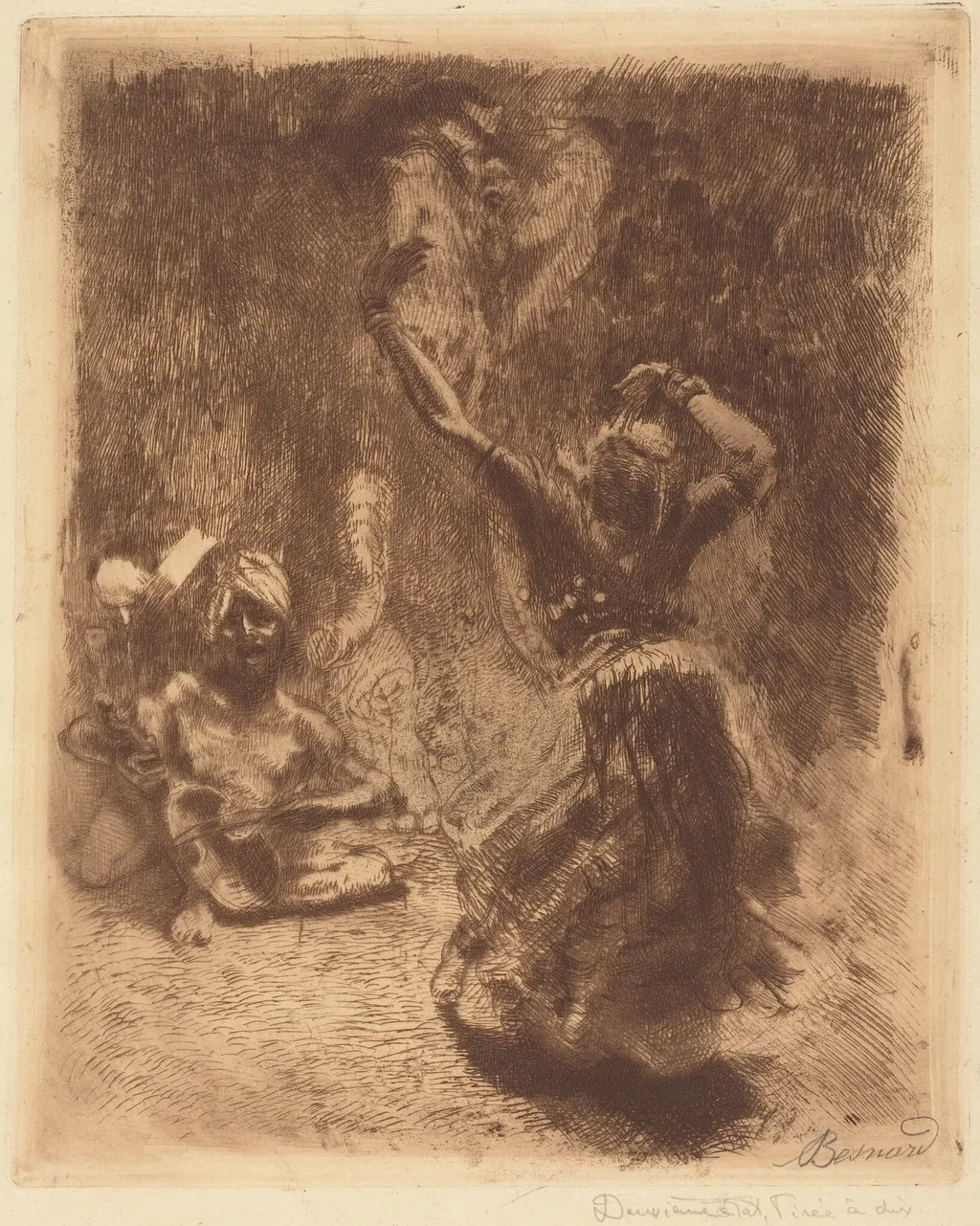
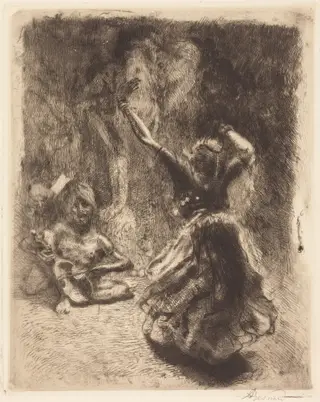
The Dancer of Tanjore (La bayadère de Tanjore) is an ink print by Albert Besnard. It dates from 1914 and is held in the collection of the National Gallery of Art.
- Inscription
- Inscribed:lower right in graphite: ABesnard / Deuxieme etat, Tiree a dix; by later hand, lower left in graphite: 174; by later hand, lower right in graphite: 162
- Markings
- Marked:None.
About this work
Overview
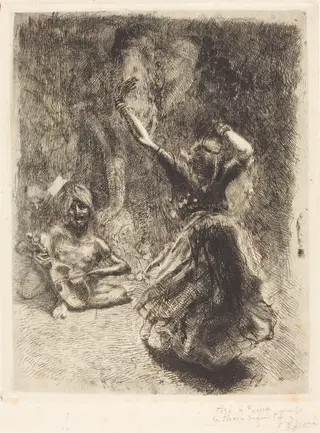
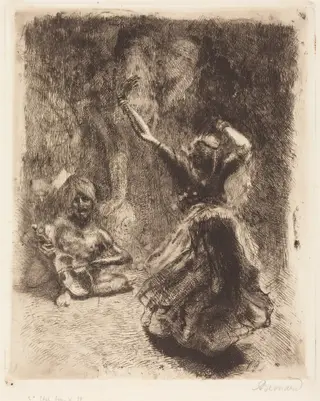
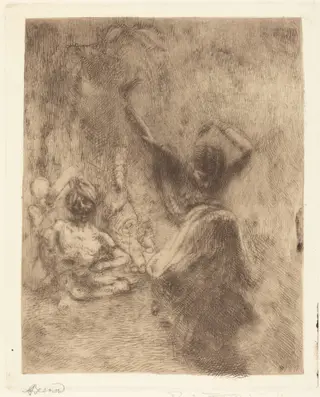
Created in 1914, Albert Besnard's 'The Dancer of Tanjore' (La bayadère de Tanjore) is a print executed in etching, drypoint, and printed tone on wove paper.
Created in 1914, Albert Besnard's 'The Dancer of Tanjore' (La bayadère de Tanjore) is a print executed in etching, drypoint, and printed tone on wove paper. The composition centers on a solitary Indian dancer, likely a devadasi, captured in a moment of poised motion. Her arms extend upward in a graceful arc, emphasizing the fluidity of her long, layered costume.
Besnard employs a dramatic chiaroscuro effect, utilizing a single light source to illuminate the dancer's face and limbs while allowing the surrounding space to recede into soft, atmospheric shadow. The work demonstrates Besnard's mastery of mixed printmaking techniques; etching provides the precise linear definition of the figure, while drypoint adds a velvety richness to the tonal areas, and the printed tone unifies the image with a warm, brown monochrome palette. This piece reflects the artist's enduring interest in exotic subjects and his technical experimentation during the early twentieth century, bridging his academic training with the atmospheric sensibilities of Symbolism.
It stands as a refined example of his graphic output, showcasing his ability to convey movement and mood through the interplay of light and texture without the use of color.
Subject & Meaning
The image captures a moment of poised performance, suggesting both ritual and theatricality inherent in Indian dance traditions. The solitary illumination may imply a focus on inner concentration or the fleeting nature of stage presence, while the surrounding darkness frames the figure as a focal point of cultural fascination for early‑twentieth‑century European audiences.
Technique & Style
Besnard combined three intaglio processes: traditional etching for precise linear detail, drypoint to produce soft, burr‑rich edges, and aquatint to achieve velvety tonal fields behind the dancer. This layered approach creates a nuanced interplay of light and shadow, allowing the brown ink to render both delicate textures of the costume and the deep, atmospheric background.
History & Provenance
Created during the First World War, the print reflects Besnard’s interest in exotic subjects that were popular in French artistic circles at the time. It was issued as a limited edition print, though specific details of its original exhibition or collection history remain sparse, typical of many early‑20th‑century commercial prints.
Own this work as a print
Artist & collection