Artist
Albert Besnard
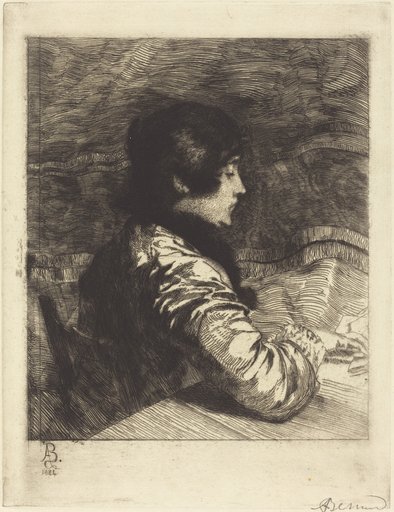
France
Albert Besnard is a France Impressionism artist. 194 works are cataloged here, principally at National Gallery of Art.
Albert Besnard (1884–1884) was an artist.
Overview
Paul-Albert Besnard (1849-1934) was a French painter, printmaker, and engraver whose career bridged academic tradition and Impressionist innovation. Born in Paris on 2 June 1849, he achieved early recognition by winning the Prix de Rome in 1874, then gradually transformed his practice under the influence of light and color studies associated with Impressionism, without ever fully abandoning his classical foundations. Besnard became one of the most decorated artists of his generation, accumulating directorships of major French institutions, membership in the Académie française, and the Grand-croix of the Légion d'honneur. He is remembered particularly for his luminous portraits of women, large-scale decorative frescoes in prominent Parisian buildings, and a significant body of etchings.
Biography & dates
Besnard was born into an artistic family in the 7th arrondissement of Paris. His father, Louis Adolphe Ferdinand Besnard, was a history painter who had studied with Ingres and died shortly after his son's birth; his mother, Marie Louise Pauline Vaillant, was a respected miniaturist. At age fifteen, he entered the studio of Jean-Auguste-Dominique Ingres, and in 1866 he was admitted to the École des Beaux-Arts in Paris, where he studied under Jean-François Brémond and Alexandre Cabanel. In 1874 he won the Prix de Rome with La Mort de Timophane, which entitled him to a four-year stay at the Villa Medici. During his Roman sojourn he met Franz Liszt and painted the portrait of his fellow pensionnaire, composer André Wormser, in 1877.
On 19 November 1879 he married Charlotte Gabrielle Dubray, a sculptor and daughter of the noted sculptor Gabriel-Vital Dubray. The couple spent three years in England between 1881 and 1884, where Besnard exhibited at the Royal Academy and studied the works of Gainsborough, Reynolds, and Lawrence. He later traveled to Spain, Morocco, and Algeria in 1885 with Jules Chéret, and in 1910 undertook a nine-month journey to India, Ceylon, and Pondichéry with his wife and two sons, documented in his book L'Homme en rose. In 1886 the family discovered Talloires on Lake Annecy, where Besnard built a villa the following year to escape Parisian society.
His institutional career advanced steadily: he was a founding member of the Société Nationale des Beaux-Arts in 1890, became director of the Académie de France à Rome in 1913 (succeeding Carolus-Duran), joined the Académie des Beaux-Arts in 1912, directed the École des Beaux-Arts from 1922, and co-founded the Salon des Tuileries in 1923. On 27 November 1924 he was elected to the Académie française (Seat 13), becoming the first painter admitted since 1760. He died on 4 December 1934 at his home at 17 rue Guillaume Tell in Paris, following a long illness, and was buried at Montparnasse Cemetery (division 9) after national funeral ceremonies.
Style & movement
Besnard's artistic trajectory moved from strict academicism toward a distinctive synthesis of Impressionist technique and Symbolist or decorative aims. Until about 1880 he worked within academic conventions, but his residence in London around 1880-1884 proved pivotal: the grey English atmosphere awakened in him a pursuit of light and color that he channeled into increasingly luminous works. He adopted the Impressionists' technical methods, their analysis of light, and their bright palette, yet he rejected their realism, applying these tools instead to ideological and decorative compositions on a grand scale. His close study of light is evident in works such as La femme qui se chauffe (Musée du Luxembourg), one of numerous nude studies, and in the pictures produced during and after his 1911 trip to India. In portraiture, he developed an unconventional, sometimes dreamlike manner, blending classicism with Impressionism in ways characteristic of the belle époque. His pastel portraits, including Liseuse and Le Silence (both Musée des Beaux-Arts de Reims), show the influence of eighteenth-century masters, particularly Rosalba Carriera and Jean-Siméon Chardin, in their sober execution and psychological penetration. As a decorative painter, he functioned as a Symbolist, creating frescoes with free, natural figures that critics compared to Florentine fresco traditions. His etching practice encompassed over two hundred works in series such as La Femme, Elle, and L'Île Heureuse.
Major works
Besnard's major works span portraiture, decorative painting, and printmaking. In portraiture, his Salon debut of 1886 with Madame Roger Jourdain announced his mature style, while Femme devant un feu de cheminée (1887), particularly in its pastel version, impressed the young Pierre Louÿs. Other significant portraits include Portrait de Théâtre (Madame Réjane), The King and Queen of Belgium (1919), and the symbolic 1917 portrait of Cardinal Mercier, which represented him in the official exhibition of French art in the United States in 1919-20. His family portrait Une famille (1890) is held by the Musée d'Orsay. His decorative commissions form a major part of his legacy: the ceiling of the Comédie-Française (with René Demeurisse), the Salle des Sciences at the Hôtel de Ville, the vestibule of the École de Pharmacie, the amphitheater of chemistry at the Sorbonne, the dome of the Petit Palais, the marriage hall of the mairie of the 1st arrondissement, and the chapel of the hôpital Cazin-Perrochaud at Berck, for which he painted twelve Stations of the Cross in a modern spirit. International commissions included Union de l'Autriche-Hongrie et de la France (1908) at the French Embassy in Vienna, and La Paix par l'arbitrage (1914), a large panel for the Peace Palace at The Hague completed seven days before the outbreak of World War I. His landscape works include Leglise heureuse and Un Ruisseau dans la Montagne (1920). Many of his works are now in the Musée d'Orsay.
Influences & students
Besnard's formative influences included his teachers at the École des Beaux-Arts: Jean-François Brémond and Alexandre Cabanel, both of whom shared an admiration for Eugène Delacroix. The academic training he received under these masters provided his technical foundation, while Delacroix's colorism offered an alternative to strict neoclassicism. His encounter with English art during his London years proved equally significant; alongside the painter Alphonse Legros, he studied Thomas Gainsborough, Joshua Reynolds, and Thomas Lawrence, whose portrait traditions informed his own brilliant series of female portraits. The grey English skies, by his own account, stimulated his pursuit of light and sun. His travels brought further influences: in 1885 he journeyed with Jules Chéret through Spain, Morocco, and Algeria to study light effects, and his 1910-1911 Indian voyage yielded numerous sketches and studies. Within his broader circle, he was close to the painter Lazar Meyer and maintained connections with Symbolist and decorative artists, including Maurice Denis and George Desvallières, with whom he collaborated on private commissions such as the hôtel Rouché. As director of the Villa Medici and later the École des Beaux-Arts, he shaped the training of subsequent generations, though specific pupils are not documented in the sources. His son Philippe Besnard became a sculptor and created the bust of his father now in the Square Albert-Besnard in Paris.
Legacy
Besnard's posthumous reputation rests on his institutional prominence and his versatile oeuvre, though his fame has not equaled that of the Impressionists with whom he is sometimes associated. During his lifetime he was among France's most honored artists: Grand-croix of the Légion d'honneur, member of the Académie française, director of both the Villa Medici and the École des Beaux-Arts, and honorary member of foreign academies including the Royal Academy of Arts in London (1921) and the National Academy of Design in New York (1932). An important exhibition of his works toured American cities in 1924.
His legacy is preserved in public collections, particularly the Musée d'Orsay, and in the fabric of Paris itself, where his frescoes remain in situ at the Comédie-Française, the Sorbonne, the Hôtel de Ville, and other municipal buildings. The Rue Albert Besnard in Annecy and the Square Albert-Besnard in Paris's 17th arrondissement commemorate his name. His œuvre gravé, catalogued by André-Charles Coppier and Louis Godefroy, maintains interest among print collectors. As president of the Société internationale de la gravure originale en noir, he promoted etching alongside figures such as Auguste Lepère, Anders Zorn, and Francis Picabia. His historical significance lies in his successful negotiation between academic tradition and modern light-based painting, and in his role as an administrator who shaped French official art during the early twentieth century.
Works by Albert Besnard
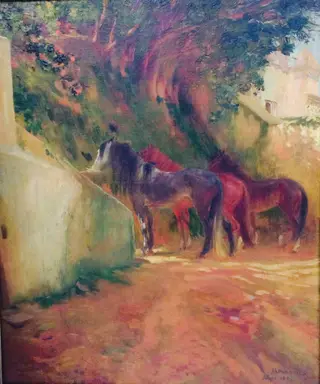 Horses
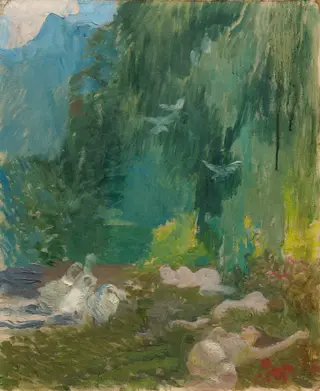 The Siesta
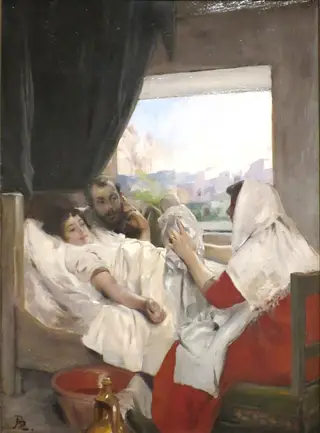 The First Morning (Albert and Charlotte Dubray Besnard and their Son, Robert)
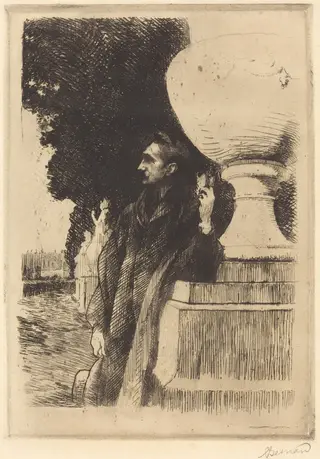 Robert de Montesquiou
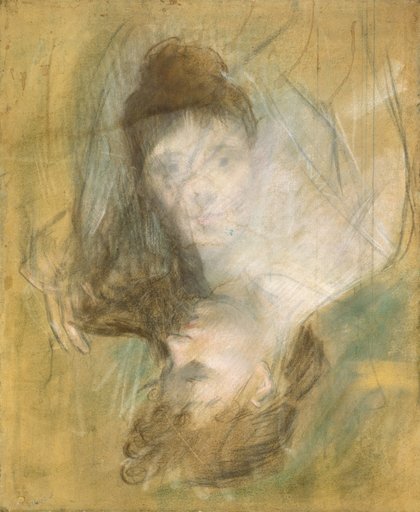
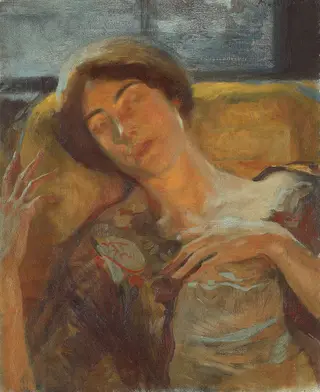 Woman's Head
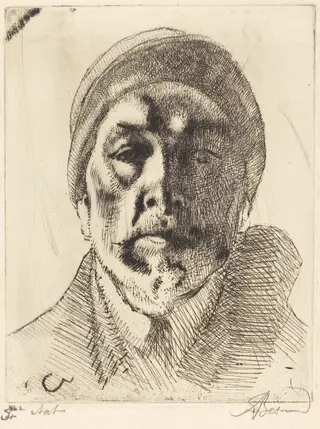 Self-Portrait
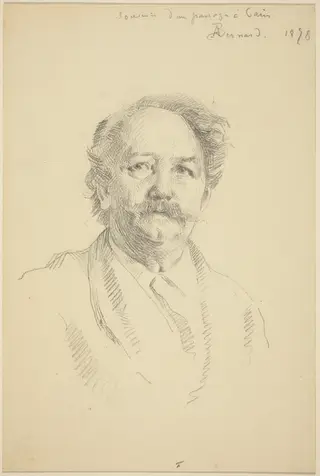 Portrait of a Man (Souvenir d'un Passage à Paris)
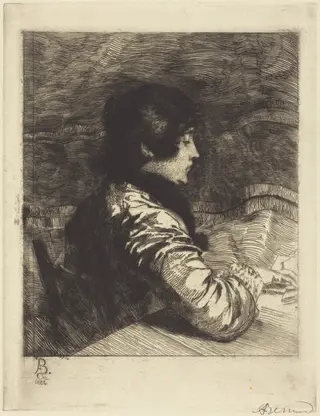 Madame Besnard
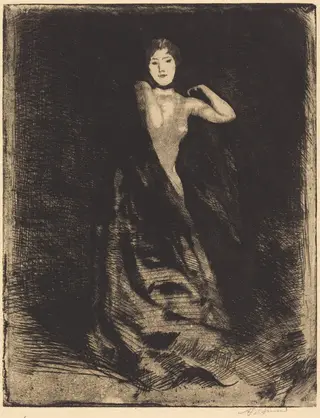 La Femme (frontispiece)
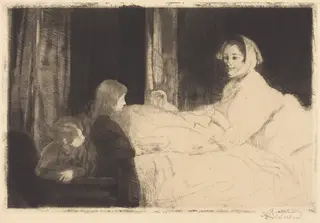 The Sick Mother (La mère malade)
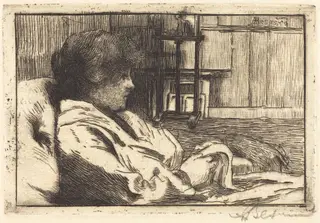 Woman Reading in the Studio (La Lecture dans l'atelier)
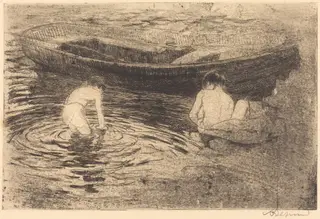 Bathing at Talloires (La baignade à Talloires)
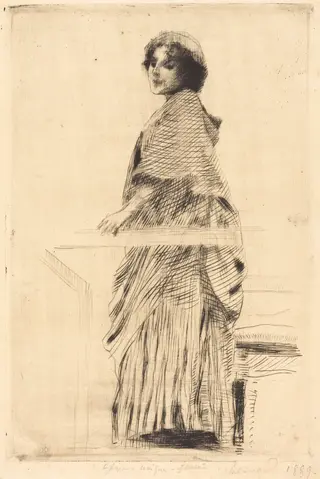 Woman in a Cape (La femme à la pèlerine)
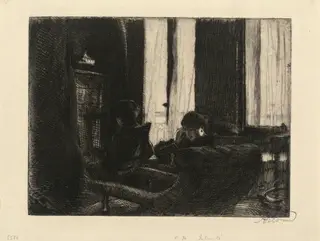 Intimacy (Intimité)
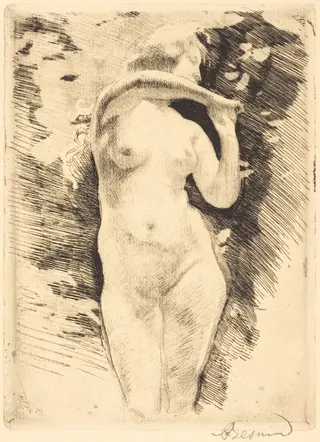 Eve
Eve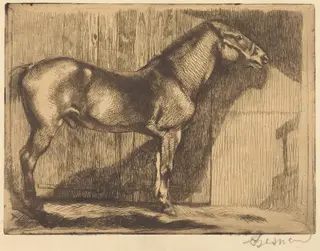 Pony (Le poney)
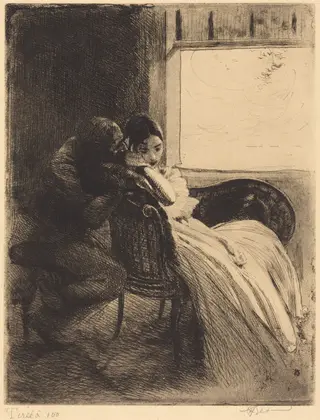 The Flirt (Le flirt)
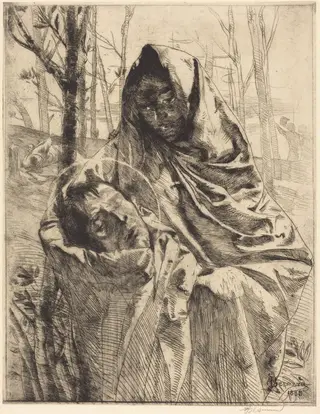 A Martyr (Un martyre)
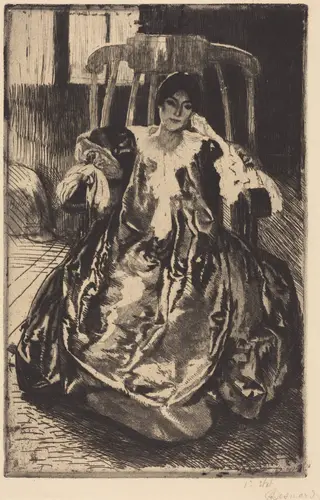 The Silk Gown (La robe de soie)
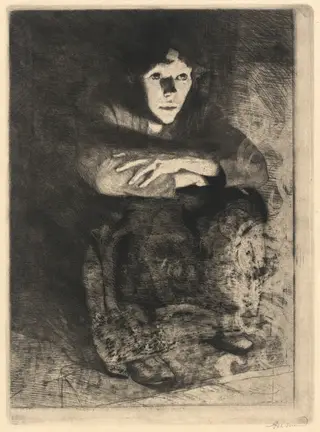 In the Embers (Dans les cendres)
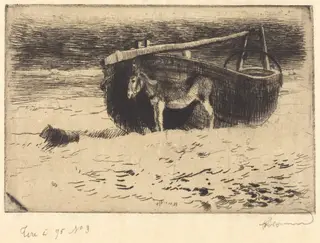 Small Donkey at Berck (Un petit ane à Berck)
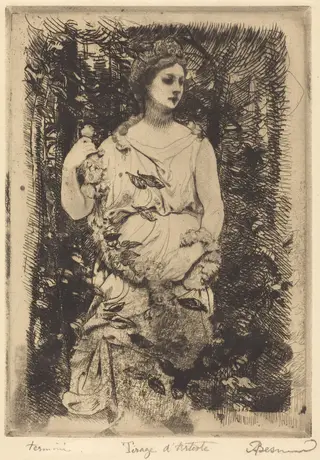 La Flore de le Gros
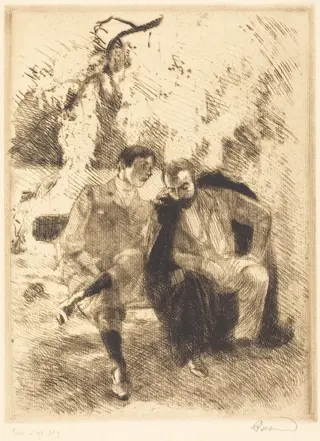 Confidences
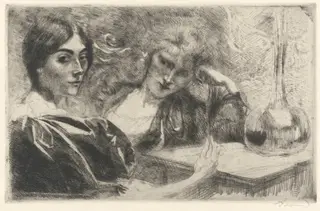 Morphine Addicts (Morphinomanes)
194 works in the catalog · 24 shown
Collections represented


Artists in a similar vein