Artwork
Illustration to Jean Desmarets' "L'Ariane"
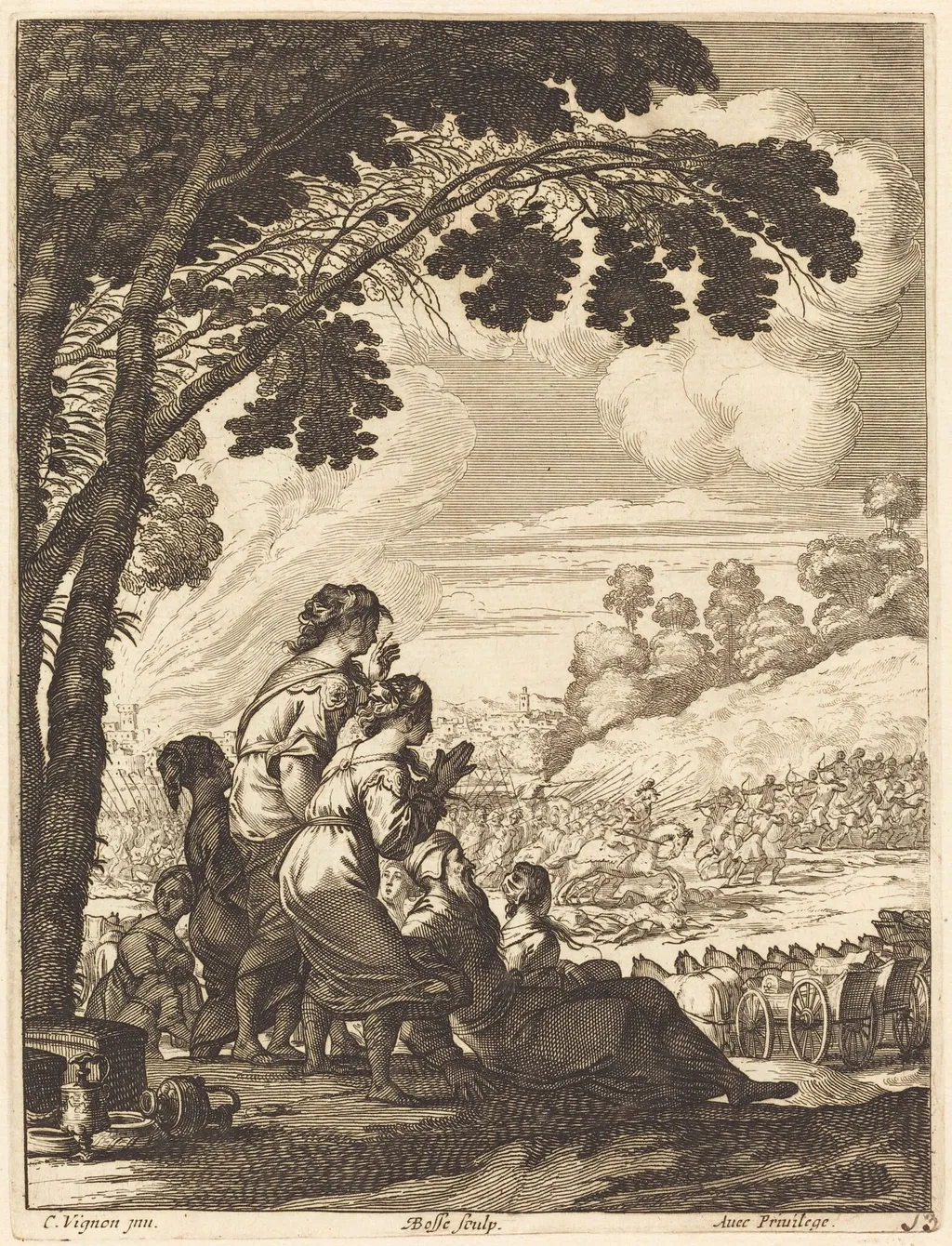
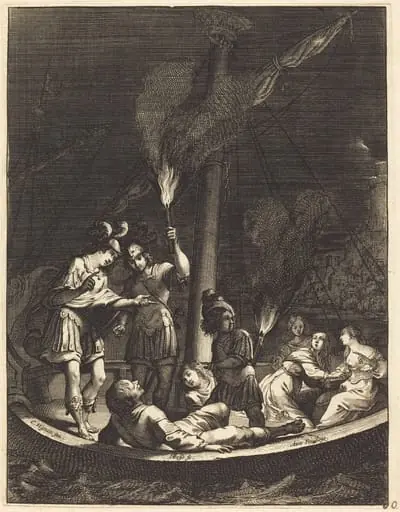
Illustration to Jean Desmarets' "L'Ariane" is an ink print by the Baroque artist Abraham Bosse. It dates from 1639 and is held in the collection of the National Gallery of Art.
About this work
Overview
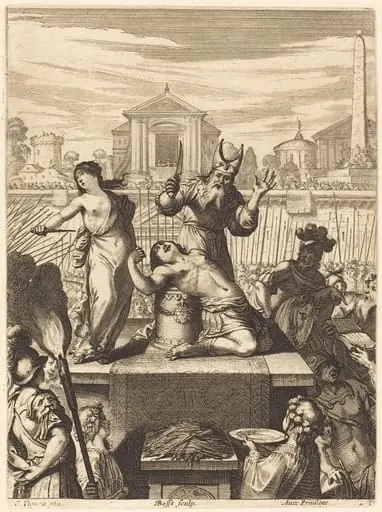
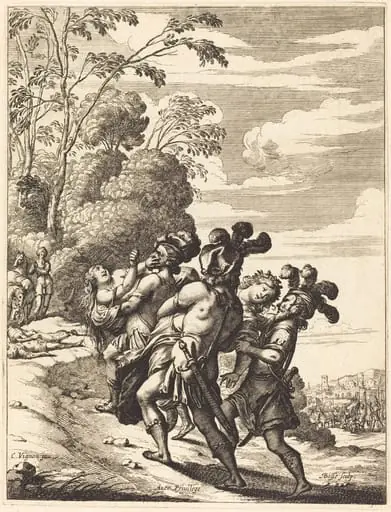
' The composition depicts the mythological figure Ariadne seated beneath a leafless tree, holding a scroll that signifies her narrative or plea.
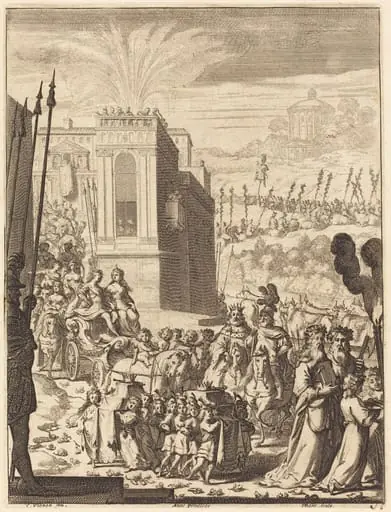
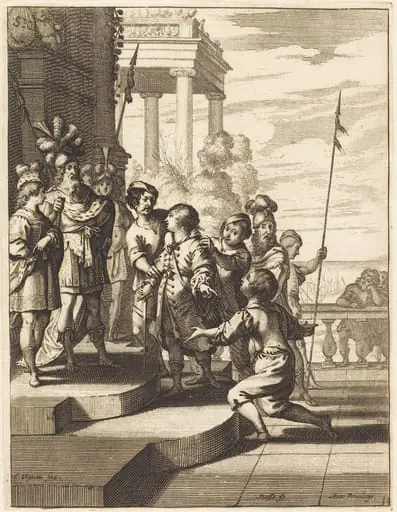
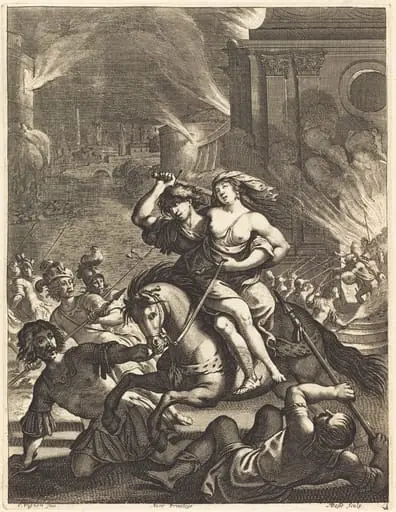
Created in 1639, Abraham Bosse's etching and engraving serves as an illustration for Jean Desmarets' tragedy 'L'Ariane.' The composition depicts the mythological figure Ariadne seated beneath a leafless tree, holding a scroll that signifies her narrative or plea. She maintains a serene, static posture that contrasts sharply with the surrounding turmoil.
A dynamic crowd of figures, including mounted riders, surrounds her, gazing upward in a manner that suggests awe or distress. The background features a receding landscape with a distant village and rolling hills, rendered with the precise linear clarity characteristic of Bosse's technique. This work exemplifies the artist's mastery of the etching medium during the French Baroque period, where he frequently collaborated with literary figures to visualize dramatic texts.
Bosse, known for his detailed depictions of 17th-century life and his theoretical writings on printmaking, applies his rigorous draftsmanship here to balance the emotional weight of the scene with architectural and natural precision. The print captures a pivotal moment of isolation for the protagonist amidst a chaotic environment, reflecting the dramatic conventions of the era while showcasing Bosse's ability to translate literary emotion into graphic form.
Subject & Meaning
The composition centers on a seated woman beneath a leafless tree, clutching a scroll. Around her a bustling crowd, including figures on horseback, looks upward, while a distant village and undulating hills recede into the sky. The woman's composed stance contrasts with the surrounding activity, suggesting a theme of calm authority amid disorder.
Technique & Style
Bosse employed the fine, incised lines characteristic of etching alongside the deeper, more defined strokes of engraving to model forms and convey depth. The sharp linear treatment delineates foliage, drapery, and terrain, creating a sense of movement and spatial recession within the limited tonal range of the black‑and‑white medium.
History & Provenance
Created in 1639, the print was intended as a frontispiece for Desmarets’ publication. It reflects Bosse’s early career, when he was establishing his reputation for book illustrations and for integrating etching with traditional engraving techniques.
Context
The work belongs to a period in French art when printmaking served both decorative and didactic purposes, often accompanying literary texts. Bosse’s collaboration with Desmarets illustrates the close relationship between writers and visual artists in the cultural milieu of the French Baroque.
Own this work as a print
Artist & collection

Artist
Abraham Bosse (c. 1604 – 14 February 1676) was a French artist, mainly as a printmaker in etching, but also in watercolour.