Artwork
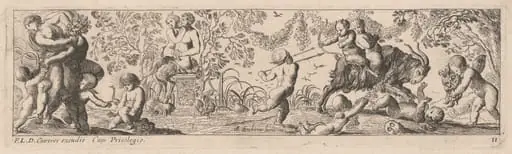
Satyr and Mercury Shooting at a Statue
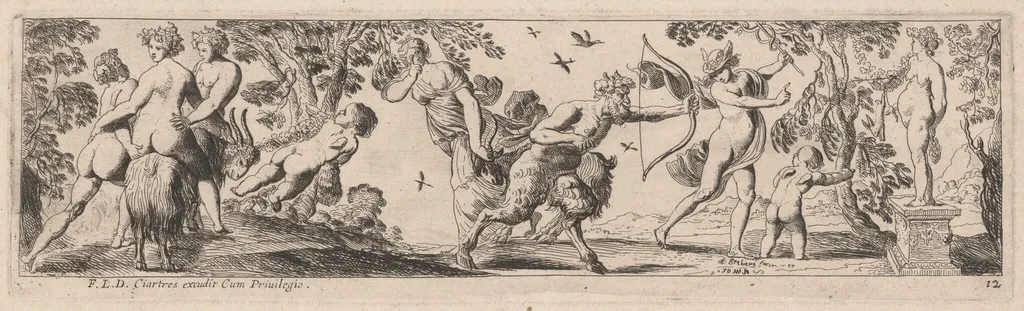
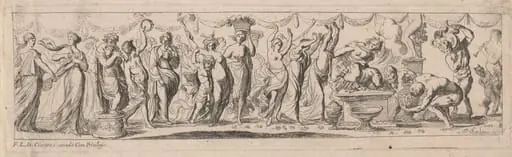
Satyr and Mercury Shooting at a Statue is an ink print by the Baroque artist Pierre Brebiette. It dates from 1626 and is held in the collection of the National Gallery of Art.
- Inscription
- Inscribed:lower center in plate: F.L.D. Ciartres excudit Cum Privilegio; lower right in plate: Brebiette [undecipherable]/12.
- Markings
- Marked:verso: unknown mark upper left
About this work
Overview
Pierre Brebiette’s 1626 etching titled Satyr and Mercury Shooting at a Statue presents a compact scene on laid paper. The print captures a mythological encounter where a satyr and the messenger god Mercury aim their weapons at a stone figure, focusing particularly on the statue’s nose. The composition is rendered in fine line work characteristic of early seventeenth‑century French printmaking.
Subject & Meaning
The image juxtaposes the mischievous satyr, a creature of rustic revelry, with Mercury, identifiable by his winged helmet, a symbol of swift communication.
The image juxtaposes the mischievous satyr, a creature of rustic revelry, with Mercury, identifiable by his winged helmet, a symbol of swift communication. Their shared aim at the statue’s nose suggests a playful subversion of reverence, turning an object of worship into a target. This humorous twist reflects contemporary Baroque tastes for narrative irony and the blending of sacred and profane motifs.
Technique & Style
Executed as an etching, the work relies on incised lines on a copper plate, transferred onto laid paper with a slightly textured surface. Brebiette’s handling of line creates delicate shading and a sense of depth, while the crisp rendering of Mercury’s helmet catches light, emphasizing the divine figure. The overall style aligns with the detailed, narrative-driven prints circulating in Paris during the early 1600s.
History & Provenance
Created in 1626, the print is among the relatively few surviving works attributed to Pierre Brebiette, a French printmaker active in the early seventeenth century. While specific ownership records are scarce, the etching appears in several catalogues of French Baroque prints and is held in a number of museum and library collections that specialize in early modern graphic art.
Artist & collection