Artwork
Recruitment of Troops
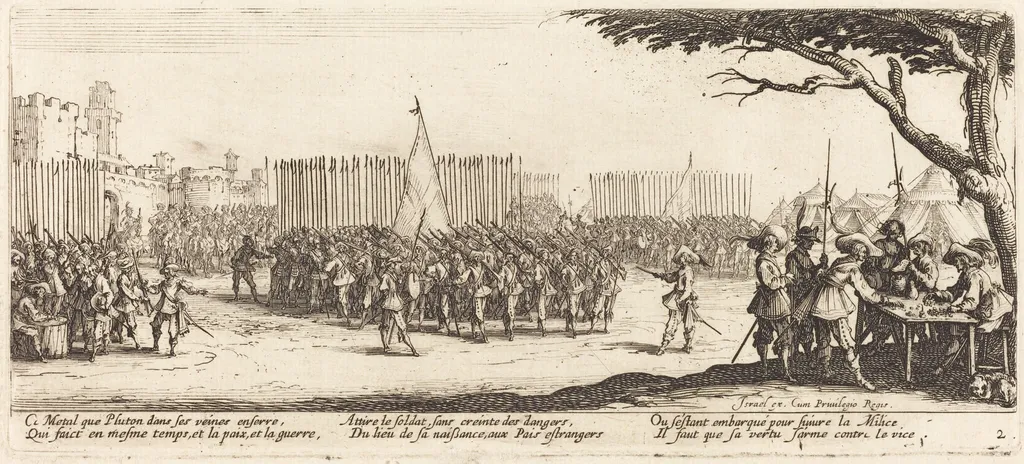
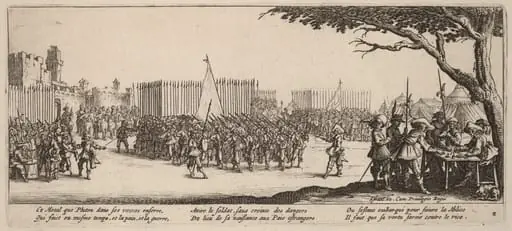
Recruitment of Troops is an ink print by the Baroque artist Jacques Callot. It dates from 1633 and is held in the collection of the National Gallery of Art.
About this work
Overview
Recruitment of Troops is an etching on laid paper created by Jacques Callot around 1633. It is one of over 1,400 prints produced by the artist, a prominent figure in the development of old master printmaking.
Subject & Meaning
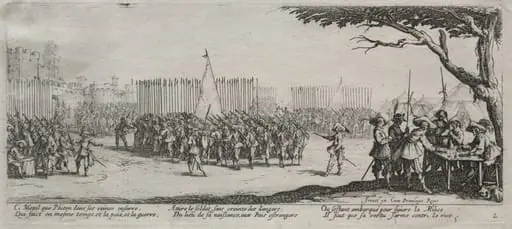
The print depicts a scene of military conscription, with soldiers marching in formation and figures standing apart, engaged in conversation. The image reflects Callot's interest in military subjects and the social dynamics of his time.
Technique & Style
Executed in fine lines, the etching showcases Callot's technical skill, capturing details such as uniforms and architectural features. The use of etching allowed for a high level of precision and intricacy in the print.
Context
The print is accompanied by a French text that describes soldiers leaving home for war, adding an additional layer of meaning to the image. The scene is set against a backdrop of a city skyline, framing the action and providing context.
Artist & collection
Artist
Jacques Callot (French: ; c. 1592 – 1635) was a baroque printmaker and draftsman from the Duchy of Lorraine. He is an important person in the development of the old master print. He made more than 1,400 etchings that…

 Holy Family at supper
 Restoration of the Aqueduct at Pisa
 Restoration of the Aqueduct at Pisa
 Square in Paris with Many Figures
 Square in Paris with Many Figures
 Horsemen Attacked by Robbers
 HOW WILL A COVERED PART BE CORRECTED?HOW WIKA A COVERED HEART DEED CORRECTED?
![Christ Walking on the Water [second plate], by Jacques Callot](https://artifactworldgallery.com/img/jacques-callot--christ-walking-on-the-water-second-plate--2069f3bfe4cb2126-w320.webp) Christ Walking on the Water [second plate]
Christ Walking on the Water [second plate]