Artwork
Sts. Gervase & Protase; St. Silverius; St. Eusebius of Samosata; St. Paulinus of Nola
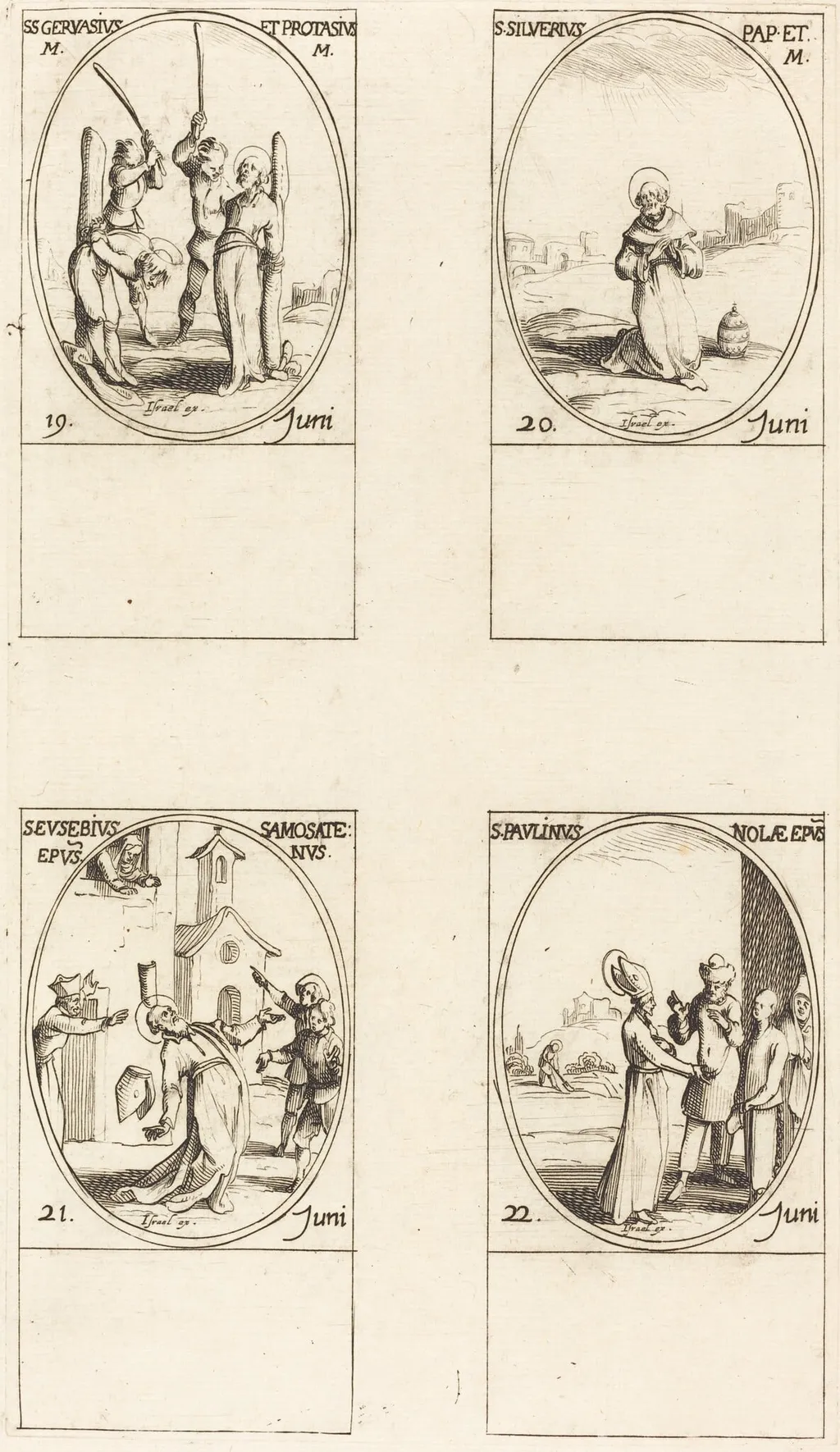
Sts. Gervase & Protase; St. Silverius; St. Eusebius of Samosata; St. Paulinus of Nola is an ink print by the Baroque artist Jacques Callot. It dates from 1634 and is held in the collection of the National Gallery of Art.
About this work
Overview
Created circa 1634, this etching on laid paper presents a quartet of saints, Gervase and Protase, Silverius, Eusebius of Samosata, and Paulinus of Nola, standing together in a compact composition. The work is attributed to Jacques Callot, a French printmaker active in the early seventeenth century, whose output includes more than a thousand etched images.
Subject & Meaning
The four figures are identified by their traditional attributes and inscriptions, linking them to distinct hagiographic traditions. By grouping these saints, Callot underscores a collective model of Christian virtue, drawing on the saints’ varied histories to suggest a universal sanctity that transcends regional cults.
Technique & Style
Executed with fine, linear incisions, the etching demonstrates Callot’s capacity to render intricate facial features and elaborate garments despite the medium’s inherent simplicity. The use of laid paper provides a subtle texture that enhances the depth of the line work, while the composition balances individual detail with a unified spatial arrangement.
History & Provenance
The print emerged from Callot’s prolific period in Lorraine, where he produced a vast corpus of religious, military, and genre scenes. Though the original ownership trail is not fully documented, the work has been catalogued among his religious series and appears in several early modern collections of prints.
Context
Callot’s practice reflects the Baroque era’s fascination with narrative clarity and dramatic representation. His religious prints often merged meticulous figure study with broader visual motifs drawn from contemporary courtly and devotional art, situating this etching within the larger currents of seventeenth‑century French print culture.
Artist & collection
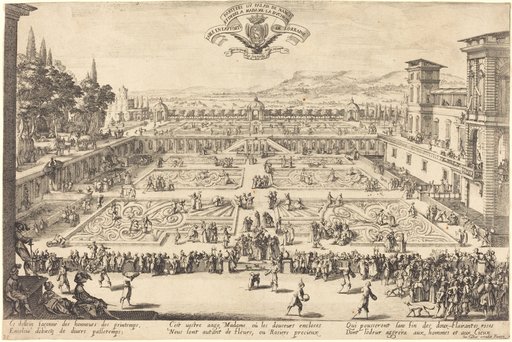
Artist
Jacques Callot (French: ; c. 1592 – 1635) was a baroque printmaker and draftsman from the Duchy of Lorraine. He is an important person in the development of the old master print. He made more than 1,400 etchings that…

 Holy Family at supper
 Restoration of the Aqueduct at Pisa
 Restoration of the Aqueduct at Pisa
 Square in Paris with Many Figures
 Square in Paris with Many Figures
 Horsemen Attacked by Robbers
 HOW WILL A COVERED PART BE CORRECTED?HOW WIKA A COVERED HEART DEED CORRECTED?
![Christ Walking on the Water [second plate], by Jacques Callot](https://artifactworldgallery.com/img/jacques-callot--christ-walking-on-the-water-second-plate--2069f3bfe4cb2126-w320.webp) Christ Walking on the Water [second plate]
Christ Walking on the Water [second plate]
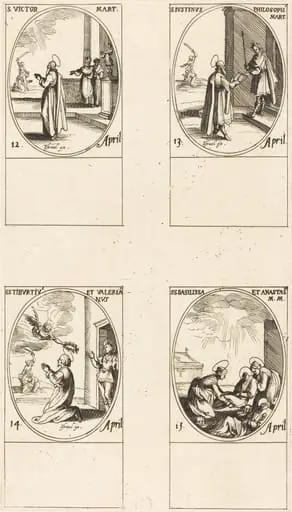 St. Victor; St. Justinus; Sts. Tiburtius and Valerianus; Sts. Basilissa and Anastasia
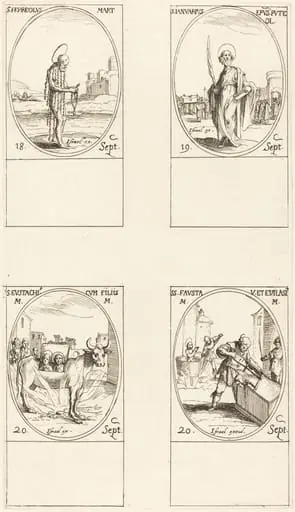 St. Ferreolus; St. Januarius; St. Eustachius & his Children; Sts. Fausta & Evelasius
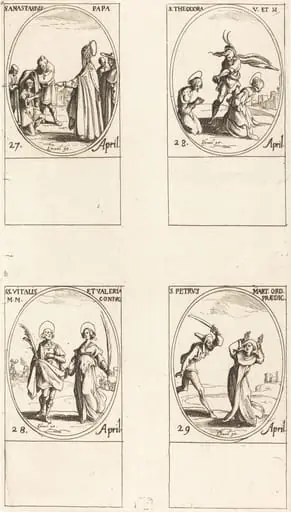 St. Anastasius; St. Theodora; Sts. Vitalis and Valeria; St. Peter Martyr
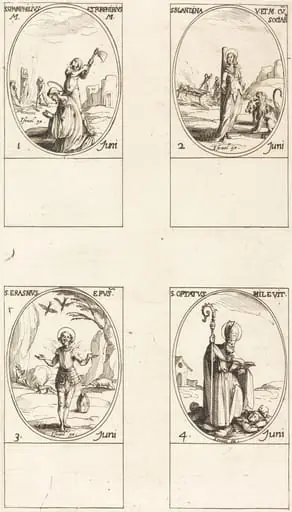 Sts. Pamphilius and Porphyrius; St. Blandina and Companions; St. Erasmus; St. Optatus
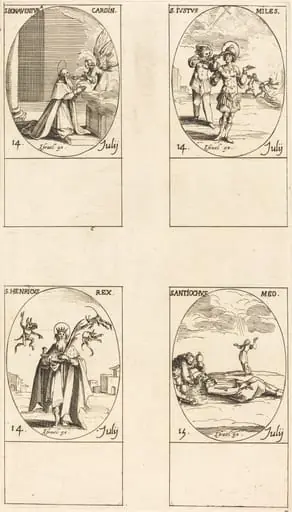 St. Bonaventura; St. Justus; St. Henry, Emperor; St. Antiochus
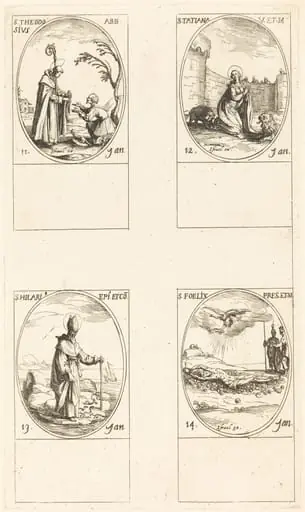 St. Theodosius; St. Tatiana; St. Hilary; St. Felix
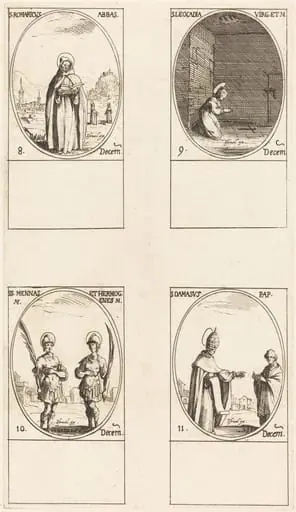 St. Romaricus; St. Leocadia; Sts. Mennas and Hermogenes; St. Damasus