Artwork
Taglia Cantoni and Fracasso
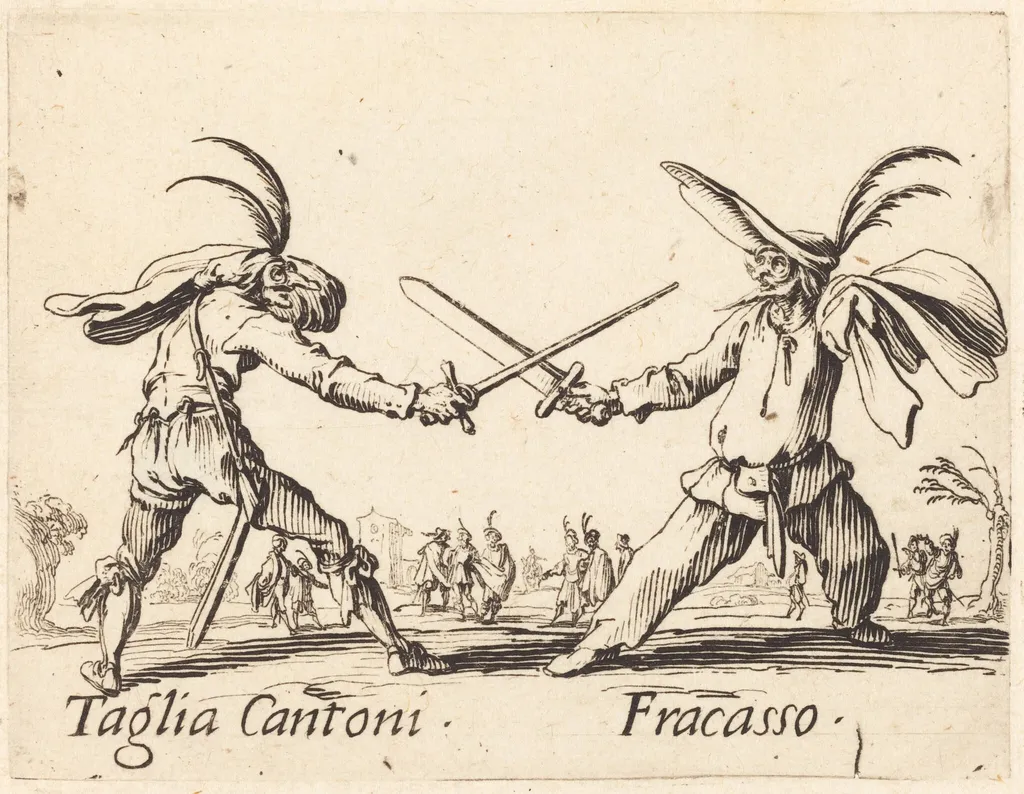
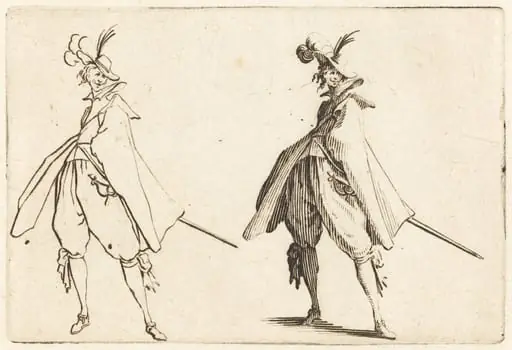
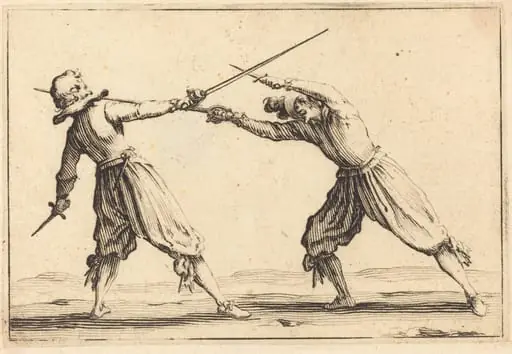
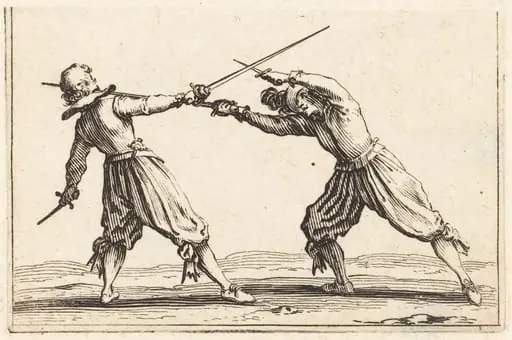
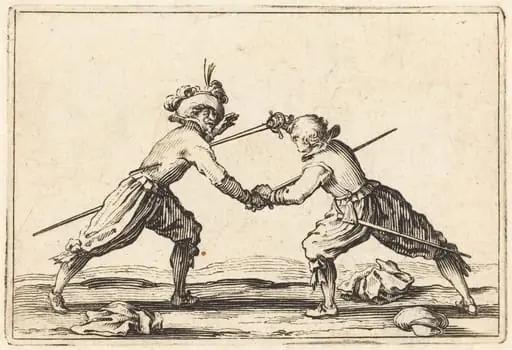
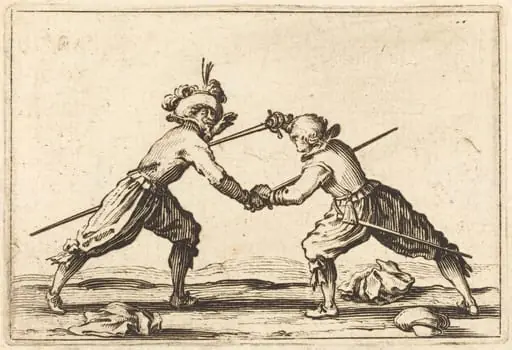
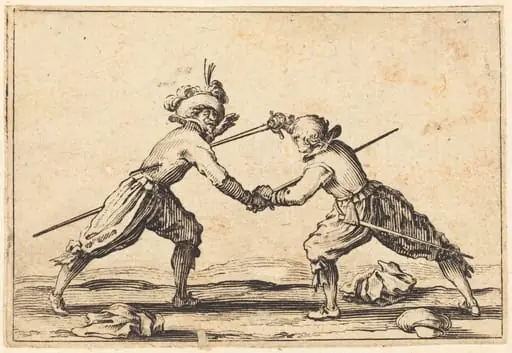
Taglia Cantoni and Fracasso is an ink print by the Baroque artist Jacques Callot. It dates from 1622 and is held in the collection of the National Gallery of Art.
About this work
Overview
As part of a broader series documenting street life and popular entertainments, the print reflects Callot’s interest in the margins of society.
Created around 1622 by Jacques Callot, this etching on laid paper captures a moment of violent spectacle involving two named figures. As part of a broader series documenting street life and popular entertainments, the print reflects Callot’s interest in the margins of society. His technical precision and attention to gesture distinguish this work among his more than 1,400 prints, offering a snapshot of public spectacle in early 17th-century Europe.
Subject & Meaning
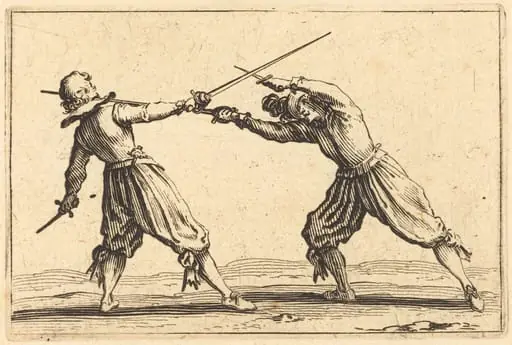
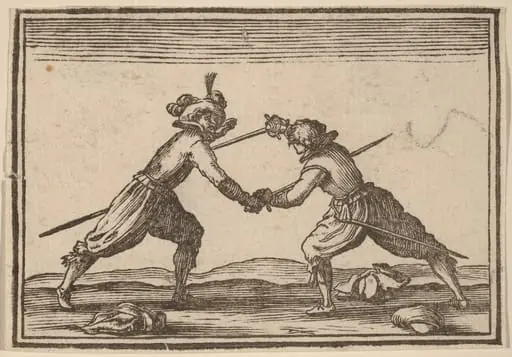
The scene depicts two men, identified as Taglia Cantoni and Fracasso, locked in a sword duel. Their elaborate hats, loose garments, and dramatic postures suggest they are performers or known local figures rather than nobility. The presence of onlookers in the background frames the fight as public entertainment, possibly a staged brawl or folk spectacle.
The names inscribed beneath imply these were recognizable personalities, their identities tied to local lore or street culture.
Technique & Style
Callot employed fine, controlled etching lines to render texture and motion with remarkable clarity. The fighters’ clothing, weapons, and facial expressions are rendered in sharp detail, while the crowd behind them is suggested with minimal strokes, creating depth without clutter. His use of cross-hatching and varied line weight enhances the drama of the confrontation, demonstrating his mastery of the medium to convey both action and atmosphere.
History & Provenance
The print was produced during Callot’s time in Florence, where he was influenced by Italian theatrical traditions and public spectacles. Though the exact provenance of this specific impression is undocumented, it aligns with his broader practice of collecting and reworking popular imagery. Many of his prints circulated widely across Europe, often collected by patrons interested in the visual record of contemporary life.
Context
In early 17th-century Italy and Lorraine, public brawls and staged combats were common forms of entertainment, often involving professional fighters or local characters. Callot’s interest in such scenes reflected a growing fascination with the lives of common people, distinct from traditional religious or mythological subjects. His prints served as both documentation and commentary on the social fabric of the time.
Legacy
Callot’s detailed depictions of everyday violence and spectacle influenced later generations of printmakers, including Goya and Hogarth. His ability to capture fleeting moments with precision helped elevate etching from a reproductive medium to a vehicle for social observation. 'Taglia Cantoni and Fracasso' remains a testament to his role in documenting the unvarnished realities of his era.
Own this work as a print
Artist & collection
Artist
Jacques Callot (French: ; c. 1592 – 1635) was a baroque printmaker and draftsman from the Duchy of Lorraine. He is an important person in the development of the old master print. He made more than 1,400 etchings that…

 Holy Family at supper
 Restoration of the Aqueduct at Pisa
 Restoration of the Aqueduct at Pisa
 Square in Paris with Many Figures
 Square in Paris with Many Figures
 Horsemen Attacked by Robbers
 HOW WILL A COVERED PART BE CORRECTED?HOW WIKA A COVERED HEART DEED CORRECTED?
![Christ Walking on the Water [second plate], by Jacques Callot](https://artifactworldgallery.com/img/jacques-callot--christ-walking-on-the-water-second-plate--2069f3bfe4cb2126-w320.webp) Christ Walking on the Water [second plate]
Christ Walking on the Water [second plate]