Artwork
The Entry into Jerusalem
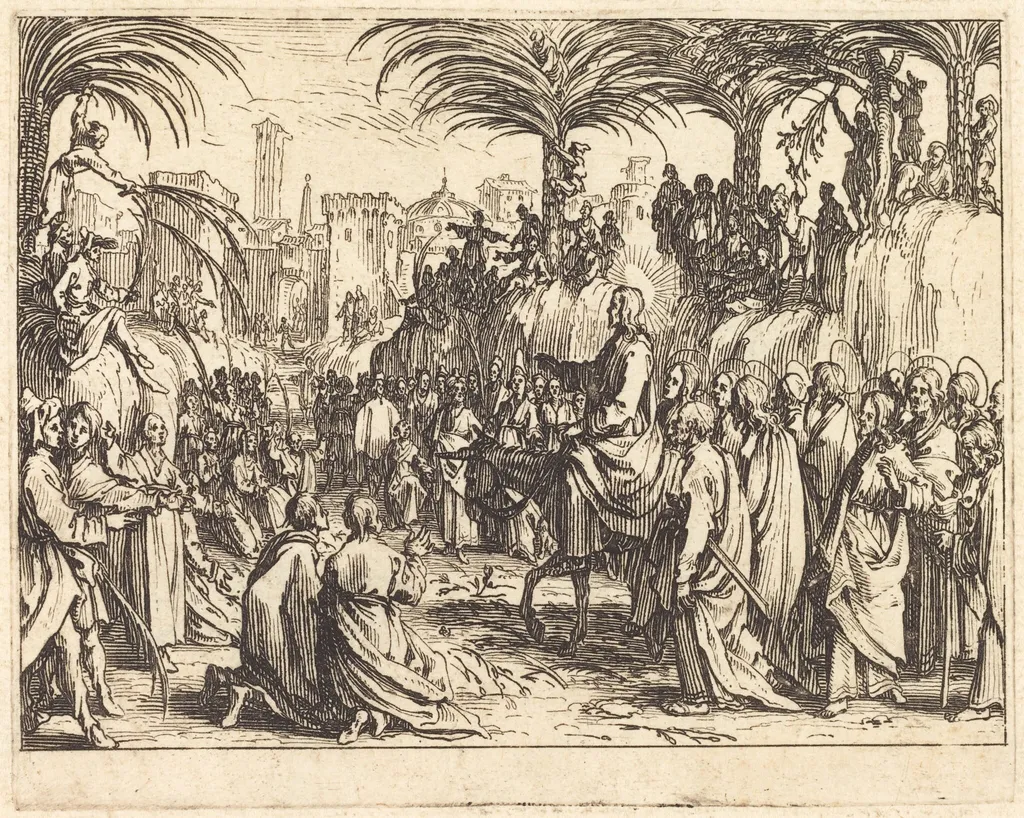
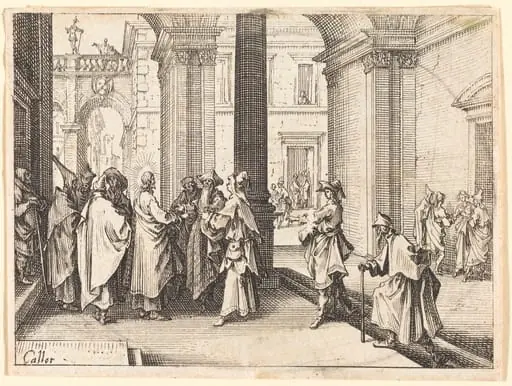
The Entry into Jerusalem is an ink print by the Baroque artist Jacques Callot. It dates from 1635 and is held in the collection of the National Gallery of Art.
About this work
Overview
Jacques Callot produced The Entry into Jerusalem in 1635, an etching on laid paper that exemplifies his prolific output during the Baroque period.
Jacques Callot produced The Entry into Jerusalem in 1635, an etching on laid paper that exemplifies his prolific output during the Baroque period. As a printmaker from the Duchy of Lorraine, Callot specialized in intricate compositions, ranging from military campaigns to religious narratives. This work forms part of a broader tradition of 17th-century European printmaking, where technical precision and narrative clarity were paramount.
Subject & Meaning
The print depicts Christ’s arrival in Jerusalem, a pivotal moment in Christian liturgy. A central figure on a donkey is surrounded by a throng of figures, some kneeling or waving palm branches, while others observe from the periphery. The scene’s density underscores the event’s significance, blending devotion with the spectacle of public gathering. Callot’s interpretation aligns with contemporary religious imagery, emphasizing both reverence and the immediacy of the moment.
Technique & Style
Callot employed etching to achieve fine detail, using acid-bitten lines to render textures, from the folds of garments to the fronds of palm trees. The contrast between densely hatched shadows and the paper’s natural tone enhances the scene’s dramatic effect. His linear precision reflects the influence of Italian printmaking, while the composition’s dynamism aligns with Baroque conventions, balancing clarity with movement.
History & Provenance
Created in 1635, The Entry into Jerusalem belongs to Callot’s later works, produced during a period of prolific artistic activity. As with many of his prints, it circulated widely, reflecting the era’s demand for devotional and historical imagery. The etching’s survival in collections underscores its role in the dissemination of religious themes across 17th-century Europe, though specific early ownership remains undocumented.
Context
The print emerges from a period marked by religious and political upheaval in Europe, where printmaking served as a vital medium for both propaganda and devotion. Callot’s work bridges secular and sacred themes, catering to a diverse audience. The Entry into Jerusalem exemplifies how religious narratives were adapted to the visual language of the Baroque, reinforcing cultural and spiritual ideals through accessible imagery.
Own this work as a print
Artist & collection
Artist
Jacques Callot (French: ; c. 1592 – 1635) was a baroque printmaker and draftsman from the Duchy of Lorraine. He is an important person in the development of the old master print. He made more than 1,400 etchings that…

 Holy Family at supper
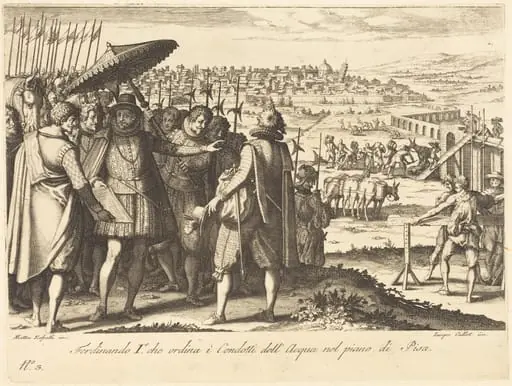 Restoration of the Aqueduct at Pisa
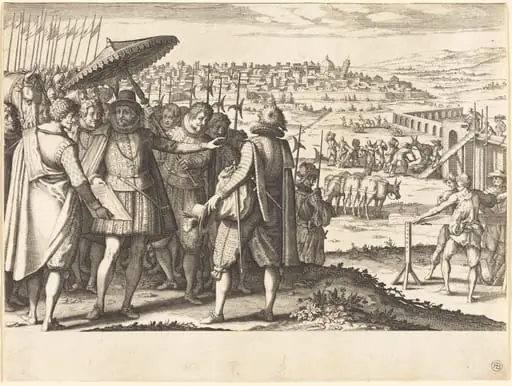 Restoration of the Aqueduct at Pisa
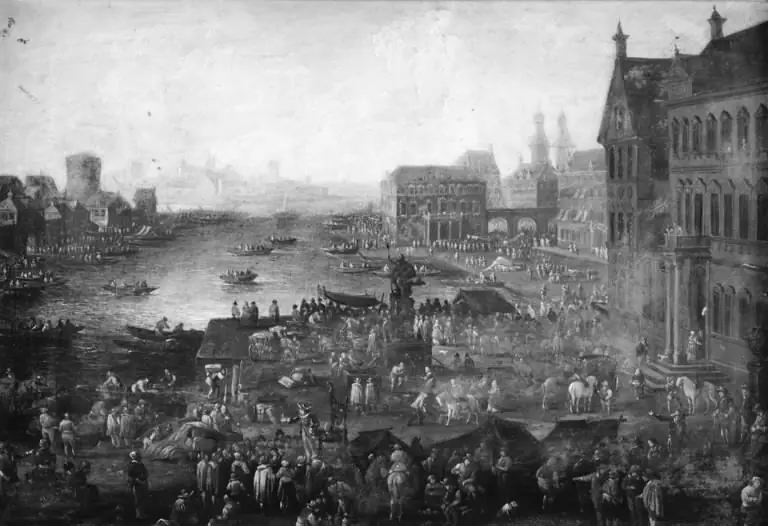 Square in Paris with Many Figures
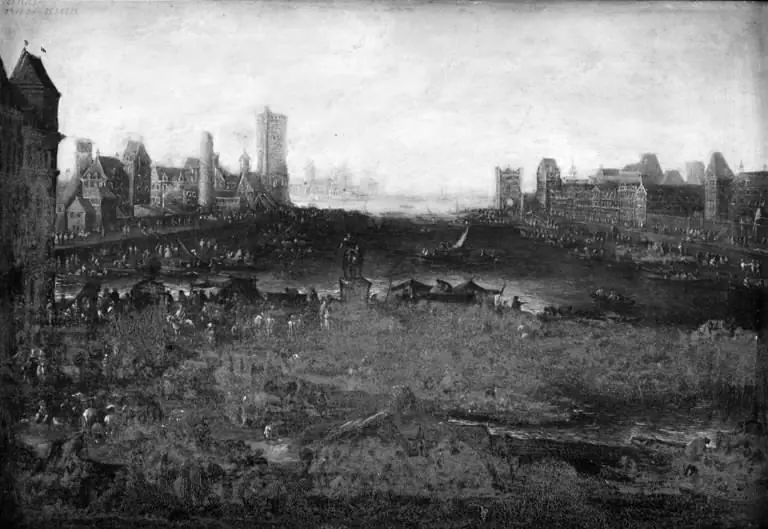 Square in Paris with Many Figures
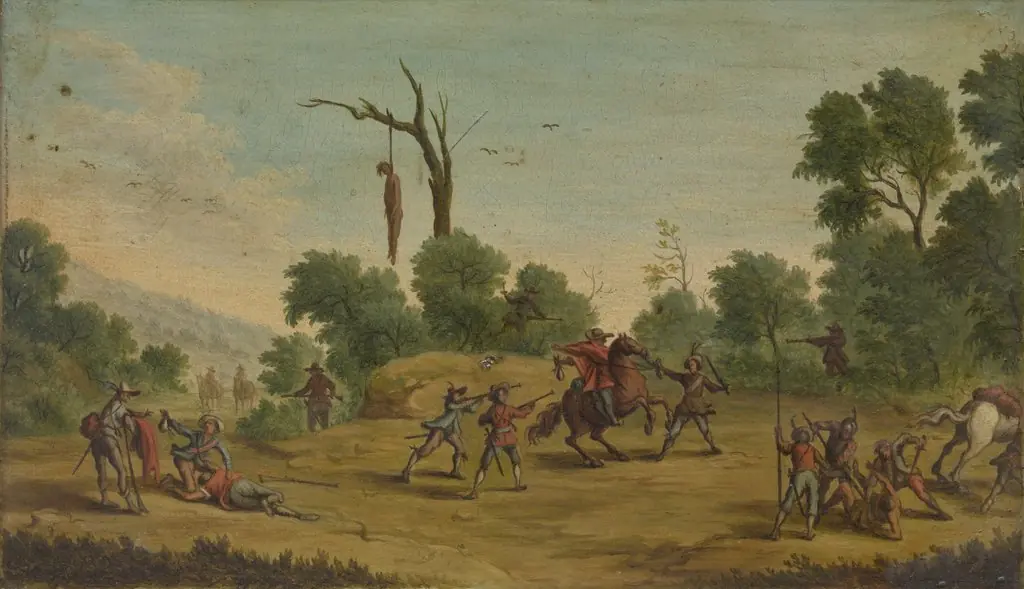 Horsemen Attacked by Robbers
 HOW WILL A COVERED PART BE CORRECTED?HOW WIKA A COVERED HEART DEED CORRECTED?
![Christ Walking on the Water [second plate], by Jacques Callot](https://artifactworldgallery.com/img/jacques-callot--christ-walking-on-the-water-second-plate--2069f3bfe4cb2126-w320.webp) Christ Walking on the Water [second plate]
Christ Walking on the Water [second plate]