Artwork
The Landing of the Troops
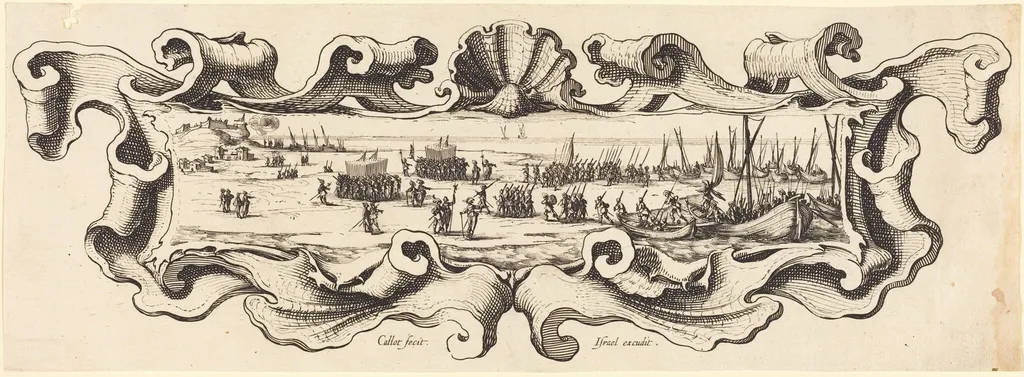
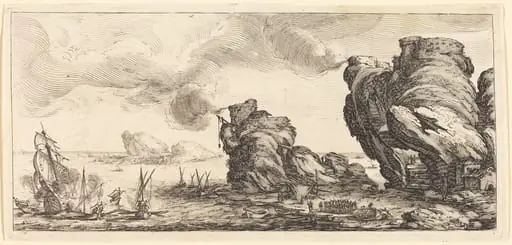
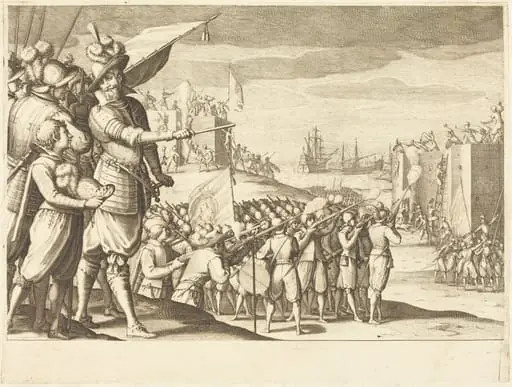
The Landing of the Troops is an ink print by the Baroque artist Jacques Callot. It dates from 1630 and is held in the collection of the National Gallery of Art.
About this work
Overview
Created around 1630 by Jacques Callot, The Landing of the Troops is a black-and-white print made through etching and engraving on laid paper.
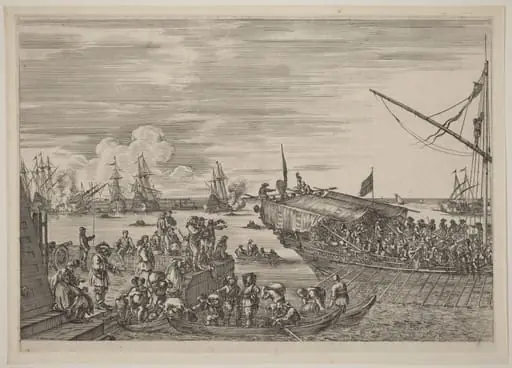
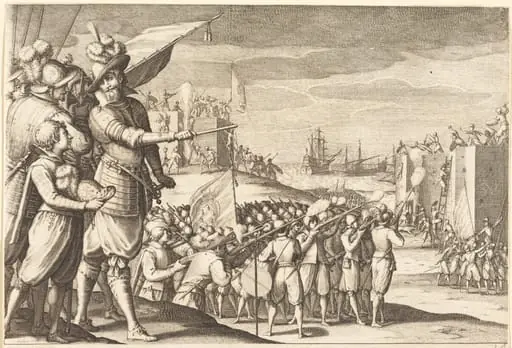
Created around 1630 by Jacques Callot, The Landing of the Troops is a black-and-white print made through etching and engraving on laid paper. It captures a military force disembarking onto a shoreline, with ships anchored offshore and a distant town perched on a hill. Callot, a prolific printmaker from Lorraine, used this medium to record scenes of war and daily life with exceptional precision, contributing significantly to the development of early modern printmaking.
Subject & Meaning
The scene depicts soldiers advancing onto a beach under a turbulent sky, suggesting the arrival of an army in an unfamiliar landscape. The composition emphasizes order and movement, with figures arranged in disciplined rows. The looming clouds and distant towers imply an impending engagement or occupation.
Rather than glorifying battle, the work conveys the quiet tension of military deployment, reflecting Callot’s interest in the mechanics and atmosphere of war.
Technique & Style
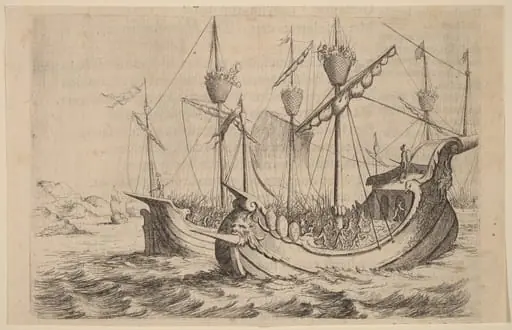
Callot employed fine-line etching to render intricate details: the texture of armor, the ripples of waves, and the layered clouds above. His use of engraving added depth and contrast to the composition. The paper’s laid texture subtly enhances the tactile quality of the image.
The precision of the lines, particularly in the figures and ships, demonstrates his mastery of the medium, allowing for both broad narrative scope and minute realism within a single plate.
History & Provenance
The print was produced during Callot’s mature period, when he was actively documenting military campaigns across Europe. Though the exact commission or context for this specific image remains unrecorded, it aligns with his broader series on warfare, likely intended for collectors and military observers. Its survival in multiple institutional collections suggests early circulation among European elites interested in contemporary military affairs.
Context
Made during the Thirty Years’ War, the print reflects the widespread presence of mercenary armies in Central and Western Europe. Callot, who witnessed troop movements firsthand, avoided overt propaganda, instead focusing on the visual rhythm of military logistics. His prints served as both records and commentaries, offering viewers a detached yet vivid glimpse into the realities of war beyond the battlefield’s chaos.
Legacy
Callot’s technical innovations in etching influenced generations of printmakers, particularly in their ability to render complex scenes with clarity. The Landing of the Troops exemplifies his role in elevating printmaking from reproduction to a respected artistic medium. His detailed, observational approach laid groundwork for later documentary and topographical prints, establishing a precedent for visual reporting in the pre-photographic era.
Artist & collection
Artist
Jacques Callot (French: ; c. 1592 – 1635) was a baroque printmaker and draftsman from the Duchy of Lorraine. He is an important person in the development of the old master print. He made more than 1,400 etchings that…

 Holy Family at supper
 Restoration of the Aqueduct at Pisa
 Restoration of the Aqueduct at Pisa
 Square in Paris with Many Figures
 Square in Paris with Many Figures
 Horsemen Attacked by Robbers
 HOW WILL A COVERED PART BE CORRECTED?HOW WIKA A COVERED HEART DEED CORRECTED?
![Christ Walking on the Water [second plate], by Jacques Callot](https://artifactworldgallery.com/img/jacques-callot--christ-walking-on-the-water-second-plate--2069f3bfe4cb2126-w320.webp) Christ Walking on the Water [second plate]
Christ Walking on the Water [second plate]