Artwork
'Palama'
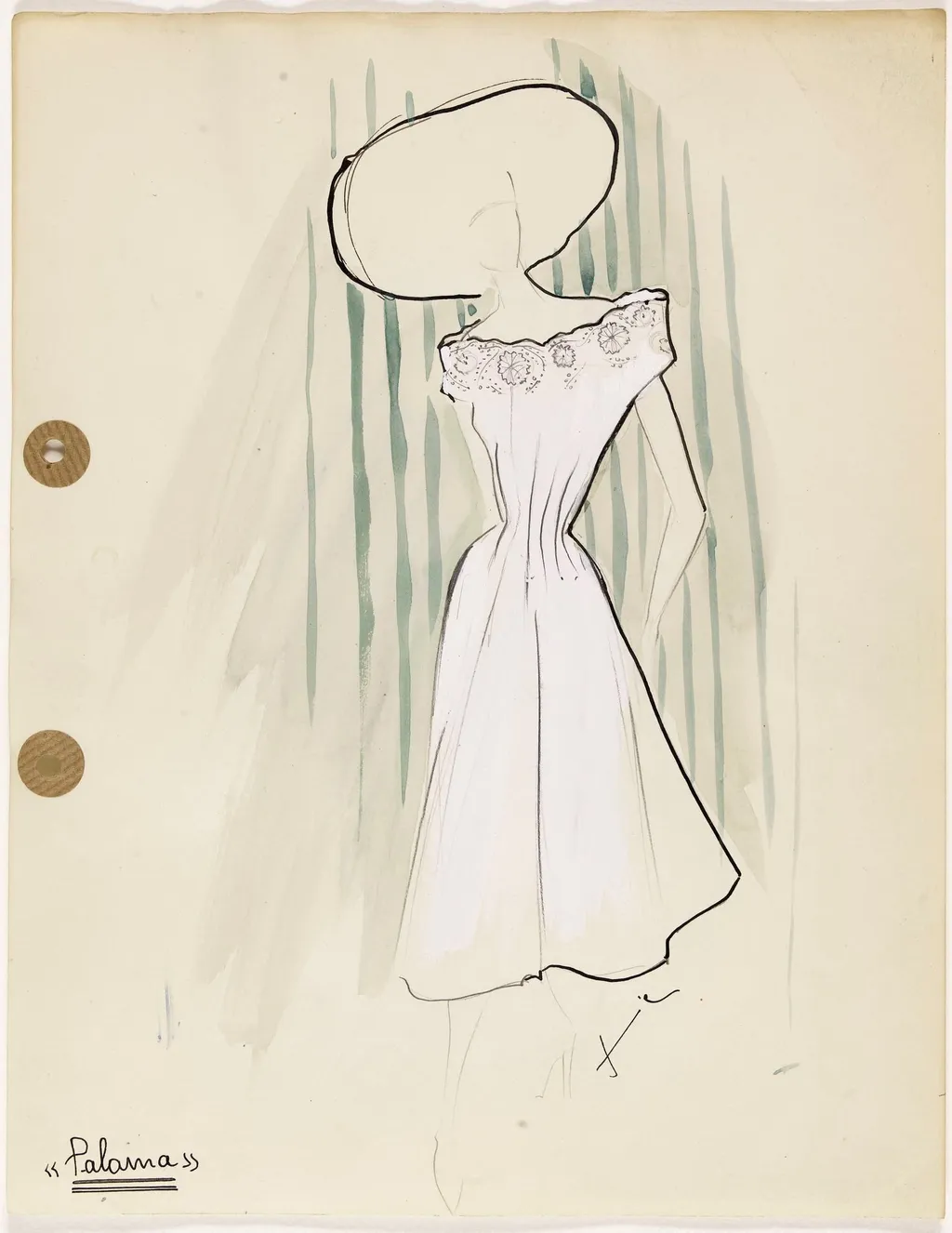
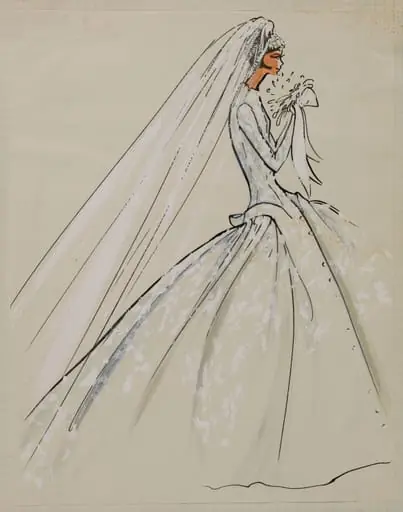
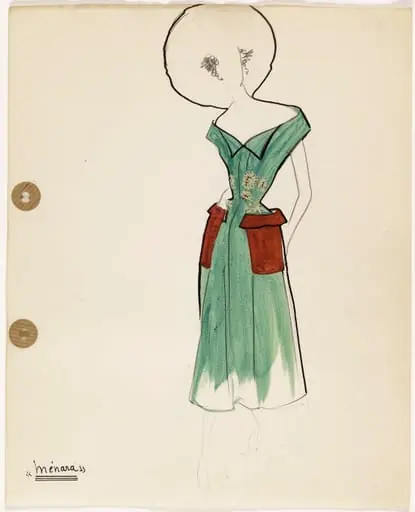
'Palama' is a drawing by Carven. It dates from 1949 and is held in the collection of the Palais Galliera - Musée de la Mode de la Ville de Paris.
About this work
Overview
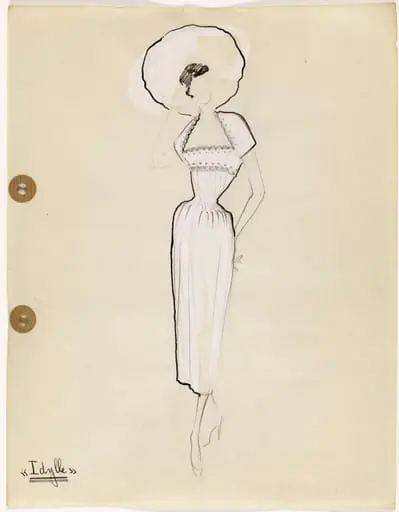
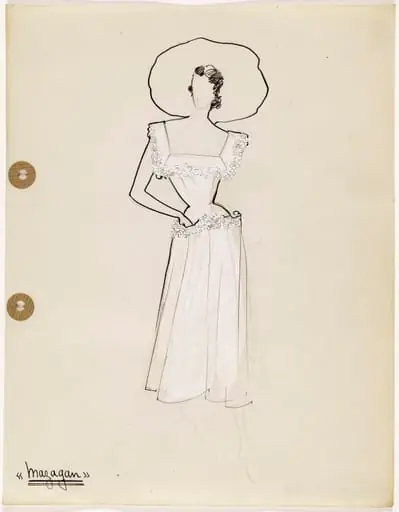
Created in 1949 by the artist Carven, 'Palama' is a pencil or ink drawing held in the collection of the Museum of Ethnography. The work presents a solitary female figure viewed from behind, rendered with restrained precision. Its minimalist approach emphasizes form and posture over detail, reflecting a deliberate focus on silhouette and presence rather than facial expression or narrative context.
Subject & Meaning
The absence of the face and the turned posture invite contemplation rather than identification.
The figure, dressed in a sleeveless white gown with lace trim and a wide-brimmed hat, suggests a formal or ceremonial setting, though no specific event is indicated. The absence of the face and the turned posture invite contemplation rather than identification. The composition evokes anonymity and quiet dignity, possibly reflecting cultural ideals of modesty or the universal representation of feminine grace in mid-century design.
Technique & Style
Carven employs clean, unbroken lines and minimal shading to define the figure and garment. The dress’s flared silhouette and lace details are suggested with economy, avoiding heavy texture or depth. The background’s light beige field is interrupted by vertical green stripes, introducing subtle rhythm without distraction. The technique prioritizes clarity and balance, aligning with modernist tendencies to distill form to its essential contours.
History & Provenance
The drawing entered the Museum of Ethnography’s collection shortly after its creation, likely acquired as part of a broader interest in mid-century fashion illustration or cultural representation. Its provenance remains tied to the artist’s personal archive, with no public record of prior ownership or exhibition prior to its institutional acquisition.
Context
Produced in postwar Europe, 'Palama' reflects a period when fashion and graphic art increasingly intersected in commercial and cultural spheres. While Carven was known for textile and dress design, this work stands apart as a standalone drawing, perhaps a study or personal sketch, offering insight into how aesthetic ideals of elegance were translated beyond the runway into visual art.
Legacy
Though not widely reproduced, 'Palama' remains a quiet example of how simplicity in line can convey presence and poise. It contributes to the Museum of Ethnography’s collection as a bridge between fashion design and observational drawing, illustrating how everyday elegance was captured in an era transitioning from traditional craftsmanship to modernist abstraction.
Artist & collection
Artist
These delicate ink-on-paper drawings capture the quiet poetry of everyday things: pinecones, reeds, apples.
Museum
Palais Galliera - Musée de la Mode de la Ville de Paris
Continue through works from the same source collection.