Artwork
The King
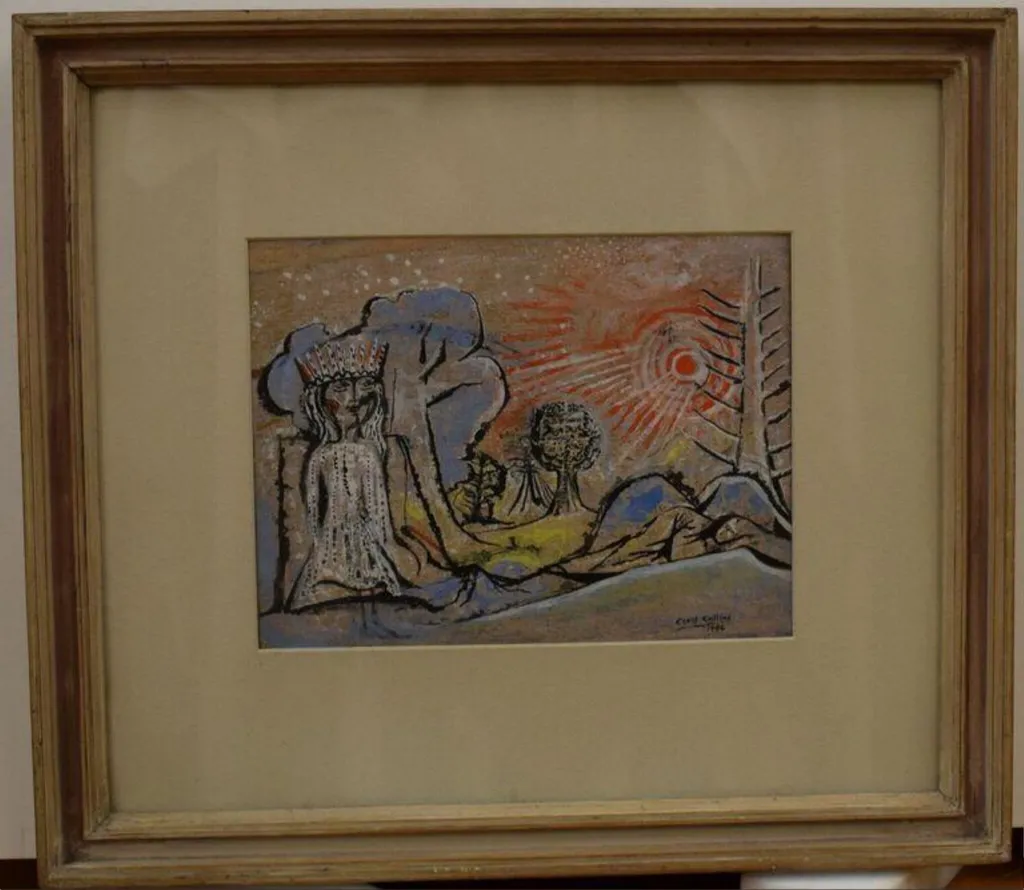
The King is a watercolor work on paper by the Art Brut artist Cecil Collins. It dates from 1946 and is held in the collection of the Victoria and Albert Museum.
About this work
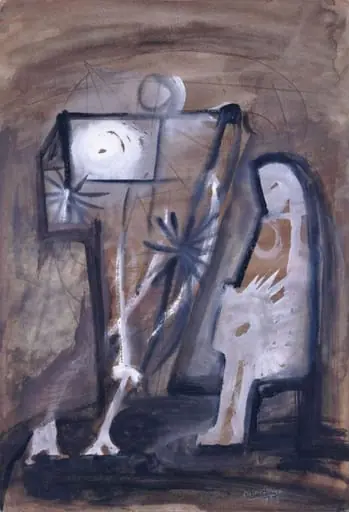
It’s a simple scene: a crowned king stands in the left foreground, looking outward.
Cecil Collins painted "The King" in 1946 using watercolour. It’s a simple scene: a crowned king stands in the left foreground, looking outward.
Collins studied art in Plymouth and London. In the 1930s he saw work by Picasso and Klee, but later moved away from surrealism. By the 1940s, his style leaned toward mystical vision.
Check out Collins' other mystical works at the Victoria and Albert Museum.
Overview
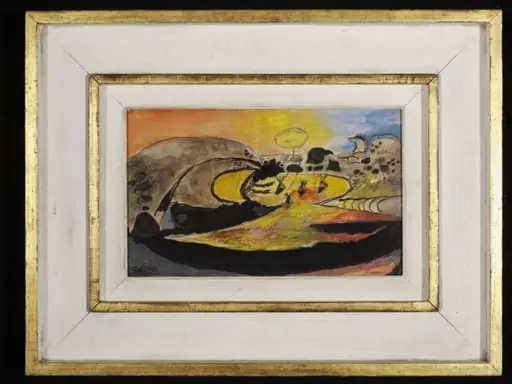
Cecil Collins’s watercolour titled The King was completed in 1946. The composition presents a crowned figure, shown from the waist up, positioned in the left foreground and gazing directly toward the viewer. Behind the monarch a gently rolling, hilly landscape curves away, establishing a sense of depth within a compact, almost diagrammatic setting.
Subject & Meaning
The central figure is a solitary king, his crown and upright posture suggesting authority and contemplation. The direct gaze invites the audience into a quiet, introspective encounter, reflecting Collins’s belief that art should arise from visionary experience and a spiritual quest, echoing the mystical atmosphere found in his other works of the period.
Technique & Style
Executed in watercolour, the image employs bold primary hues outlined in black, a method that creates spatial recession and emphasizes the figure against the landscape. This approach, combining flat colour areas with defined contours, typifies Collins’s mid‑1940s style, which balances simplified forms with a subtle, otherworldly ambience.
History & Provenance
Collins, trained at the Plymouth School of Art (1923‑27) and the Royal College of Art (1927‑31), participated in the 1936 International Surrealist Exhibition before distancing himself from that movement. After teaching at Dartington Hall during World War II, he produced The King as part of his post‑war output, reflecting his turn toward mysticism.
Context
The work emerges from a period when Collins, influenced earlier by Picasso and Klee, sought a personal visual language rooted in spiritual vision. The painting’s serene, visionary quality aligns it with the mystical traditions of Samuel Palmer and Odilon Redon, whose influence is evident in Collins’s atmospheric landscapes and symbolic figures.
Artist & collection
Artist
James Henry Cecil Collins MBE was an English painter and printmaker, originally associated with the Surrealist movement.