Artwork
Hunting Dogs (Cani di caccia)
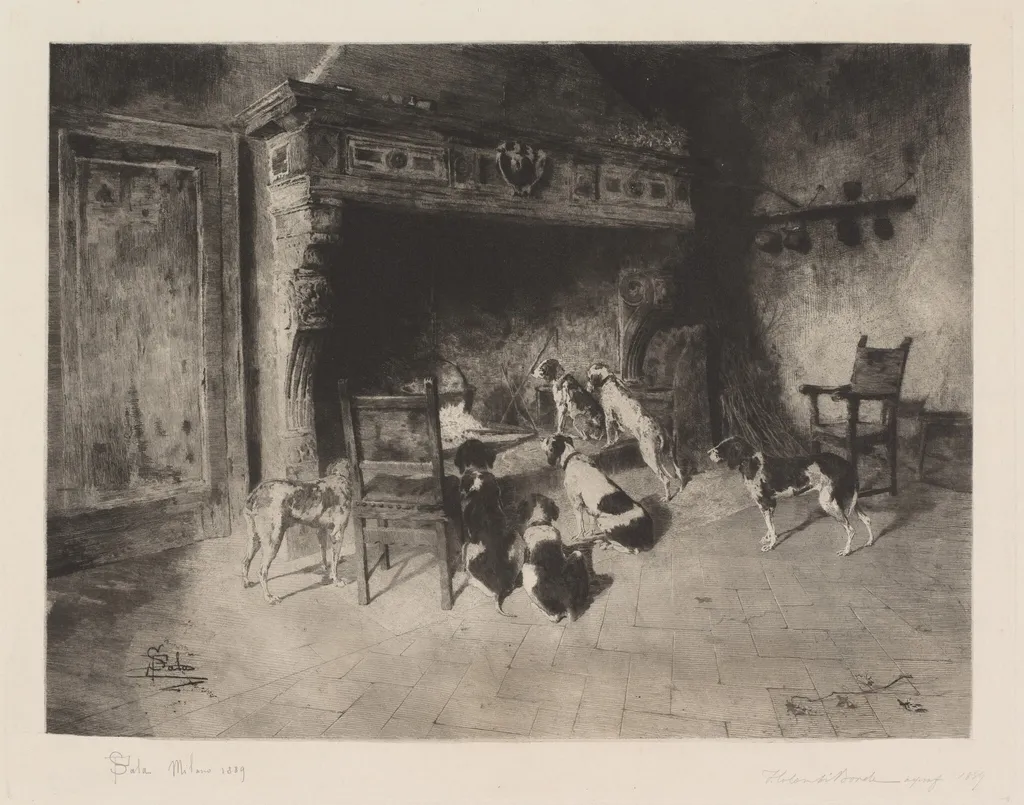
Hunting Dogs (Cani di caccia) is an ink print by the Impressionist artist Francesco Colombi Borde. It dates from 1889 and is held in the collection of the National Gallery of Art.
- Inscription
- Inscribed:recto: lower left in plate: PSala; signed by artist, lower left, in graphite: PSala Milano 1889; signed by artist, lower right, in graphite: F Colombi Borde acquaf 1889; verso: none
- Markings
- Marked:none
About this work
Overview
Hunting Dogs (Cani di caccia) is an 1889 etching by Francesco Colombi Borde, executed on wove paper in a proof state prior to the addition of lettering.
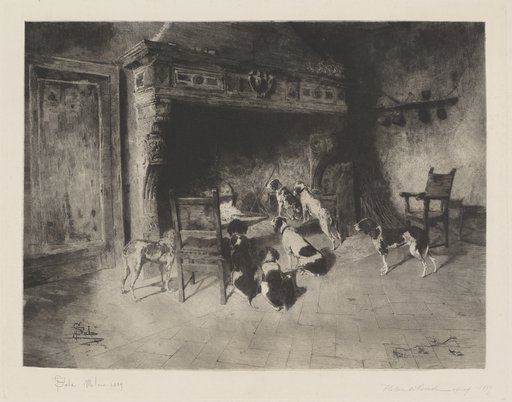
Hunting Dogs (Cani di caccia) is an 1889 etching by Francesco Colombi Borde, executed on wove paper in a proof state prior to the addition of lettering. The work depicts a domestic interior where eight dogs gather near a fireplace, capturing a quiet, unposed moment. Unlike painted compositions, the medium emphasizes tonal gradation and fine line work to suggest texture and volume, reflecting the artist’s engagement with printmaking traditions.
Subject & Meaning
The scene portrays a group of hunting dogs resting indoors, their postures ranging from alert standing to relaxed sitting. The absence of human figures shifts focus to the animals’ presence, suggesting companionship and the quiet aftermath of labor. The fireplace, a central element, implies warmth and shelter, subtly honoring the dogs’ role in rural life without overt sentimentality or narrative drama.
Technique & Style
Borde employed etching to render fine details in the dogs’ fur and the wooden furnishings with precise, controlled lines. The tonal range relies on hatching and cross-hatching to model form, using muted grays and browns to evoke a subdued, earthy atmosphere. The composition is grounded in realism, avoiding idealization; textures of wood, stone, and fur are rendered with observational accuracy, characteristic of late 19th-century Italian printmaking.
History & Provenance
Created in 1889, this print exists as a proof before the addition of inscriptions, indicating it was likely an early impression pulled for the artist’s review. Its survival in this state suggests limited circulation, possibly retained within the artist’s circle or private collections. No public exhibition history or documented ownership prior to the 20th century is widely recorded.
Context
In late 19th-century Italy, Realism extended beyond urban scenes to include rural and domestic subjects, often focusing on animals and everyday environments. Borde’s work aligns with this trend, reflecting a broader interest in truthful representation over romanticized narratives. Etching, though less common than painting for such subjects, allowed for intimate, detailed studies accessible to collectors outside major art centers.
Legacy
Hunting Dogs remains a modest but distinctive example of Italian printmaking from the period, valued for its quiet observation and technical restraint. While not widely reproduced or exhibited, it contributes to understanding how Realist sensibilities were adapted in graphic media. The work continues to be studied for its nuanced depiction of animal life and its place within the broader context of European print culture.
Own this work as a print
Artist & collection

- Untitled
![Intérieur d'église à Milan [Interior of a Church in Milan], by Mosè Bianchi](https://artifactworldgallery.com/img/mose-bianchi--interieur-d-eglise-a-milan-interior-of-a-church-in-milan--6e5465a8fb58e0ea-w320.webp) Intérieur d'église à Milan [Interior of a Church in Milan]
Intérieur d'église à Milan [Interior of a Church in Milan] The Forge
 Les Soutiens de la société
 The Music Room
 The Artist in His Mother's Room, Danzig
 The Dog on the Kennel
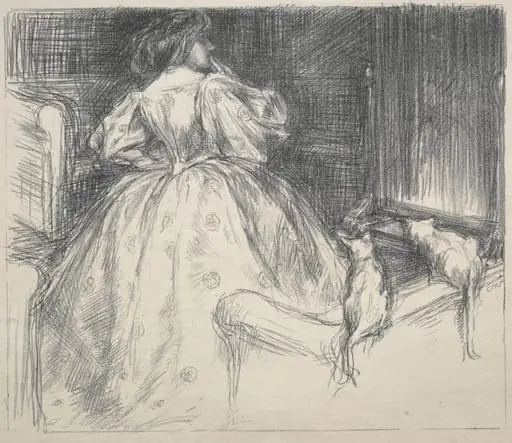 The Fantastic Dress
![Un Miracle [A Miracle], by Mosè Bianchi](https://artifactworldgallery.com/img/mose-bianchi--un-miracle-a-miracle--333a12cf5ec140c5-w320.webp) Un Miracle [A Miracle]
Un Miracle [A Miracle]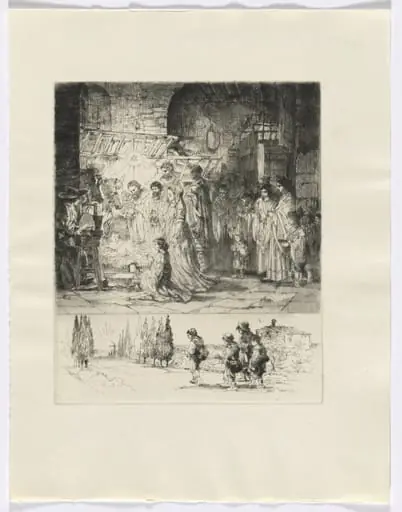 Frédéric Mistral: Mémoires et Recits by Frédéric Mistral: nativity/ figures walking on a road (insert after p. 32)
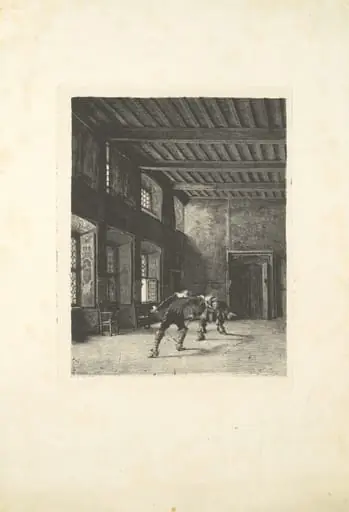 Il Duello (The Duel)
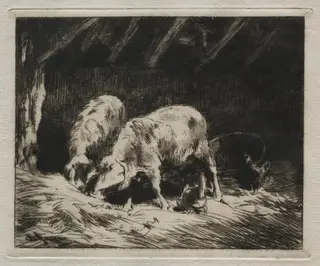 Two Pigs