Artwork
Still Life with Asparagus and Red Currants
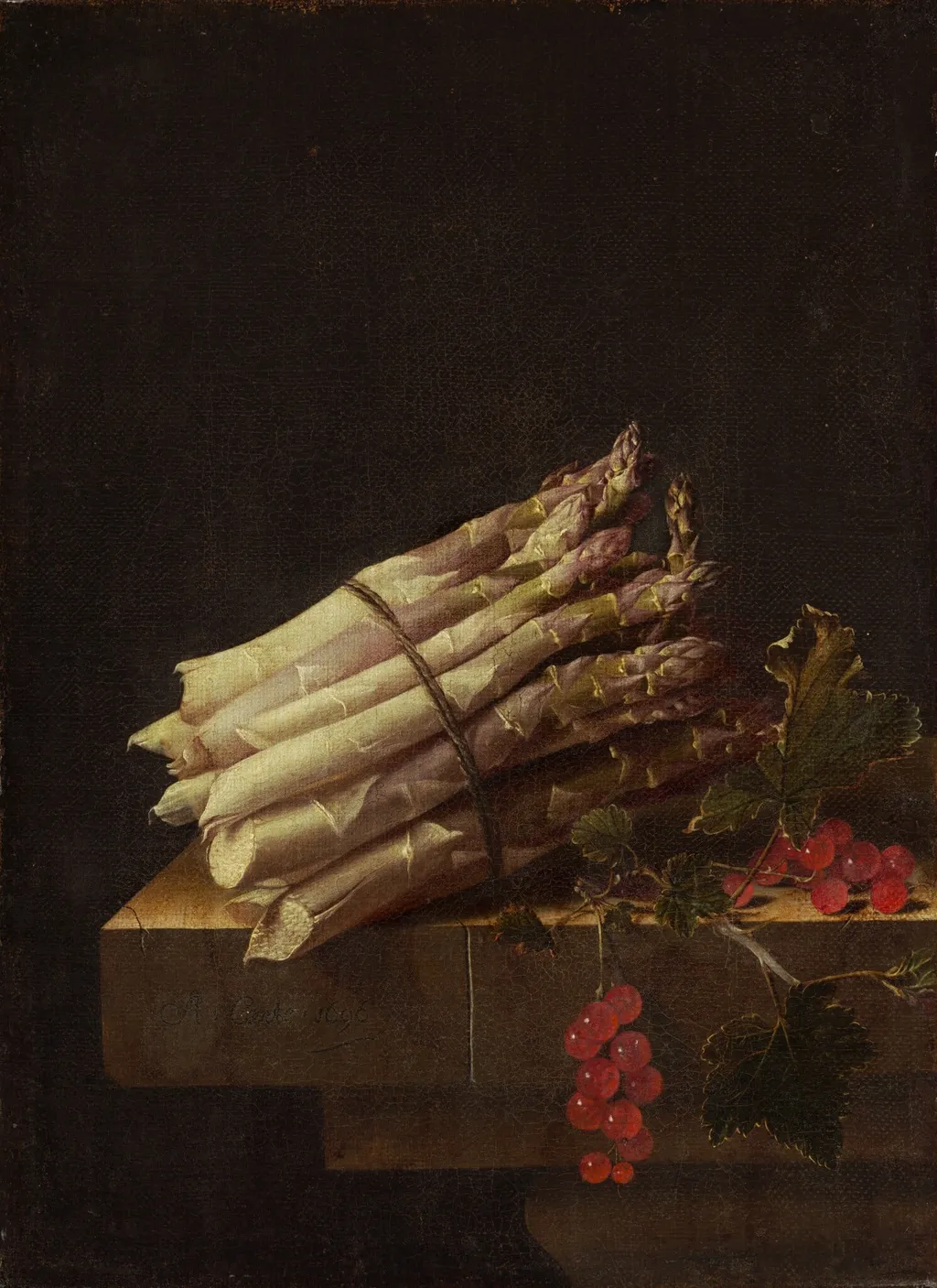
Still Life with Asparagus and Red Currants is an oil painting by the Baroque artist Adriaen Coorte. It dates from 1696 and is held in the collection of the National Gallery of Art.
- Inscription
- Inscribed:lower left on front of ledge in black paint: A. Coorte. 1696; on reverse: two circular red seals removed from previous stretcher and set into current stretcher, on each, “IRENE” under a crown, and large, embossed fabric monogram on a piece of fabric that may have been cut from a previous lining fabric, under a crown, ornately intertwined letters, possibly “IBK”
About this work
Technique & Style
The painting’s condition appears stable, with no significant losses or abrasions reported in recent records.
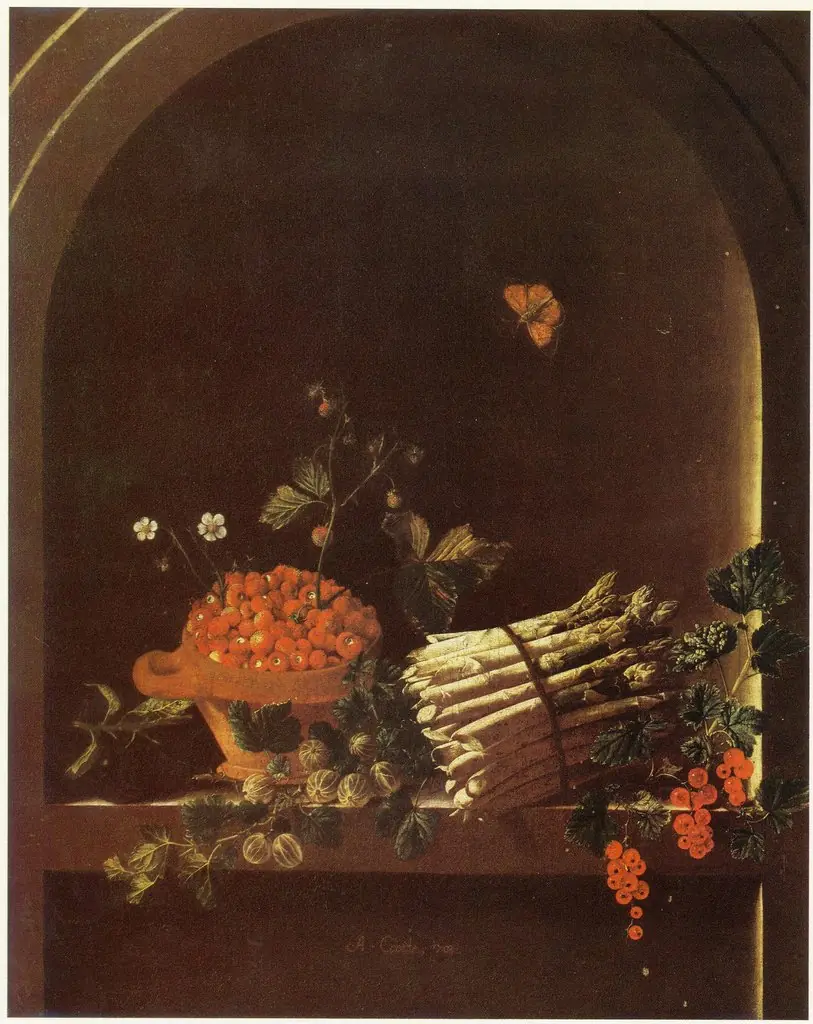
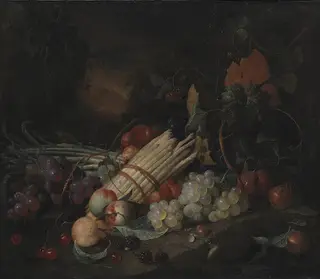
Executed in oil on canvas in 1696, Still Life with Asparagus and Red Currants measures 34 × 25 cm and exemplifies Coorte’s restrained handling of still-life subjects. The composition is tightly focused, with slender asparagus stalks arranged diagonally across the lower half and clusters of red currants placed centrally, their translucent berries catching light against the dark background. Coorte’s technique emphasizes delicate modeling through subtle glazing and delicate impasto on the berries, while the asparagus is rendered with fine, linear precision.
The palette is muted, punctuated by the bright reds of the currants, creating a quiet yet luminous effect. The painting’s condition appears stable, with no significant losses or abrasions reported in recent records.
History & Provenance
Still Life with Asparagus and Red Currants was painted by Adriaen Coorte in 1696, as recorded in contemporary documentation. The work first appeared in the collection of Baroness Irene von der Becke‑Klüchtzner, who listed it as the property of a gentleman. It was sold at Christie, Manson & Woods in London on 8 July 1977 (lot 84) and subsequently handled by the David Koetser Gallery in Zurich, entering a private collection before the National Gallery of Art acquired it on 7 October 2002. The painting’s creation date derives from the artist’s dated oeuvre and the 1696 inscription noted in catalogues.
Adriaen Coorte's Still Life with Asparagus and Red Currants (1696) is held in the collection of the National Gallery of Art in Washington, D.C. The museum acquired the oil-on-canvas painting on October 7, 2002, following its purchase from the David Koetser Gallery in Zurich. Prior to entering the NGA, the work passed through several private hands, including a sale at Christie, Manson & Woods in London on July 8, 1977, where it was listed as property of a gentleman. It was previously associated with Baroness Irene von der Becke-Klüchtzner.
While the National Gallery of Art currently lists the work in its holdings, the provided sources do not document a specific exhibition history or record of public display dates for this piece.
Overview
Adriaen Coorte's 'Still Life with Asparagus and Red Currants,' executed in 1696, is a quintessential example of his mature style within the Dutch Golden Age. The composition features a sparse arrangement of green asparagus spears and a cluster of red currants set against a uniform, dark ground. Coorte isolates these humble subjects, eliminating traditional table surfaces or elaborate props to focus entirely on the forms and textures of the produce.
The asparagus is rendered with precise attention to its fibrous structure and fresh appearance, while the currants are depicted with a luminous quality that suggests translucency and moisture. Painted in oil on canvas, the work demonstrates Coorte's mastery of light and his ability to elevate everyday items through rigorous observation. Created during a period when the artist was producing some of his most refined and intimate works, this painting reflects his unique departure from the opulent still lifes of his contemporaries.
Instead of abundance, Coorte offers a meditative study of simplicity, where the quiet presence of the objects invites close inspection. The work stands as a significant testament to his career-long dedication to the monochromatic background and the poetic potential of minimal subject matter.
Subject & Meaning
The artwork meticulously renders a handful of vibrant green asparagus spears alongside a small cluster of glistening red currants. These elements are presented in isolation, contrasting sharply with the plain, dark background. Coorte frequently chose to depict individual items or small groupings of produce, emphasizing their inherent beauty and texture. The composition invites close observation of the natural forms and subtle light effects on the surfaces.
Context
This painting aligns with the rich tradition of Dutch still life painting from the 17th century, a genre that often celebrated everyday objects and natural bounty. While Coorte's work shares a lineage with these artists, his particular emphasis on isolated, humble subjects and a restrained palette distinguishes his contribution. His compositions offer a contemplative perspective on the transient beauty of nature.
Own this work as a print
Artist & collection
Artist
Adriaen Coorte (ca. 1665 – after 1707) was a Dutch Golden Age painter of still lifes, who signed works between 1683 and 1707. He painted small and unpretentious still lifes in a style more typical of the first half of…