Artwork
Minerva Standing
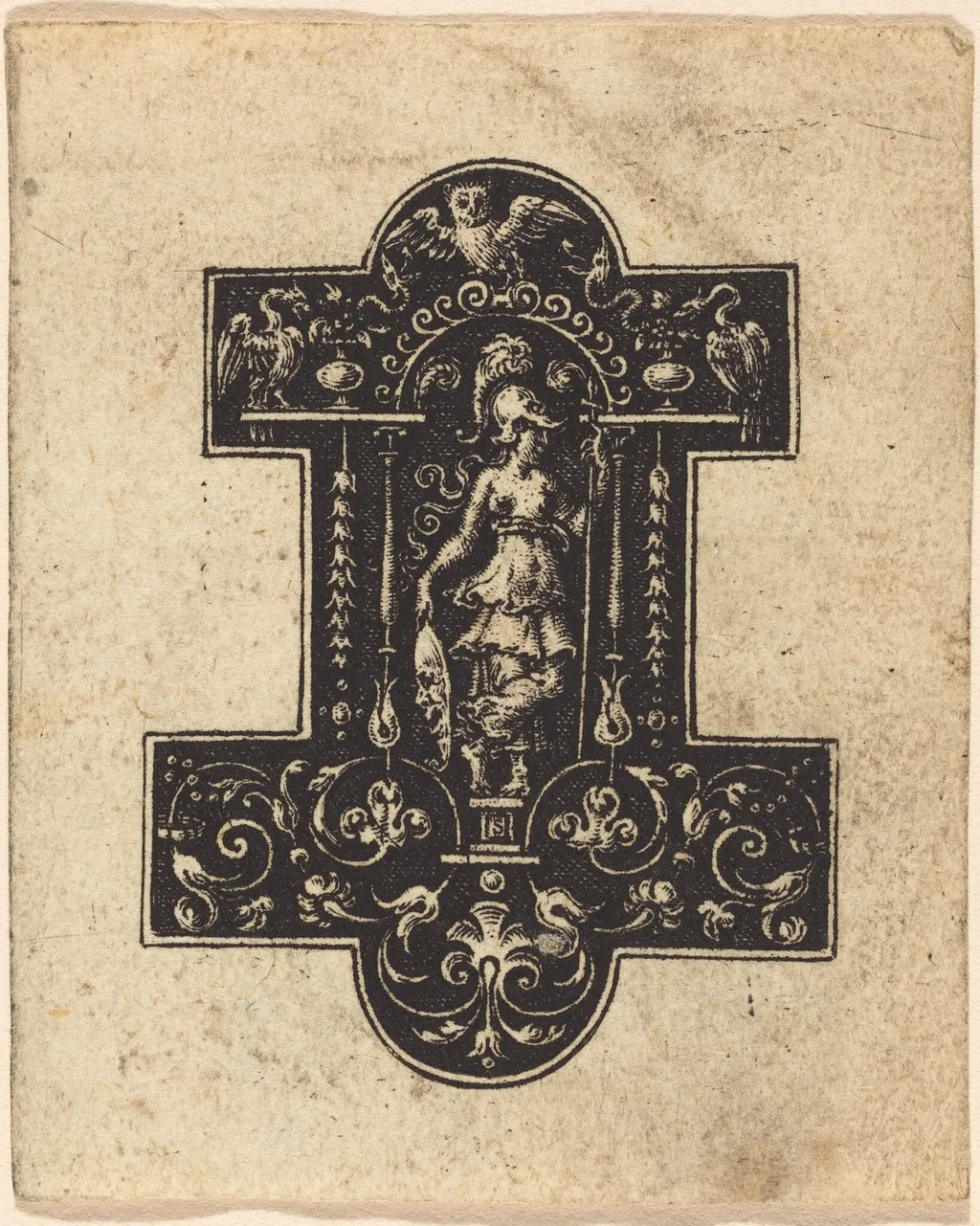
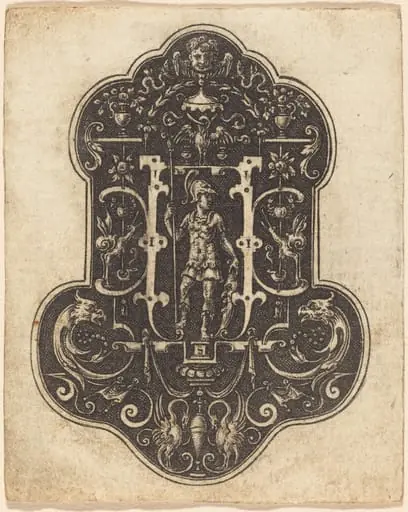
Minerva Standing is an ink print by the Renaissance artist Etienne Delaune. It dates from 1551 and is held in the collection of the National Gallery of Art.
About this work
Overview
The composition centers Minerva, who is clad in classical armor, including a crested helmet, and holds a spear in her right hand and a shield in her left.
Etienne Delaune's 'Minerva Standing' is a 1551 engraving depicting the Roman goddess of wisdom in a full-length, frontal pose. The composition centers Minerva, who is clad in classical armor, including a crested helmet, and holds a spear in her right hand and a shield in her left. The figure is framed within a distinct cross-shaped cartouche, a format Delaune frequently employed for his mythological and allegorical subjects.
The background and surrounding borders are filled with intricate strapwork and ornamental motifs characteristic of the French Renaissance style. Delaune, a prominent goldsmith and engraver active in Paris, produced this work during a period when he was refining his distinctive linear style, which combined precise draftsmanship with elaborate decorative elements. This piece exemplifies his contribution to the dissemination of mythological imagery through print, serving both as an artistic study and a model for decorative arts.
The engraving demonstrates the artist's mastery of line to create volume and texture without the use of color, relying on the density and direction of hatching to define the armor and drapery.
Subject & Meaning
The figure embodies Minerva, the patron of wisdom and strategic warfare, identifiable by her classical helmet, shield, and spear. Her confident posture and ready weapons convey both intellectual authority and martial readiness, reflecting the dual aspects of the goddess in Roman mythology.
Technique & Style
Executed with fine incised lines, the engraving showcases Delaune’s skill in rendering texture and depth on a flat surface. The intricate hatching creates subtle tonal variations, while the geometric cross background imposes a sense of order and balance typical of Renaissance print aesthetics.
History & Provenance
Created in 1551, the work belongs to Delaune’s early period, when he was active in Paris producing ornamental designs for metalwork and book illustrations. Surviving copies are held in several European print collections, attesting to the print’s circulation among connoisseurs of mythological imagery during the Renaissance.
Own this work as a print
Artist & collection


- Diana Standing
 Judith with the Head of Holofernes
 Female Figure
 Head of Medusa
 Mars
Mars Mercury with the Head of Argus
 Large Pendant, Three Nude Women with Twigs at Centre
 Large Pendant, Charity Standing at Centre
 Large Pendant, Faith Standing at Centre
 Brooch with Sprigs at Top and Griffins with Trophies at Bottom