Artwork
Title Page
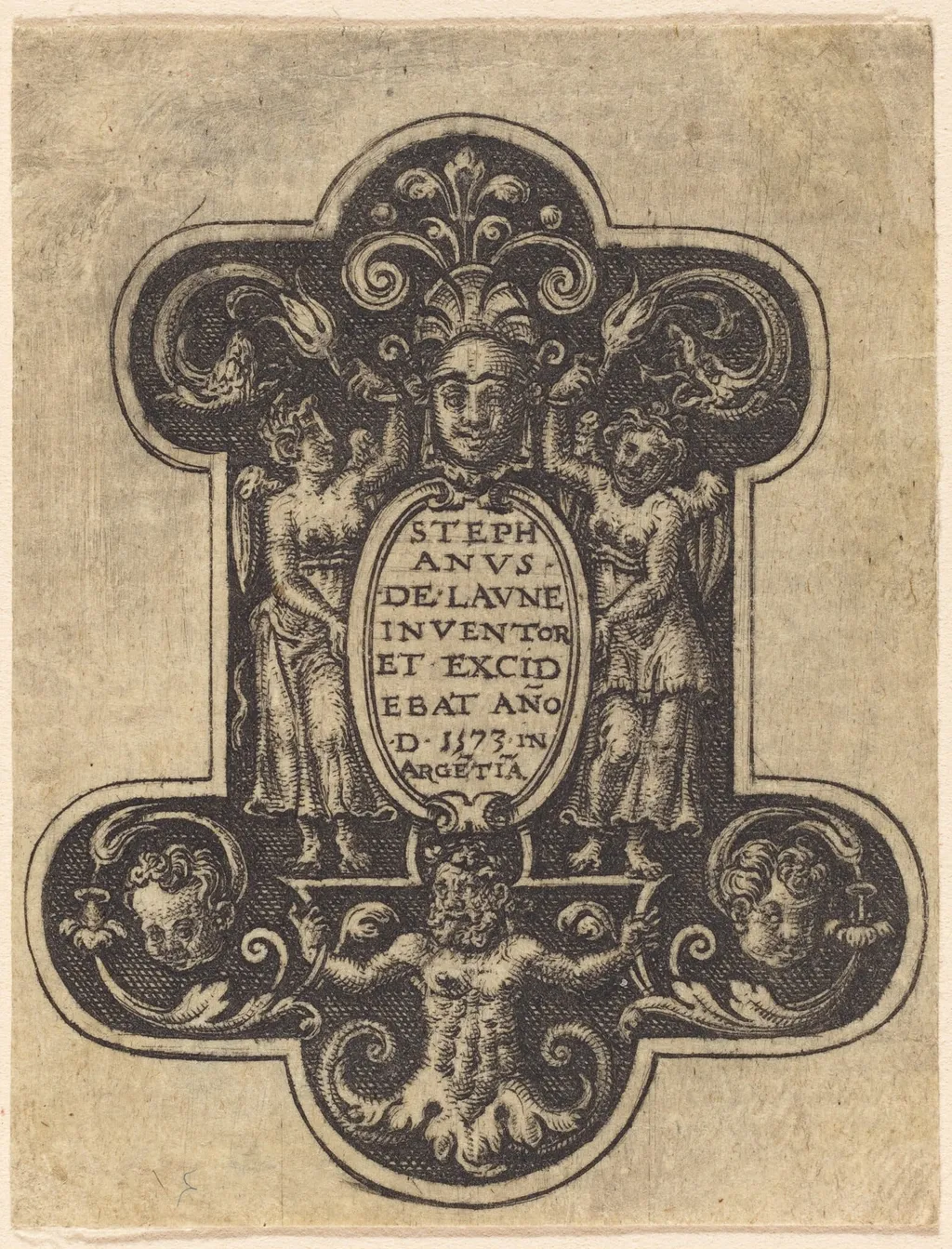
Title Page is an ink print by the Renaissance artist Etienne Delaune. It dates from 1551 and is held in the collection of the National Gallery of Art.
About this work
" On either side of the plaque stand two muscular, draped figures, one holding a scroll, the other a staff.
This image is a black-and-white engraving framed like a shield. At the center is a round plaque with old-style writing: "Stephanus de Laune inventor et excid ebat anno D. 1573 in Argentia." On either side of the plaque stand two muscular, draped figures, one holding a scroll, the other a staff.
Above them is a fancy crown of leaves and swirls, and below, more ornate designs fill the corners.
The text on the plaque names the artist, Etienne Delaune, and the year 1573. This kind of detailed, symbolic imagery was common in Renaissance art to show skill and status.
Next, look up engraving to see how artists like Delaune created intricate prints like this one.
Overview
This black-and-white engraving, created by Étienne Delaune in 1573, functions as a title page with the formal structure of a heraldic shield. At its core is a circular inscription naming the artist and the date of execution. Flanking the central plaque are two allegorical figures, their drapery and posture suggesting classical influence.
Above and below, elaborate ornamentation frames the composition, reinforcing its role as a marker of authorship and craftsmanship within printed works of the period.
Subject & Meaning
The two standing figures likely represent the arts of writing and authority, one holding a scroll, the other a staff, symbolizing intellectual and institutional power. The leafy crown above evokes victory or scholarly distinction, while the ornamental borders reflect Renaissance ideals of order and refinement. The inscription serves not merely as attribution but as a declaration of the artist’s role as creator and master of his medium, aligning printmaking with the elevated status of fine art.
Technique & Style
Executed in fine-line engraving, the work demonstrates Delaune’s precision in rendering texture and form through controlled incisions. The figures and decorative elements are rendered with meticulous detail, characteristic of French Mannerist printmaking. The use of symmetry, stylized drapery, and dense ornamentation reflects the influence of Italian Renaissance design, adapted to the demands of the printed page and the expectations of scholarly audiences.
History & Provenance
Created in 1573 in Strasbourg, then a center of printing and humanist culture, this plate was likely produced as the frontispiece for a published work. Delaune, trained in France and active in the imperial court, often designed prints for books and medals. The inscription confirms his dual role as inventor and engraver, a common practice among artists who controlled both design and production in the early print trade.
Context
In the mid-16th century, engraved title pages became a means for printers and authors to assert cultural legitimacy. Delaune’s design aligns with broader trends in Northern European print culture, where classical motifs and symbolic figures were used to elevate printed texts. His work bridges the gap between manuscript illumination and mass-produced imagery, reflecting the growing prestige of the printed word in scholarly and courtly circles.
Legacy
Delaune’s title page exemplifies how engravers shaped the visual identity of printed books during the Renaissance. His integration of heraldic composition and allegorical figures influenced later book design across Europe. Though primarily known for medals and decorative prints, this work underscores his role in establishing printmaking as a disciplined art form capable of conveying intellectual authority through visual language.
Own this work as a print
Artist & collection