Artwork
The Breakers
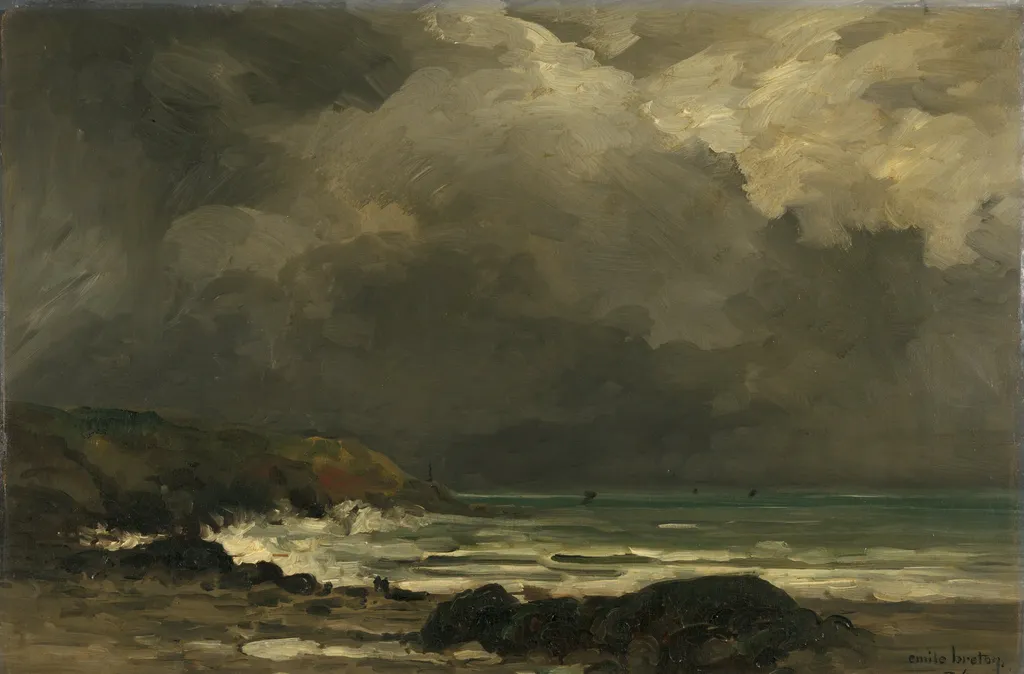
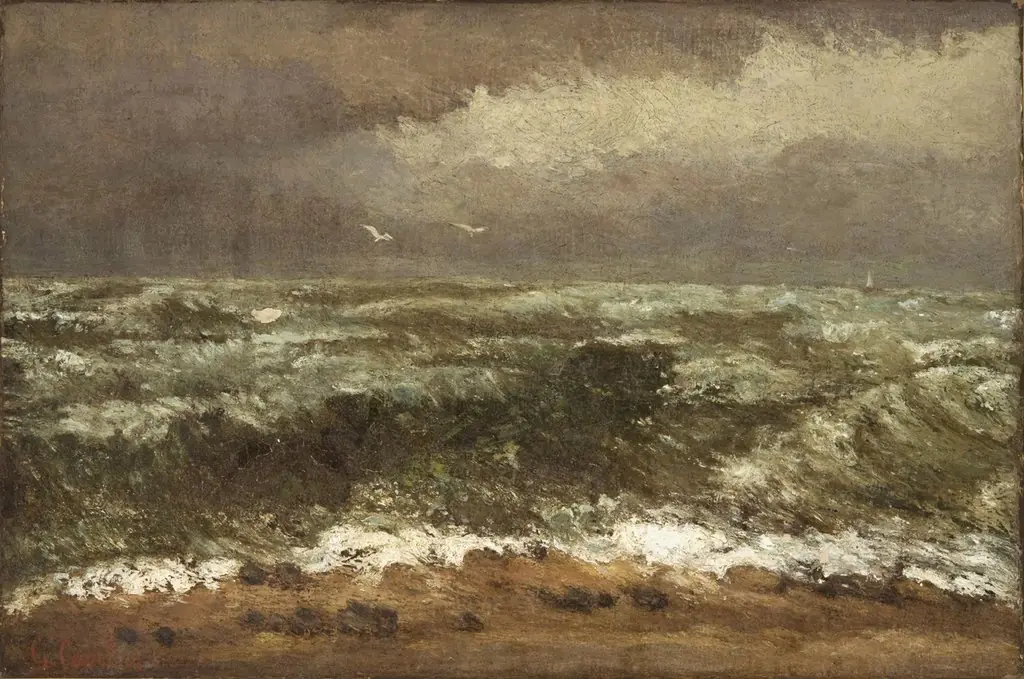
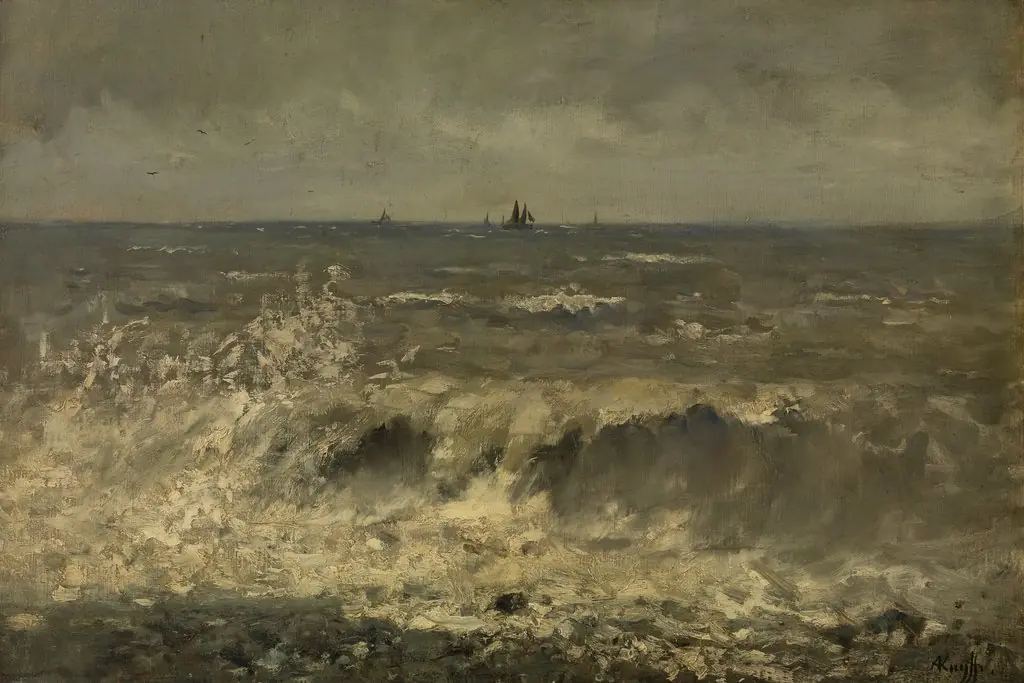
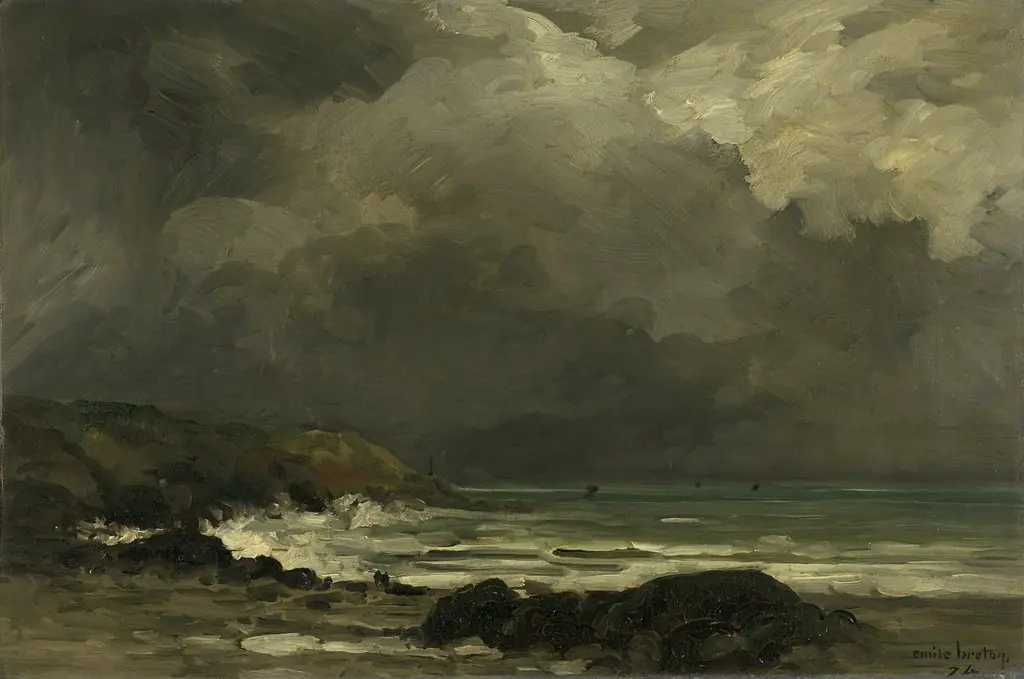
The Breakers is an unspecified painting by the Barbizon school artist Emile Adélard Breton. It dates from 1874 and is held in the collection of the Rijksmuseum.
About this work
The Rijksmuseum thinks it might be a study, not a finished work, which explains why no one signed it.
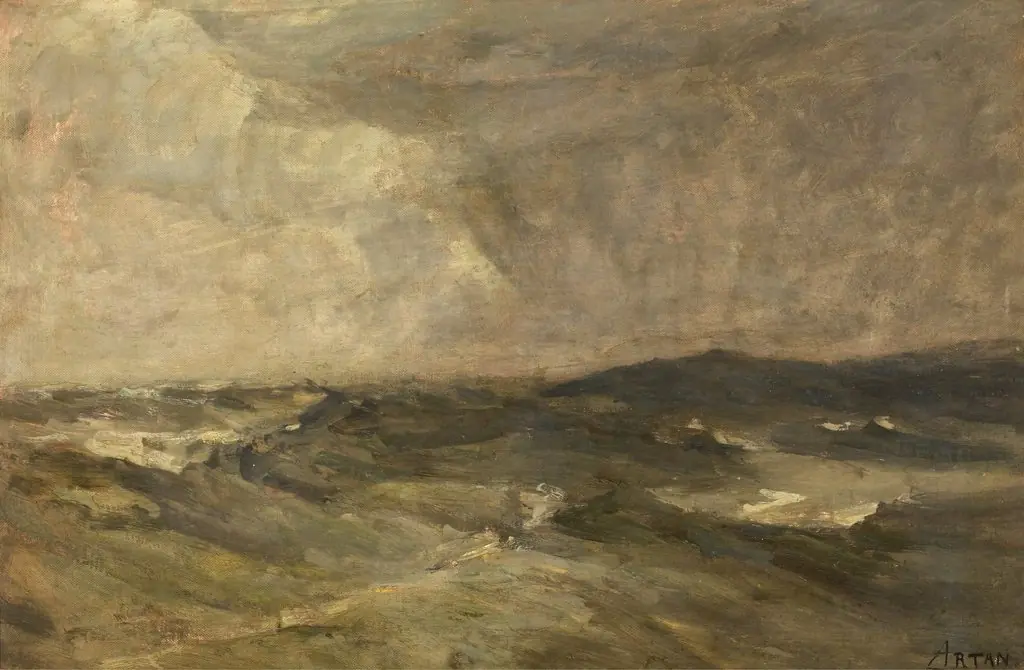
You see waves crashing against dark, jagged rocks under a stormy sky.
This painting was made in 1874, when artists often worked in studios, not outdoors. Yet the foam and spray feel real, as if the painter stood right there in the wind. The Rijksmuseum thinks it might be a study, not a finished work, which explains why no one signed it.
To see more waves like this, look up the Rijksmuseum’s seascapes.
Technique & Style
Émile Adélard Breton's painting The Breakers (1874) is an oil on canvas landscape depicting a nocturnal scene with a low horizon, heavy cloud cover, and a restricted compositional space. The work features a wintery atmosphere with snow-covered ground, dark forests, and faint village lights emerging through night, evoking a sense of melancholy and stillness. Breton employs a restrained palette of rich, somber tones to convey a desolate, almost theatrical mood, emphasizing the interplay of light and shadow across the landscape. The handling of the medium demonstrates a controlled, layered application characteristic of his mature style, focusing on atmospheric depth rather than detailed figuration.
The painting's condition and formal qualities reflect Breton's technique of confining his subjects within tight, enclosed frames to achieve a dramatic, tragic effect, as noted in contemporary critiques of his approach to landscape painting.
History & Provenance
Émile Adélard Breton painted The Breakers in 1874. The work is classified as a painting and belongs to the landscape genre. Breton, a French painter and engraver (1831-1902), was known for moody nocturnal landscapes with figures. He began exhibiting at the Salon in 1861, won medals in 1866-1868, received a first-class medal at the 1878 Exposition Universelle, and was awarded a gold medal at the 1889 Exposition Universelle. He was named a Knight in the Legion of Honor following the 1878 exhibition. The painting’s creation history aligns with his broader practice of atmospheric, often nighttime landscapes, reflecting his military service during the Franco-Prussian War and his deep connection to rural French scenes. The Breakers thus represents a mature phase of his career, produced before his temporary withdrawal from painting after 1891.
Context
Émile Breton's work, including his 1874 painting The Breakers, was recognized for its distinct departure from the academic and naturalist styles of his brother Jules. Critics characterized his approach as dreamlike and melancholic, often restricting the composition to narrow, dark frames where human figures appear merely as silhouettes against dramatic skies. Writing on the Salon of 1869, Théophile Gauthier praised Breton for capturing nature at singular moments, noting the audacious realism of his cloud formations and lighting.
By the Salon of 1874, reviewers observed that Breton sought tragic effects through simplicity, employing low, veiled skies and thick forests to create an atmosphere of powerful desolation. His style, heavily influenced by his military service during the Franco-Prussian War, frequently depicted autumnal or winter scenes marked by orange glows piercing through darkness. Scholarship suggests his art successfully resisted the sentimental mysticism associated with his brother's oeuvre, establishing a unique position within the French landscape tradition.
Own this work as a print
Artist & collection

Artist
Émile Adélard Breton (8 March 1831, Courrières – 24 November 1902, Courrières) was a French painter and engraver; best known for his moody nocturnal landscapes with figures.