Artwork
Autopsy
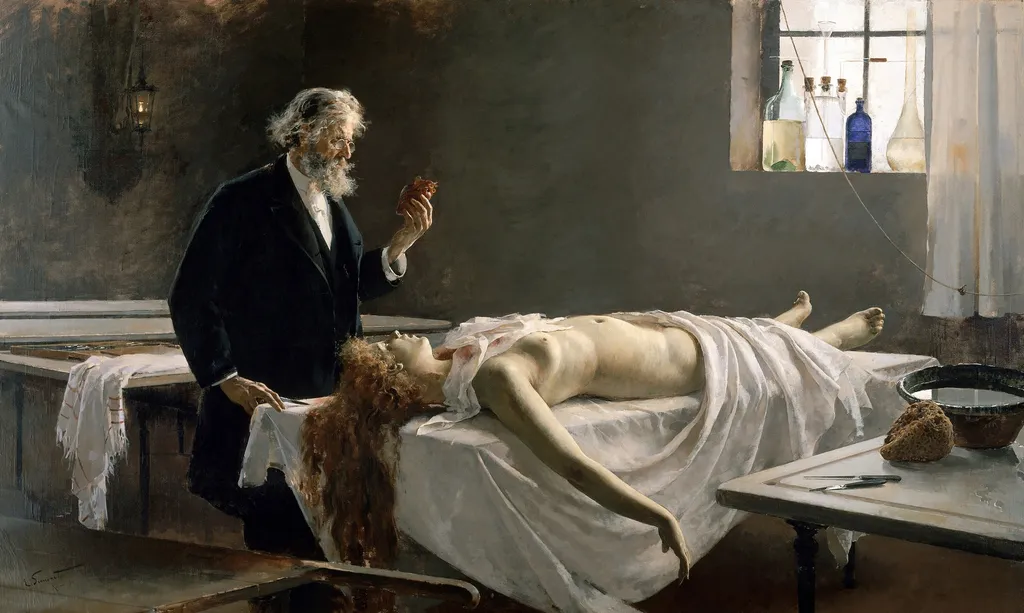
Autopsy is an oil painting by the Post-Impressionist artist Enrique Simonet. It dates from 1896 and is held in the collection of the Museo del Prado.
About this work
Subject & Meaning
The painting exemplifies the 19th-century scientistic movement, using realistic anatomical detail to explore themes of life, death, and social judgment.
Enrique Simonet's 1890 painting, Autopsy (also known as And It Had a Heart or Anatomy of the Heart), depicts a forensic physician performing an autopsy on a young woman's corpse. The scene centers on the doctor lifting the woman's heart, surrounded by scientific instruments, a scalpel, and a sponge. The composition is characterized by stark lighting that highlights the pale skin of the deceased against a dark, neutral background.
The work is widely interpreted as a commentary on the intersection of science and humanity, challenging the assumption that a woman perceived as a prostitute could possess a moral heart. According to tradition, the model for the deceased was a young actress who died by suicide due to unrequited love, while the elderly physician was modeled after a beggar Simonet encountered in Rome. The painting exemplifies the 19th-century scientistic movement, using realistic anatomical detail to explore themes of life, death, and social judgment.
Technique & Style
The work Autopsy (1890) is an oil on canvas painting measuring 177 × 291 cm. Simonet employed oil paint to achieve a highly detailed, almost photographic rendering of a forensic examination, emphasizing precise anatomical structures and the pallid skin illuminated against a dark, neutral background. The composition showcases a physician grasping a heart while a corpse lies on a table, rendered with meticulous brushwork that conveys texture of hair and fabric. Light is used starkly to highlight the subject, creating dramatic contrast.
The painting’s formal qualities align with the scientific realism of the late nineteenth century, reflecting the era’s fascination with anatomical inquiry.
History & Provenance
Enrique Simonet created the oil painting Autopsy (also known as ¡Y tenía corazón! or Anatomía del corazón) in 1890 while staying in Rome. The work was produced during his tenure as a pensioner at the Spanish Academy of Fine Arts in Rome, a position he held from 1888 to 1931. Following its creation, the painting entered the collection of the Museo de Arte Moderno in Madrid.
On February 13, 1931, the Madrid institution transferred the work to the Museum of Fine Arts of Málaga, now known as the Museo de Málaga, where it has remained since.
Enrique Simonet's Autopsy (1890) is currently held by the Museo de Málaga (formerly the Museo de Bellas Artes de Málaga). The work was originally transferred from the Museo de Arte Moderno in Madrid to the Málaga museum on February 13, 1931, where it has remained since. Although the Museo del Prado lists the painting in its collection records, the physical location and custodianship belong to the Málaga institution.
The artwork has traveled for various exhibitions, including appearances at medical colloquies due to its anatomical subject matter and shows held outside of Spain.
Context
Enrique Simonet's Autopsy (1890), created during his tenure as a pensioner at the Spanish Academy of Fine Arts in Rome, is frequently categorized within the cientifist current that dominated the nineteenth century rather than strict social realism. The work reflects the era's scientific interest in using autopsies to investigate and cure diseases, a theme that led the painting to be exhibited at medical colloquies and international exhibitions. Art historical analysis emphasizes its dramatic use of light, which highlights the pale skin of the subject against a neutral dark background, alongside its precise anatomical rendering.
The composition, depicting a physician extracting a heart from a female corpse, has secured the piece a prominent place in Spanish art history as a significant example of the intersection between medical inquiry and artistic representation.
Legacy
Since its completion, Autopsy has been repeatedly mobilized outside fine-art circuits for medical and scientific contexts, lending it an enduring interdisciplinary reputation. Medical colloquia and exhibitions have featured the painting, capitalizing on its anatomically detailed depiction of cardiac dissection and its nineteenth-century scientistic associations. Within Spain, the work’s status has grown through loans and special displays, including presentations at the Museo del Prado intended to highlight emblematic holdings from regional museums.
Its technical precision and stark lighting have been repeatedly noted, reinforcing its legacy as a paradigm of nineteenth-century realism oriented toward empirical inquiry rather than purely aesthetic ends.
Overview
Enrique Simonet's 1896 oil painting, Autopsy, presents a somber scene of medical investigation. This work, executed in oil, captures a moment of intense focus within a laboratory setting. It is currently housed in the collection of the Museo del Prado, where it represents a significant example of late 19th-century Spanish academic painting.
Own this work as a print
Artist & collection