Artwork
Cinder clearance
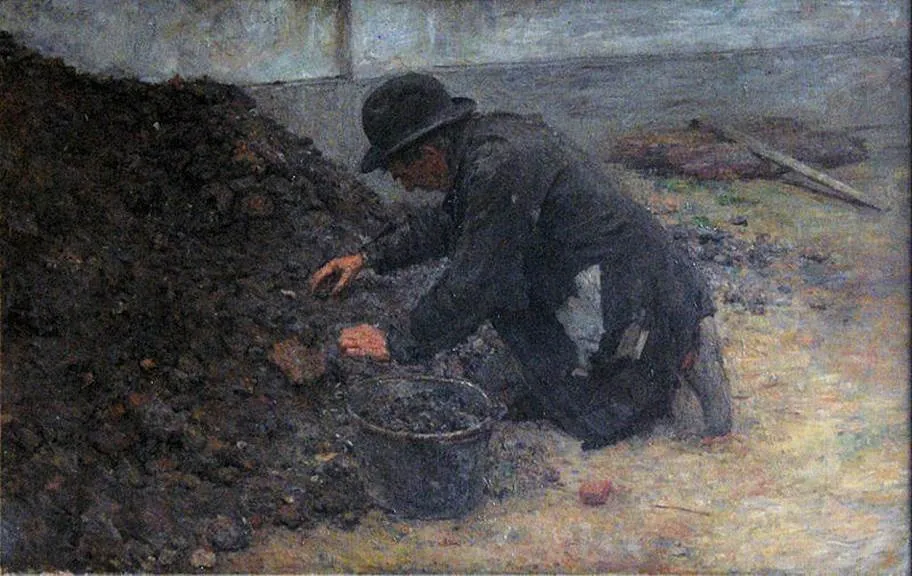
Cinder clearance is an oil painting by the Realist artist Evert Larock. It dates from 1900 and is held in the collection of the Royal Museums of Fine Arts of Belgium.
About this work
Subject & Meaning
The composition focuses on the man's hands, highlighted by a touch of color, as they perform the slow, careful gesture of sorting through refuse to avoid burns.
The painting depicts a man kneeling beside a deposit of combustion waste, meticulously selecting small fragments of coal from the ash and placing them into a copper pot. The figure, described as one of the disenfranchised of industrial society, survives on the margins by scavenging discarded materials. The composition focuses on the man's hands, highlighted by a touch of color, as they perform the slow, careful gesture of sorting through refuse to avoid burns.
Symbolically, the work represents the harsh realities of the industrial age and the plight of the poor who depend on production waste for survival. Executed with a sober, earthy, and muted palette, the image serves as a social realist critique, denouncing the injustices of industrial society and highlighting deep social inequalities in late 19th-century Belgium.
Technique & Style
Executed in 1900, this work is an oil painting on canvas measuring 70 by 110.5 cm. The artist employed a sober, earthy, and muted color palette to render the scene. Visually, the composition focuses on a kneeling figure, largely indistinct against a background of arid ground and combustion waste, who meticulously sifts through ash to collect coal fragments in a copper pot. The central focus rests on the hands, highlighted by subtle touches of color, capturing a slow and prudent gesture intended to avoid burns.
Stylistically, the piece exemplifies social realism, utilizing these formal qualities to depict the marginalization of industrial workers and highlight societal inequalities through the depiction of scavenged materials.
History & Provenance
"Cinder clearance" is an oil painting on canvas created by the Belgian artist Evert Larock in 1900, measuring 70 cm in height by 110.5 cm in width.
The work was first publicly exhibited in 1901 at the Exposition 1901 in Antwerp, where it was catalogued as number 28 in the official catalogue. It subsequently appeared in several retrospective and thematic exhibitions devoted to Larock and to Belgian social realism, including the 1937 memorial exhibition "Evert Larock. Herdenking" in Kapelle-op-den-Bos (catalogue no. 36), the 1943–1944 "Rétrospective Evert Larock (1865–1901)" in Brussels (catalogue no. 4), and the 1952 group show "De arbeid in de kunst van Meunier tot Permeke" in Antwerp (catalogue no. 47).
Later showings included the 1979 Berlin exhibition "Arbeit und Alltag: Soziale Wirklichkeit in der belgischen Kunst, 1830–1914," the 1980 "Art et société en Belgique: 1848–1914" in Charleroi, and the 1991–1992 Vatican presentation "Il lavoro dell'uomo da Goya a Kandinskij."
The painting is now held in the collection of the Royal Museums of Fine Arts of Belgium, on display at the Fin-de-Siècle Museum.
The painting Cinder clearance is held by the Royal Museums of Fine Arts of Belgium, specifically within the Fin-de-Siècle Museum in Brussels. The work was created by Evert Larock in 1900 and depicts a figure gathering coal fragments from ash. The piece has been featured in numerous exhibitions since the early 20th century.
It appeared in the 1901 Exposition in Antwerp and was included in the 1937 commemorative exhibition in Kapelle-op-den-Bos. A retrospective in Brussels during 1943–1944 showcased the work, followed by its inclusion in the 1952 Antwerp exhibition on labor in art. Later displays included the 1979 Berlin exhibition on Belgian social reality, the 1980 Charleroi show on art and society, and the 1985–1986 Antwerp retrospective.
The painting also traveled to the Vatican for the 1991–1992 exhibition on human labor from Goya to Kandinsky.
Context
The painting Cinder clearance (1900) by Evert Larock was created during the emergence of social realism in Belgium, a movement that highlighted industrial class disparities through depictions of laborers and discarded materials. It portrays a marginalized worker sifting through coal ash, emphasizing tactile detail in the hands amid a somber palette of earth tones. The work was exhibited early in its history at the 1901 Antwerp exhibition (catalogue n.
28) and later featured in retrospectives in Brussels (1943–1944) and Antwerp (1985–1986). Its thematic focus on social injustice aligns with contemporary Belgian social realism, as noted in scholarly exhibitions such as Arbeit und Alltag: Soziale Wirklichkeit in der belgischen Kunst, 1830–1914 (1979).
Overview
Cinder clearance is a 1900 oil painting by Evert Larock, a Belgian artist associated with the Secessionist movements Als ik Kan and De XIII.
Artist & collection
Artist
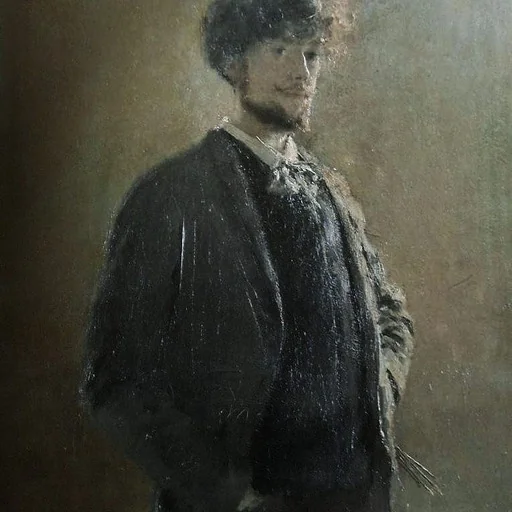
Everard Larock, known as Evert (21 May 1865 – 13 January 1901) was a Belgian Impressionist painter who belonged to the Secessionist art groups Als ik Kan and De XIII.

Museum
Royal Museums of Fine Arts of Belgium
Continue through works from the same source collection.