Artwork
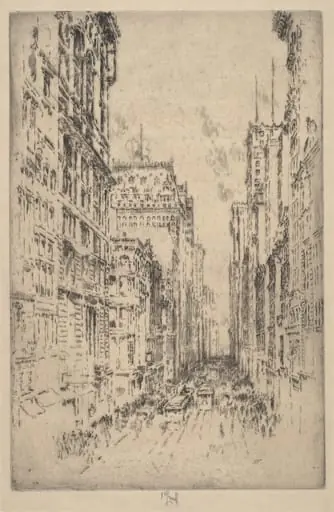
Fifth Avenue Building from Grace Church
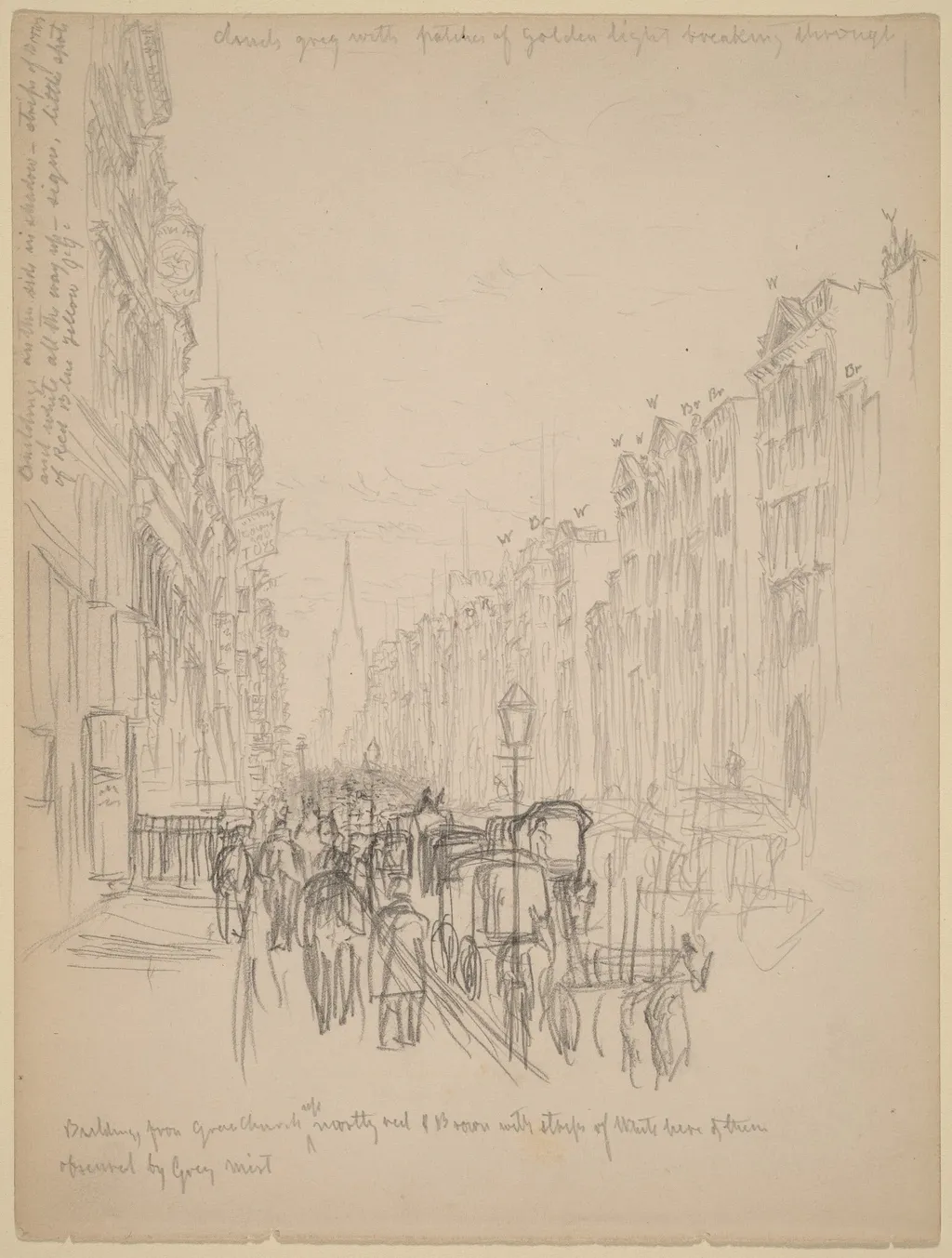
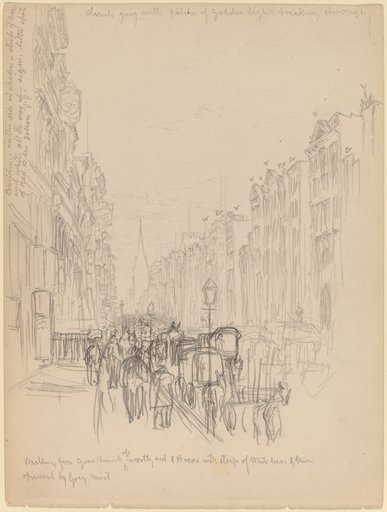
Fifth Avenue Building from Grace Church is a graphite drawing by the Romanticist artist Henry Farrer. It dates from 1873 and is held in the collection of the National Gallery of Art.
- Inscription
- Inscribed:across bottom in graphite: Buildings from Grace Church [not deciphered] mostly red & Brown with strips of White here & there / observed by gray mist; along upper left edge in graphite: Buildings on this side in shadow - strips of Brown / and white all the way up - signs, little spots / of Red Blue Yellow Gray; across upper edge in graphite: charcoal grey with patches of goldent light breaking through; lower left verso: 1862 3(reversed)
About this work
Overview
Created in 1873, this graphite drawing by Henry Farrer captures a view of a Fifth Avenue building as seen from near Grace Church. Executed on wove paper, the work belongs to a period when American artists increasingly turned to urban subjects. Its modest scale and medium reflect a personal, observational approach rather than a grand public commission.
Subject & Meaning
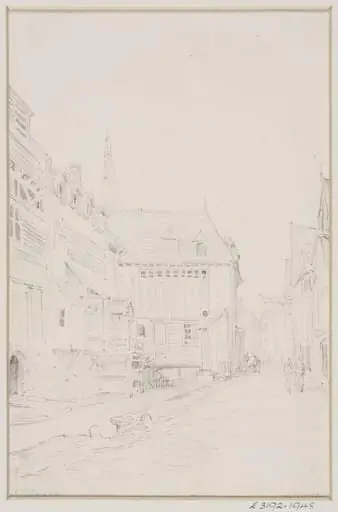
The drawing depicts a quiet streetscape dominated by a commercial or residential structure on Fifth Avenue, framed by the proximity of Grace Church. The absence of figures and the stillness of the scene suggest a contemplative mood, possibly reflecting the artist’s interest in the quiet transformation of New York’s urban fabric during the post-Civil War era.
Technique & Style
Farrer employed graphite with precision, using subtle tonal gradations to define architectural forms and atmospheric depth. The rendering emphasizes texture and structure over dramatic contrast, avoiding overt chiaroscuro in favor of a restrained, linear clarity. This method aligns with the topographical tradition of 19th-century American draftsmanship.
History & Provenance
The drawing was made during Farrer’s active years in New York, where he documented the city’s evolving architecture. It remained in private hands until acquired by a major American museum in the 20th century. Its survival in good condition offers insight into the artist’s practice outside his more widely known watercolors.
Context
In the 1870s, New York was rapidly expanding, with new buildings rising alongside older structures. Farrer’s focus on a single edifice near a prominent church reflects a broader interest among artists in recording the city’s architectural identity amid change, without overt commentary or idealization.
Legacy
Though not widely exhibited, this drawing contributes to the understanding of Farrer’s role as a keen observer of urban life. It stands as a quiet example of how American draftsmen documented the physical character of their cities, preserving details that later photographs would capture more mechanically.
Own this work as a print
Artist & collection