Artwork
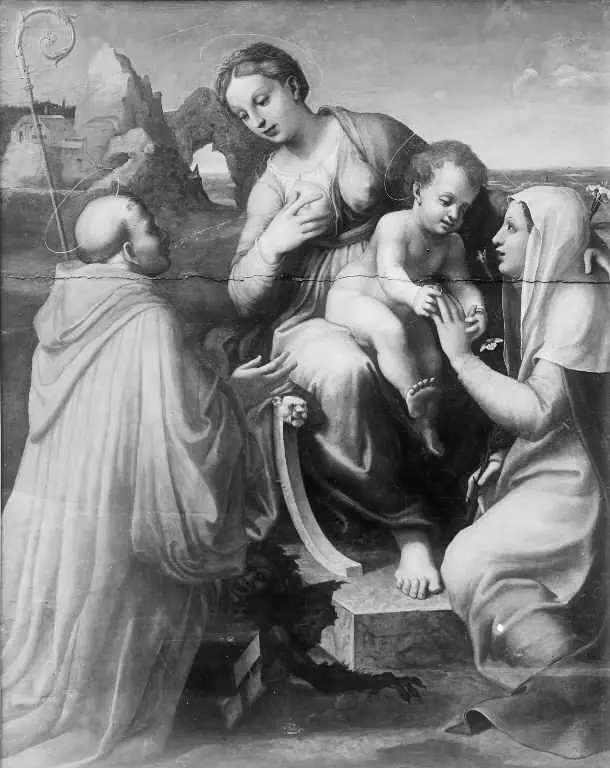
Madonna and Child with Saint Albert and Saint Catherine
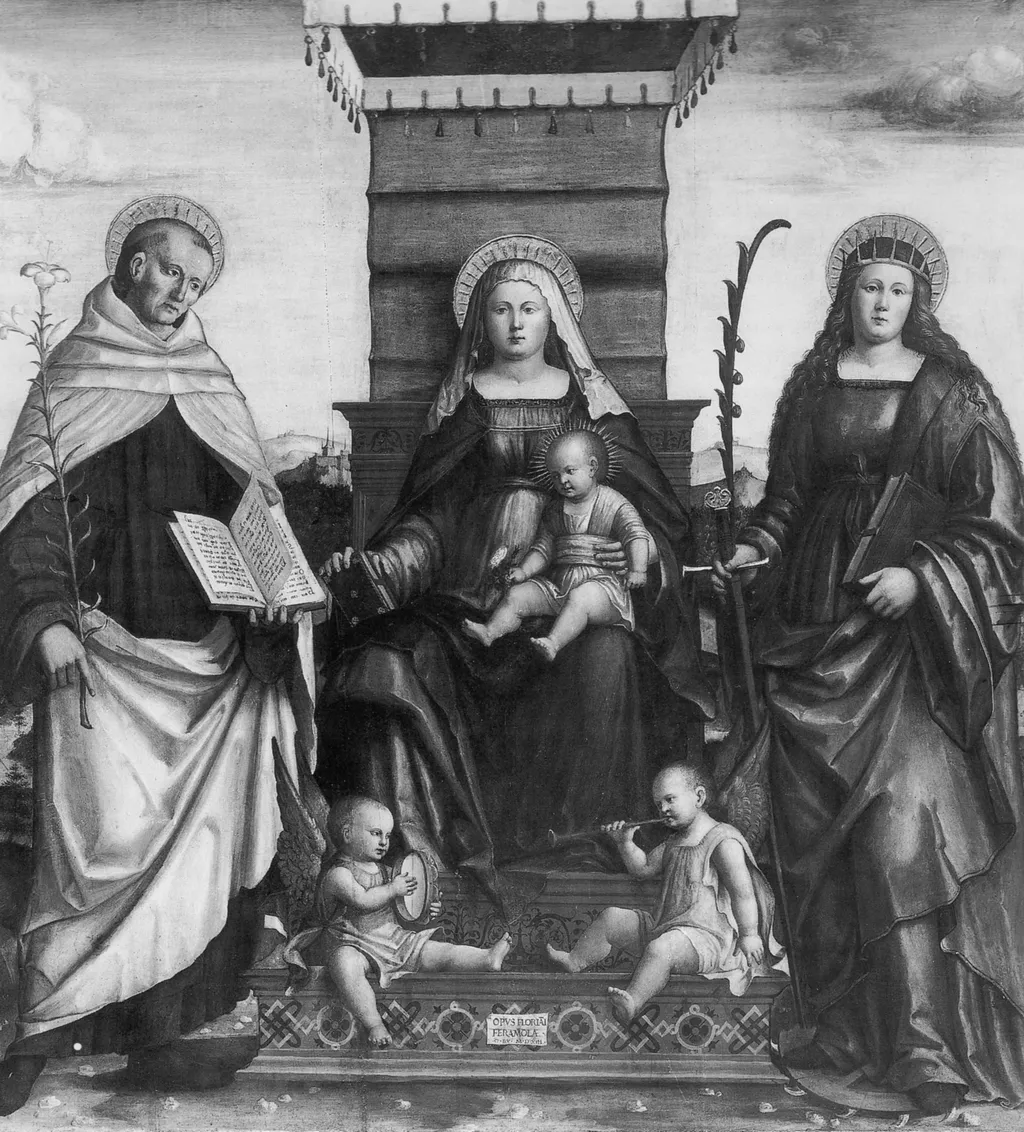
Madonna and Child with Saint Albert and Saint Catherine is an oil painting by the High Renaissance artist Floriano Ferramola. It dates from 1513 and is held in the collection of the Gemäldegalerie Berlin.
About this work
Subject & Meaning
The painting is a sacra conversazione, a devotional composition in which the Madonna and Christ Child share a unified space with attendant saints.
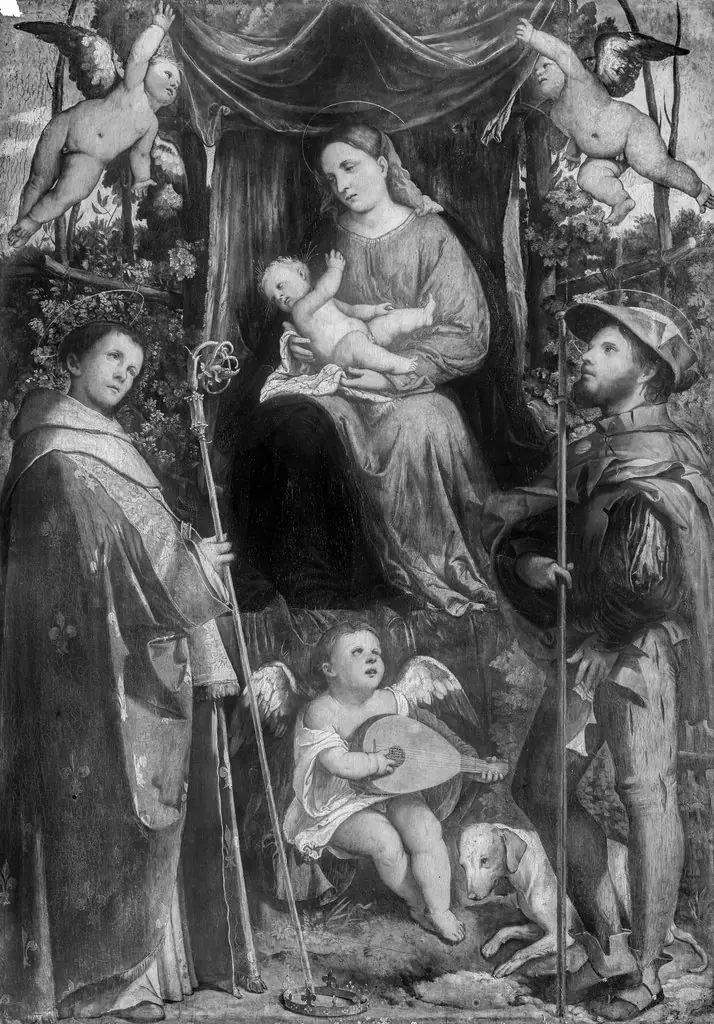
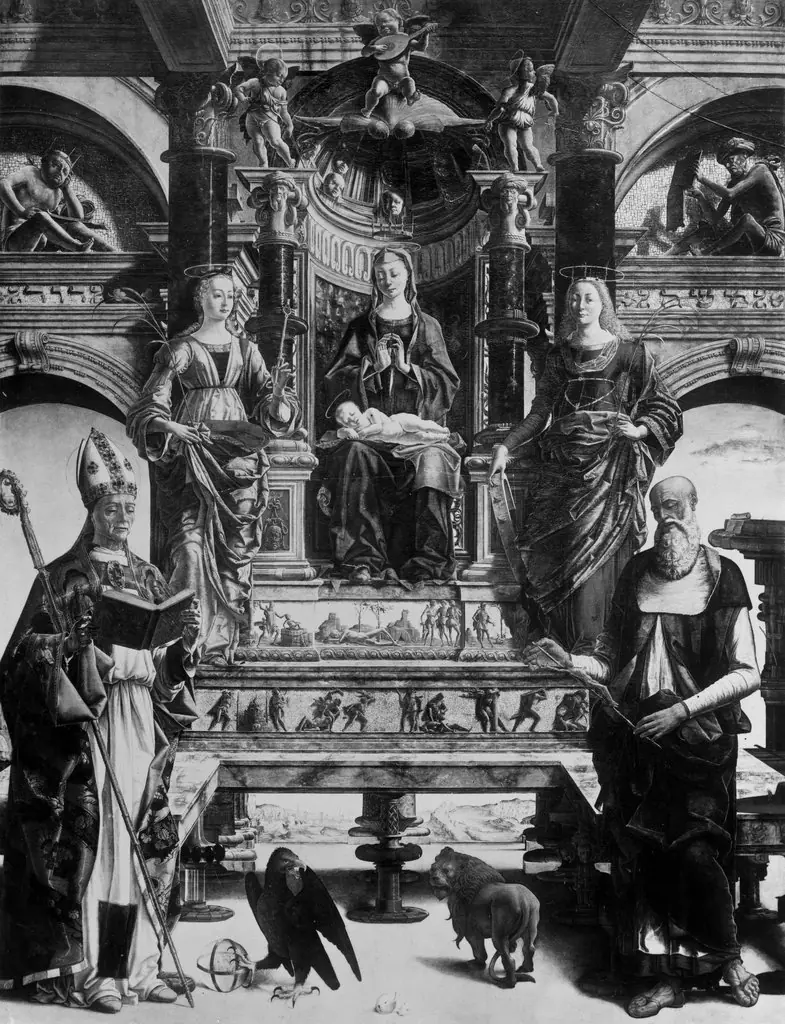
The painting is a sacra conversazione, a devotional composition in which the Madonna and Christ Child share a unified space with attendant saints. The Virgin is enthroned beneath a canopy with the Christ Child on her lap, flanked on the left by Albert of Trapani and on the right by Catherine of Alexandria, each identifiable through their personal iconographic attributes. The figures interact through exchanged gazes and gestures, while two musical putti sit on the throne's pedestal and scattered flowers and petals lie on the pavement. An expansive, hilly landscape opens behind the group, reinforcing the contemplative, sacred character of the encounter.
The work was created for the Paitoni chapel in the church of Santa Maria del Carmine in Brescia, and the presence of Albert of Trapani, a Carmelite saint, directly reflects that dedication, with Catherine of Alexandria as the companion patron.
Technique & Style
The work is executed in oil paint on a poplar wood panel, a construction typical of early 16th-century Lombard religious paintings. The surface shows yellowing and multiple paint losses, indicating the need for conservation treatment. The composition follows a sacra conversazione format, with the Madonna seated on a throne beneath a baldachin, the infant Christ held in her arms, and saints Albert of Trapani and Catherine of Alexandria positioned on either side, each identified by their traditional attributes.
Two musical putti rest on the throne’s pedestal while scattered flowers decorate the painted floor; a deep, hilly landscape recedes behind the figures. Stylistically, the piece marks Ferramola’s earliest securely dated work (1513) and demonstrates a blend of influences: the rigid composition recalls Vincenzo Foppa’s Stendardo di Orzinuovi, while the handling of angels and ornamental details shows connections to Giovanni Bellini and the later Lombard painter Altobello Melone. Subsequent scholarship has linked the work to the stylistic vocabularies of Vincenzo Civerchio, Bernardo Zenale, and the young Bernardino Luini, particularly in the modeling of figures and treatment of landscape.
History & Provenance
Commissioned for the Paitoni family chapel in the church of Santa Maria del Carmine in Brescia, this altarpiece was completed and signed by Floriano Ferramola in 1513. First documented in local guides by Francesco Paglia and Leonardo Cozzando during the late seventeenth century, the work later disappeared from civic records before resurfacing in the 1814 inventory of the Brescian collector Teodoro Lechi.
The painting subsequently entered the collection of the English banker Edward Solly, transferring to the Kaiser Friedrich Museum in Berlin in 1821. After a temporary relocation to Königsberg in 1837, it returned permanently to the Berlin museum in 1884. Although cited by scholars in the early twentieth century, the panel was presumed destroyed during the 1945 bombing of Berlin until Massimiliano Capella rediscovered it in the Bode-Museum storage facilities in 1996.
The painting is held in the collection of the Gemäldegalerie Berlin, located within the Bode Museum. Historically, the work entered the museum's predecessor institution via the Edward Solly collection in 1821. It was subsequently transferred to the Königsberg museum in 1837 before returning permanently to the Berlin collection in 1884.
Following World War II, the artwork was presumed destroyed during the bombing of Berlin and remained missing from public view for decades. It was rediscovered in 1996 by Massimiliano Capella within the museum's storage deposits. Despite its recovery, the panel has not been exhibited since its rediscovery and currently awaits conservation treatment to address yellowing varnish and paint loss.
Context
The 1513 Madonna and Child with Saint Albert and Saint Catherine serves as the earliest securely dated work by Floriano Ferramola, establishing a critical benchmark for reconstructing his artistic development. Scholars regard the panel as a masterpiece that synthesizes diverse Lombard influences, blending the rigid compositional lessons of Vincenzo Foppa with the luministic effects of the Romanino and the broader modeling of Bernardino Zenale. Critics such as Mina Gregori and Francesco Frangi have highlighted the painting's sophisticated cultural hybridity, noting specific affinities with Zenale's Madonna in the Brera and the landscape treatments of Vincenzo Civerchio.
The work's art-historical significance was further amplified by its rediscovery in 1996; after being presumed destroyed during World War II, its re-emergence from the Bode-Museum stores corrected a decades-long gap in the understanding of Ferramola's mature style and confirmed its status as a pivotal early achievement.
Legacy
The panel, dated and signed by Ferramola on the pedestal of the Virgin's throne, is regarded as the earliest securely attributed work in his oeuvre and has served as a cornerstone for reconstructing his artistic development. Scholars have repeatedly described it as one of his masterpieces, with Mina Gregori in 1986 pairing it with the Annunciation at Santa Maria in Valvendra in Lovere as Ferramola's principal achievements. The painting's stylistic breadth, drawing on Vincenzo Foppa, Vincenzo Civerchio, Bernardo Zenale, and other Lombard contemporaries, has made it a reference point for tracing his openness to varied influences.
The work's scholarly reputation was long shaped by the belief that it had been destroyed in the 1945 bombing of Berlin, a view maintained by every critic who addressed it through the late twentieth century. Its rediscovery by Massimiliano Capella in 1996 in the Bode Museum's storage renewed scholarly interest, though it has not yet been exhibited and awaits restoration to address yellowing and paint losses.
Overview
Floriano Ferramola, a Brescia‑based painter of the early sixteenth century, executed a wooden panel in 1513 that brings together the Virgin and Child with two saints. The work exemplifies the compositional balance and refined modelling typical of the High Renaissance, and it now forms part of the Gemäldegalerie’s collection in Berlin.
Own this work as a print
Artist & collection
Artist
Floriano or Fioravante Ferramola (c. 1478 – 3 July 1528) was an Italian painter of the Renaissance period, active mainly in Brescia.

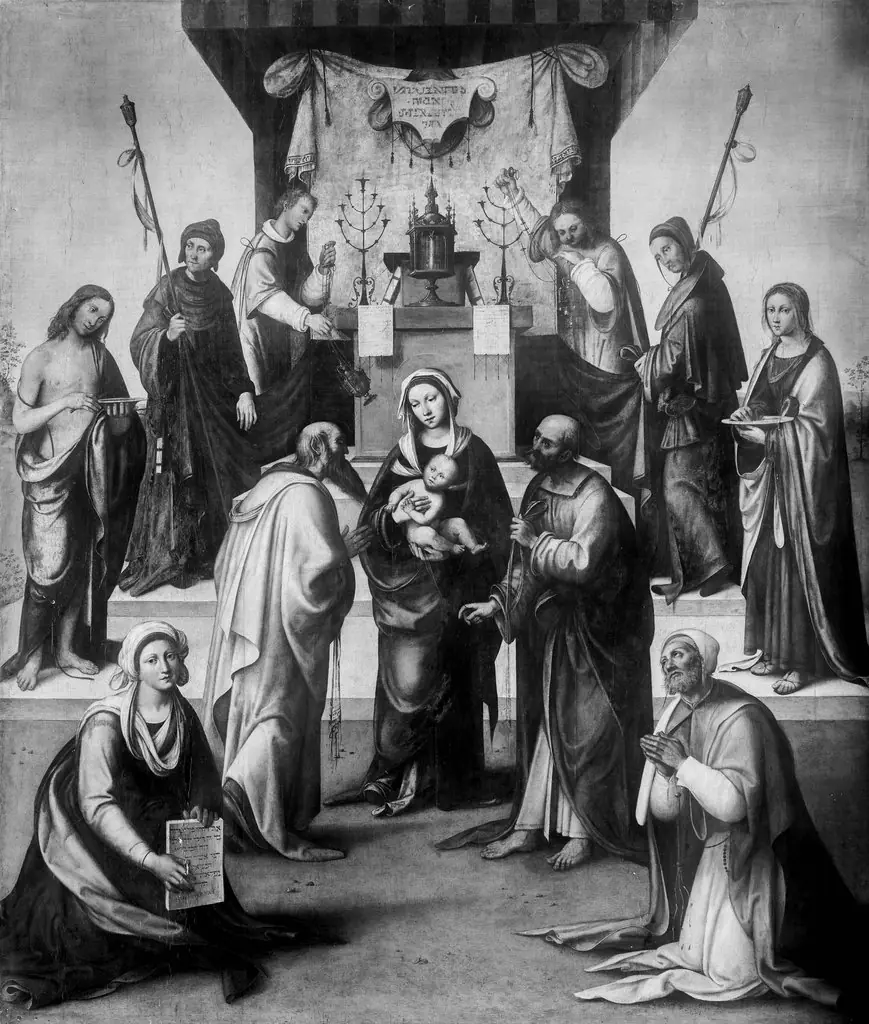 Presentation of Christ in the Temple
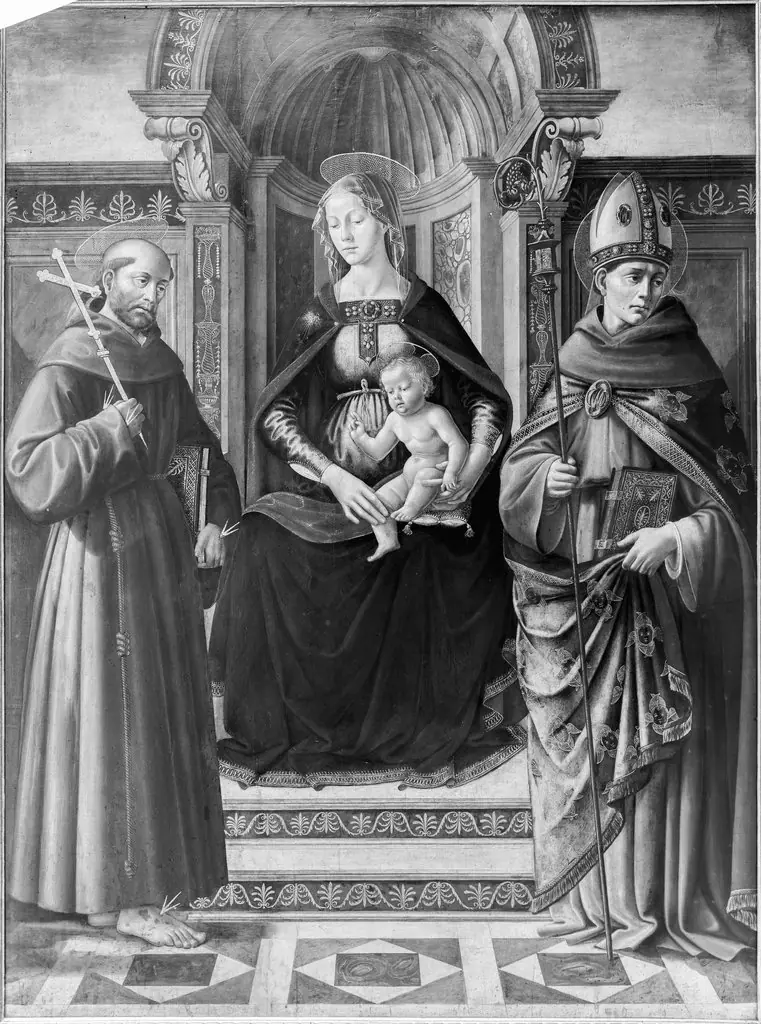 Mary and child enthroned with two saints
 Thronende Madonna mit vier Heiligen
 Mary and child enthroned with two saints
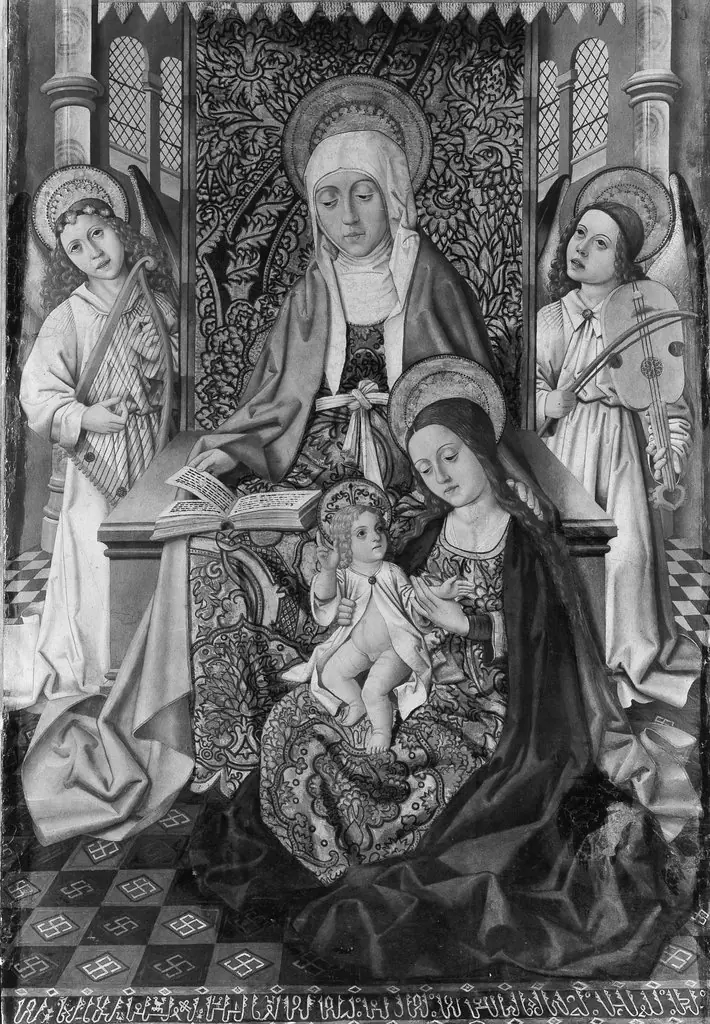 Saint Anne Enthroned with the Virgin and Child
 Mary with the child flanked by six saints
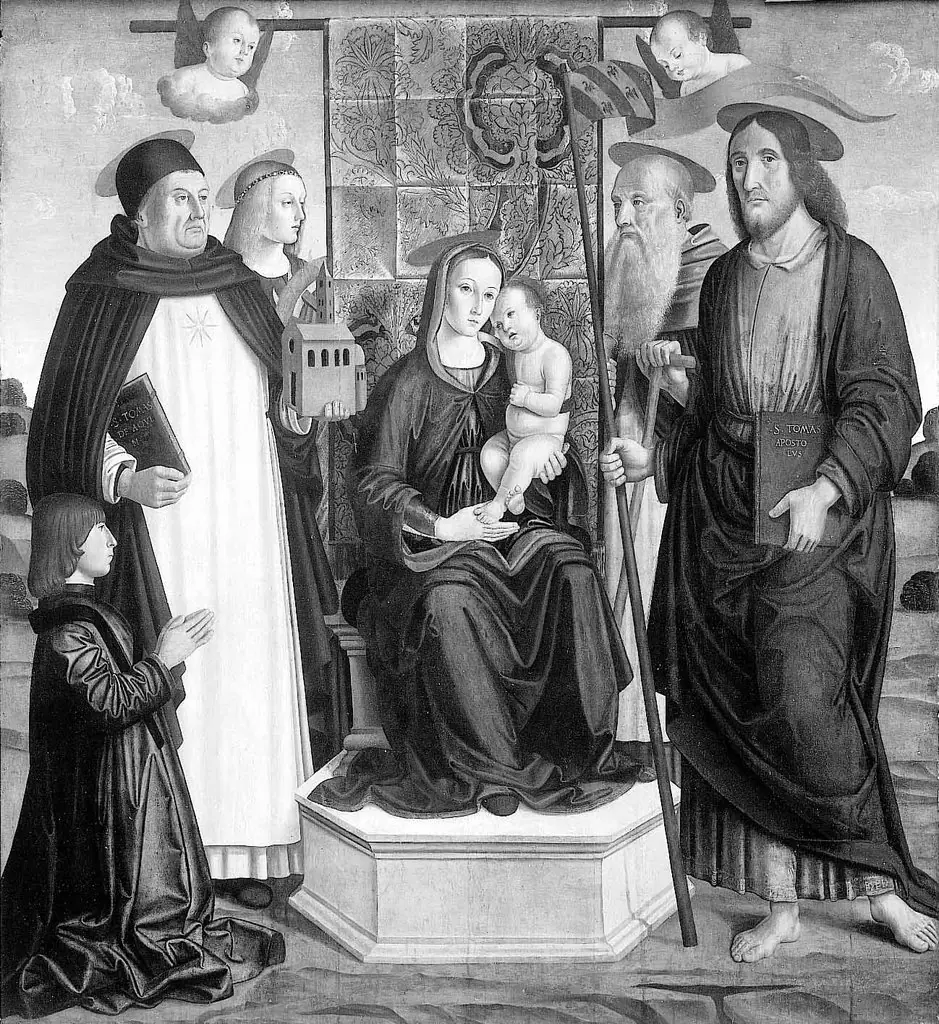 The Virgin and Child Enthroned with Saints
 Madonna enthroned with the sleeping child and four saints