Artwork
Watermelon and Grapes
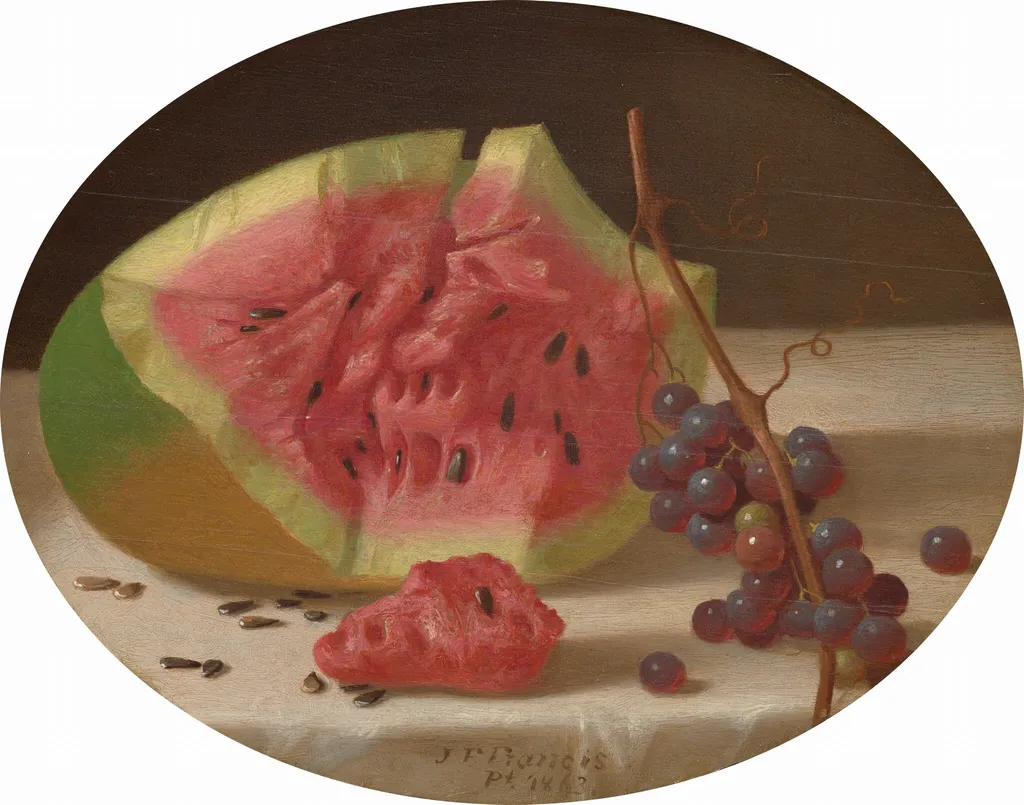
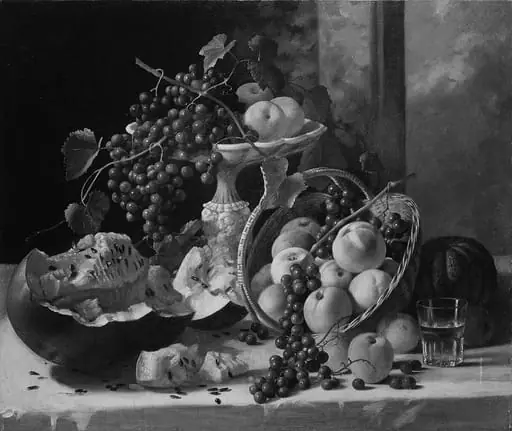
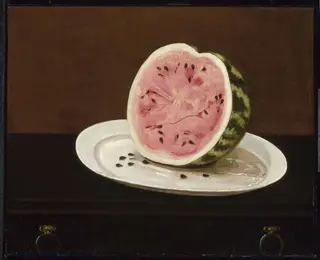
Watermelon and Grapes is an oil painting by the Impressionist artist John F. Francis. It dates from 1863 and is held in the collection of the National Gallery of Art. John F.
- Inscription
- Inscribed:lower center: JF Francis / Pt. 1863
About this work
Technique & Style
The work’s surface shows fine wood grain beneath the paint, and its condition remains stable with no noted structural or pigment deterioration.
Watermelon and Grapes is an oil painting on wood executed in 1863, depicting a still life of fruit with loose brushwork and vibrant color contrasts characteristic of mid‑19th‑century American realism. The work’s surface shows fine wood grain beneath the paint, and its condition remains stable with no noted structural or pigment deterioration. As part of the National Gallery of Art’s collection in Washington, D.C., it is displayed in a controlled environment that maintains consistent humidity and temperature to preserve its formal qualities.
History & Provenance
John F. Francis painted Watermelon and Grapes in 1863 in oil on wood. The earliest documented owner is the New York collector William H. Gerdts [1929–2020], who held the work by at least 1965, when he lent it to an American Federation of Arts exhibition in New York. Gerdts retained the painting for decades before giving it to the National Gallery of Art in 2018, where it remains in the collection.
The painting is held by the National Gallery of Art in Washington, D.C., where it was gifted in 2018.
Its accession number is not specified in the sources.
The work was included in a circa 1965 exhibition at the American Federation of the Arts in New York.
The painting was created in 1863.
Overview
John F. Francis’s 1863 oil painting on wood, titled Watermelon and Grapes, presents a modest still‑life arrangement. A sliced watermelon and a cluster of grapes rest upon a simple tabletop, rendered with meticulous attention to surface texture and color. The composition is anchored by a restrained setting that foregrounds the fruit’s natural vitality.
Subject & Meaning
The work focuses exclusively on the juxtaposition of two common fruits, highlighting their contrasting forms and hues. The watermelon’s bright, fleshy interior is set against the deep, translucent tones of the grapes, inviting contemplation of abundance and the fleeting nature of freshness. The straightforward subject underscores a 19th‑century interest in everyday objects as worthy artistic study.
Own this work as a print
Artist & collection