Artwork
Woman with a Mirror (Femme qui se mire)
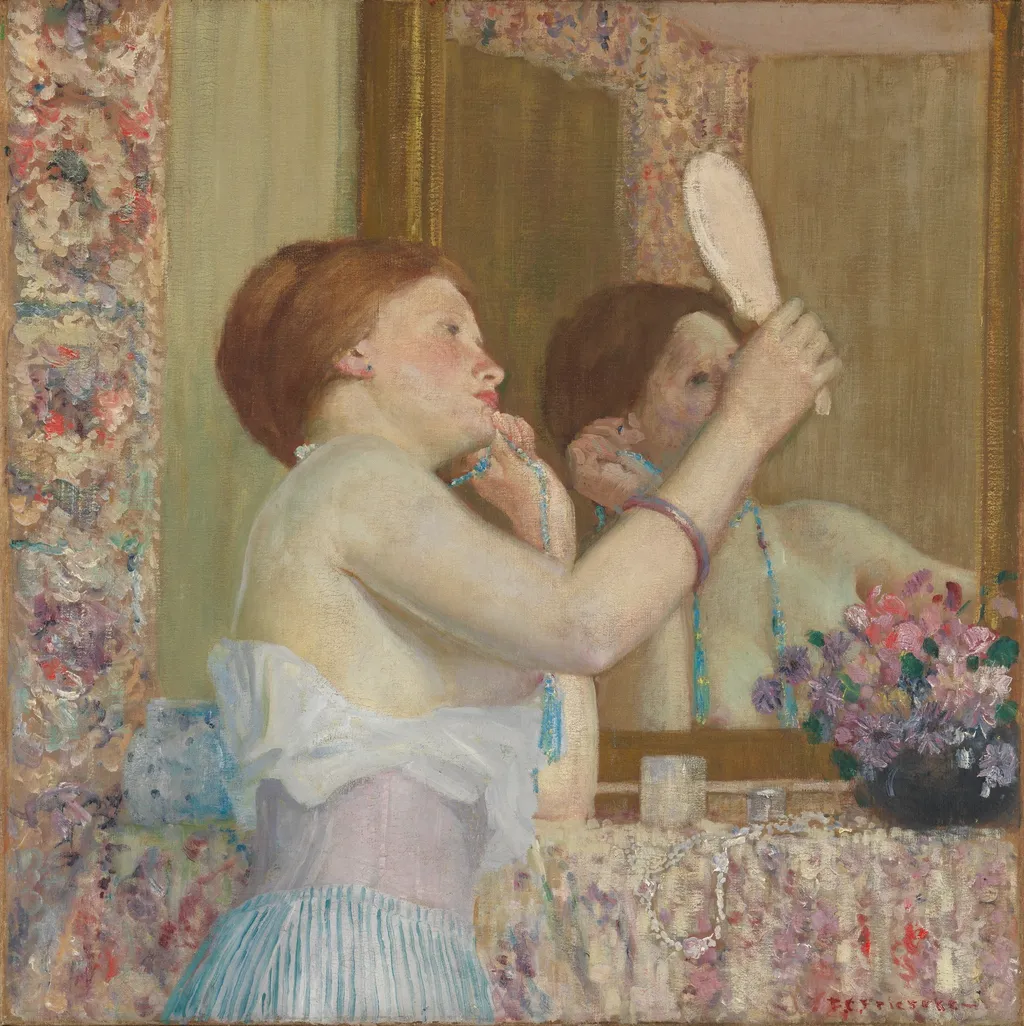
Woman with a Mirror (Femme qui se mire) is an oil painting by the American Impressionist artist Frederick Carl Frieseke. It dates from 1911 and is held in the collection of the Metropolitan Museum of Art.
About this work
Technique & Style
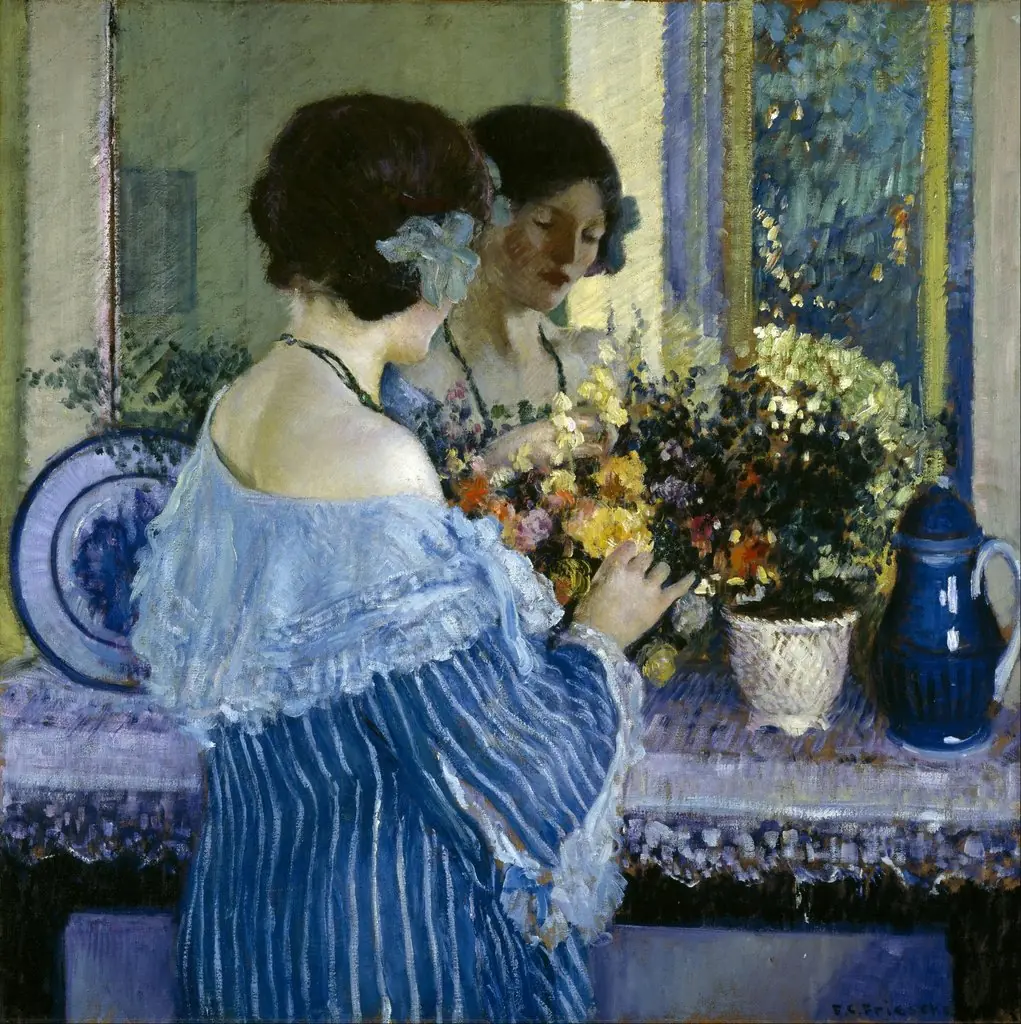
Painted in 1911, Woman with a Mirror is an oil on canvas whose handling aligns with Frieseke's late-Impressionist manner: thick, broken strokes of pigment are laid across the support to model light rather than line, especially in the sun-dappled treatment of the figure's dress and the surrounding foliage. The composition is organized around the central motif of the woman seen in profile, her reflection caught in a hand mirror that tilts the space into a shallow, planar recession. Color is applied in discrete, high-key touches, pinks, yellows, and greens, that remain distinct at close range and coalesce into optical vibration at a distance.
History & Provenance
The specific commission details and the complete chain of ownership prior to its acquisition by the museum are not detailed in the available records.
Frederick Carl Frieseke created the oil painting Woman with a Mirror (also known as Femme qui se mire) in 1911. The work is executed in oil on canvas and measures 80.6 cm in height by 81 cm in width, and depicts a woman, a mirror, and flowers. The Metropolitan Museum of Art in New York holds the work in its collection.
The specific commission details and the complete chain of ownership prior to its acquisition by the museum are not detailed in the available records. The painting remains a significant example of Frieseke's Impressionist style from this period.
Context
Frederick Carl Frieseke created Woman with a Mirror (Femme qui se mire) in 1911 as an oil on canvas that portrays a solitary woman seated before a mirror amid floral accents. The painting, classified as American Impressionist figure painting, entered the collection of the Metropolitan Museum of Art. Its composition reflects the artist's sustained interest in domestic interior settings and the modulation of natural light, while the inclusion of a mirror and botanical details underscores a focus on intimate, contemplative moments and his treatment of female subjects in leisurely, light-filled environments.
Overview
Frederick Carl Frieseke, an American Impressionist residing in France, completed Woman with a Mirror (Femme qui se mire) in 1911. This oil painting captures an intimate domestic scene, characteristic of the artist's work during his time in the Giverny art colony. The piece is now part of The Metropolitan Museum of Art's collection, representing Frieseke's contribution to early 20th-century American art.
Subject & Meaning
The painting portrays a woman engaged in a private moment of self-reflection. She stands before a mirror, one hand lifting her hair while the other holds a comb. Dressed in a light blouse, striped skirt, and a white shawl, she is framed by a floral arrangement on a nearby table and a small object on the windowsill, creating a serene, enclosed environment.
Own this work as a print
Artist & collection
Artist
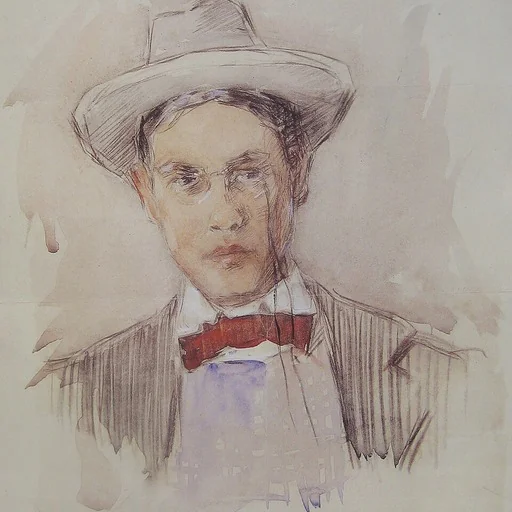
Frederick Carl Frieseke (April 7, 1874 – August 24, 1939) was an American Impressionist painter who spent most of his life as an expatriate in France.