Artwork
Girl Arranging Her Hair
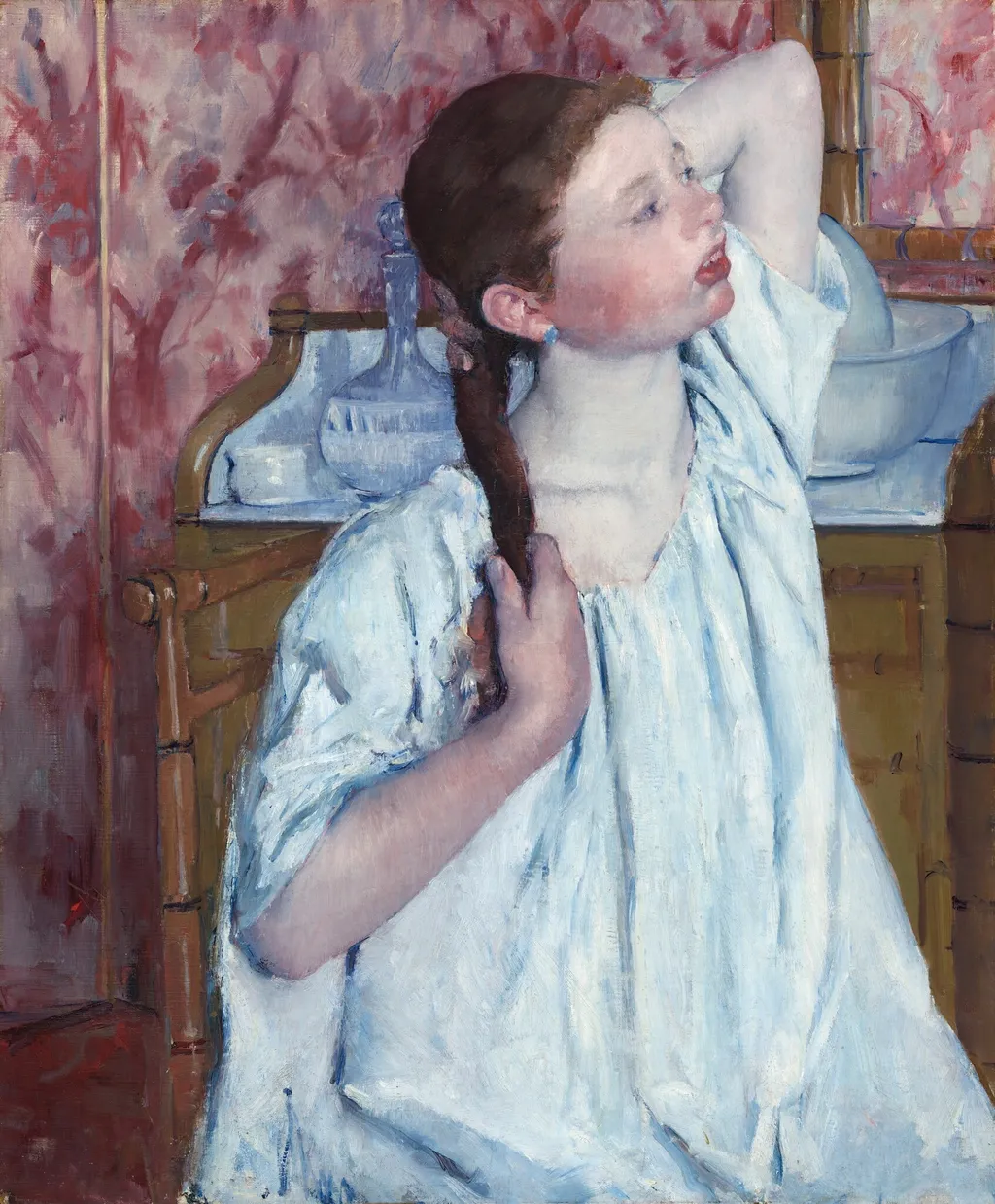
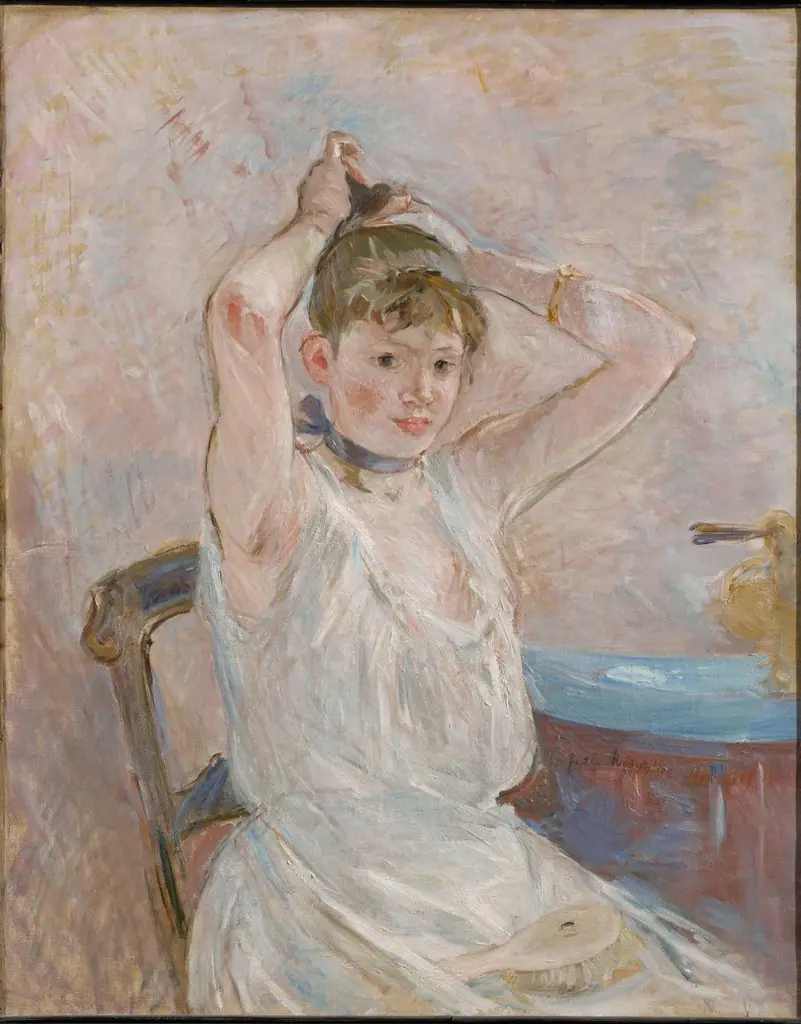
Girl Arranging Her Hair is an oil painting by the Impressionist artist Mary Cassatt. It dates from 1886 and is held in the collection of the National Gallery of Art.
About this work
Subject & Meaning
Girl Arranging Her Hair depicts a young girl in a chemise preparing for bed at a dressing table, braiding her hair with one hand raised to the back of her neck.
Girl Arranging Her Hair depicts a young girl in a chemise preparing for bed at a dressing table, braiding her hair with one hand raised to the back of her neck. Cassatt deliberately chose a model whose face was not conventionally attractive, presenting her in an almost complete profile with an open mouth that conveys weariness and self-consciousness. The natural pose has been linked to Michelangelo's Bound Slave, suggesting a state of bondage, while some scholars read the figure as imagining how she will be received by the male gaze.
The painting experiments with the simultaneous depiction of ugliness and beauty, a technique Cassatt absorbed from Degas, uniting an unconventional subject with refined form, composition, color, and light. The work was conceived as Cassatt's response to Degas's claim that women lacked artistic style, and its classical-contemporary blend led him to acquire it for his own collection.
Technique & Style
Girl Arranging Her Hair is an oil painting on canvas, measuring 75.1 by 62.5 centimeters. The work marks a departure from Cassatt's usual refined, detail-oriented manner, instead foregrounding drawing and a controlled handling of form. Cassatt deliberately juxtaposed an unconventional, unidealized subject, a young woman in a slip braiding her hair at a dressing table, with a carefully constructed composition, integrating ugliness and beauty in a manner she absorbed from Degas.
The near-profile pose, with one hand at the nape and the other tending the braid, conveys self-consciousness and weariness while echoing the torsion of Michelangelo's Bound Slave. Cassatt's mastery of color, light, and composition lends beauty to the awkward figure, producing a classical-contemporary hybrid that captivated Degas.
History & Provenance
Girl Arranging Her Hair was painted by Mary Cassatt in 1886 and first shown at the Eighth Impressionist exhibition in Paris, opening on 15 May 1886. The work originated in a debate with Edgar Degas, who questioned women's artistic abilities; Cassatt developed the painting to counter his view and executed it with notable intensity. Degas was struck by the blend of classical and contemporary qualities and acquired the picture in exchange for his own 1886 Woman Bathing in a Shallow Tub.
After Degas's death in 1917, the work was included in his atelier sale at Galerie Georges Petit, Paris (26–28 March 1918, no. 8), bought by Louisine Havemeyer, and later sold at her estate sale in New York (American Art Association Anderson Galleries, 10 April 1930, no. 75). Chester Dale acquired it and bequeathed it to the National Gallery of Art, Washington, in 1963.
Girl Arranging Her Hair is held by the National Gallery of Art in Washington, D.C., where it entered the collection as part of the bequest of Chester Dale in 1963. Its provenance traces from Edgar Degas, who acquired it directly from Mary Cassatt, through his atelier sale at Galerie Georges Petit in Paris (26–28 March 1918, lot 8), to Louisine Havemeyer in New York, then via her sale at the American Art Association Anderson Galleries (10 April 1930, lot 75) back to Chester Dale. The painting's first known public showing was the Eighth (and final) Impressionist exhibition, which opened on 15 May 1886.
Context
Exhibited at the eighth and final Impressionist exhibition in 1886, this painting marks a stylistic departure for Mary Cassatt, emphasizing rigorous drawing and control. The work emerged from a debate with Edgar Degas regarding women's artistic capabilities; Cassatt successfully challenged his skepticism, leading Degas to acquire the piece through a trade for his own work. Its integration of classical form with an unconventional, awkward subject reflecting both ugliness and beauty so closely mirrored Degas's aesthetic that connoisseurs initially misattributed it to him during the 1918 sale of his collection.
Scholars note the composition's reference to Michelangelo's Bound Slave and its subversion of traditional portraiture by capturing the model's self-consciousness. This critical reception underscores the work's significance in demonstrating Cassatt's mastery within the Impressionist circle and her complex artistic dialogue with Degas.
Legacy
After its creation in 1886, Degas acquired Girl Arranging Her Hair and displayed it in his Paris apartment, a fact documented in the painting's provenance and contemporary accounts. Following Degas's death, the work entered the market and was purchased by Louisine Havemeyer before eventually joining the National Gallery of Art's collection, where it remains on public view. Its later ownership and the 1918 Degas sale highlighted the piece as a key example of Cassatt's challenge to gendered assumptions about artistic ability, contributing to her reputation as a pioneering Impressionist, and its frequent misattribution to Degas spurred scholarly discussion of authorship and influence, cementing its role in art-historical narratives about the late-19th-century avant-garde.
Overview
Girl Arranging Her Hair is an 1886 oil painting by American artist Mary Cassatt. This work depicts a young girl in a private, everyday moment, focused on her reflection as she styles her hair. The composition, characterized by a simple dress and plain background, centers attention on the figure.
Currently, the painting is housed in the collection of the National Gallery of Art in Washington, D.C. It offers a quiet glimpse into domestic life.
Own this work as a print
Artist & collection
Artist
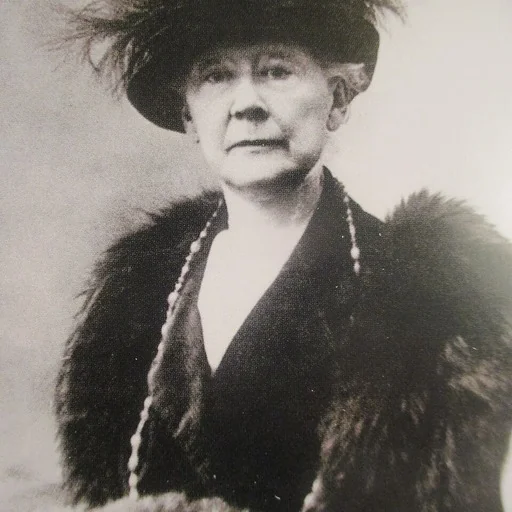
Mary Stevenson Cassatt (; May 22, 1844 – June 14, 1926) was an American painter and printmaker.