Artwork
Phaeton Asking for the Chariot
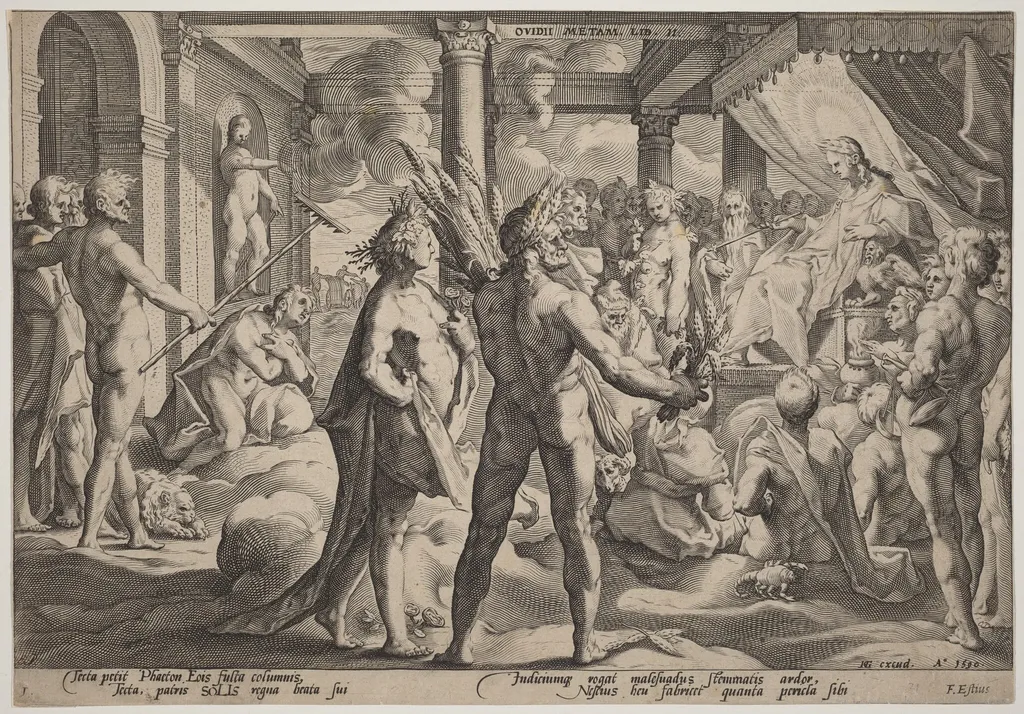
Phaeton Asking for the Chariot is an ink print by the Renaissance artist Hendrick Goltzius. It dates from 1590 and is held in the collection of the National Gallery of Art.
- Inscription
- Inscribed:across lower edge of plate: Secta petit Phaeton Eois fulta columnis / Tecta, patris Solis regna beata sui / Indici imq rogat malesuadus stemmatis ardor / Nescuis heu fabricet quanta pericla sibi / F. Estius; in plate, lower right: HG excud
About this work
Goltzius carved this in 1590 using engraving, a technique where a metal plate is cut with fine lines to hold ink.
Hendrick Goltzius shows a young man, Phaeton, begging his father, the sun god, for the sun chariot. The scene is packed with dramatic poses and strong, twisting bodies. Goltzius carved this in 1590 using engraving, a technique where a metal plate is cut with fine lines to hold ink.
This engraving stands out for its drama and deep shadows. The muscles look almost alive under the careful lines. Goltzius studied earlier artists like Michelangelo for these lifelike figures.
Want to see more like this? Find prints by Goltzius, Hendrick.
Overview
Hendrick Goltzius’s 1590 engraving presents a mythological tableau in which the youthful Phaëton implores his divine father for control of the sun‑chariot. Set against a backdrop of classical columns and arches, the composition is densely populated with twisting, muscular bodies that convey a heightened sense of movement and tension.
Subject & Meaning
The work visualizes the moment from Ovid’s Metamorphoses when Phaëton, eager to prove his lineage, begs Helios for the reins of the celestial vehicle. The surrounding figures, their gestures and expressions, underscore themes of ambition, filial pleading, and the peril inherent in overreaching one’s mortal limits.
Technique & Style
Executed through fine‑line engraving on laid paper, Goltzius incised the copper plate with meticulous hatching to render deep chiaroscuro and intricate musculature. The artist’s handling of line reflects a strong influence from Michelangelo’s anatomical studies, while the dramatic poses and crowded spatial arrangement echo the dynamism of late‑Renaissance printmaking.
History & Provenance
Created in the late sixteenth century, the print was part of Goltzius’s broader engagement with classical mythology and his reputation for technical virtuosity. Original impressions circulated among collectors of the Dutch Republic, and the work has since been documented in several major museum collections, attesting to its continued scholarly interest.
Own this work as a print
Artist & collection
Artist
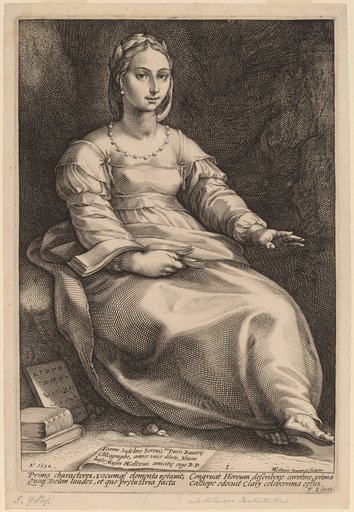
Hendrick Goltzius (German: , Dutch: ; né Goltz; January or February 1558 – 1 January 1617) was a German-born Dutch printmaker, draftsman, and painter.

- The Giants Climbing the Heavens
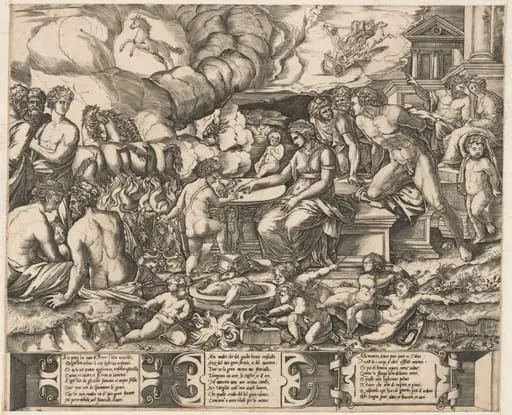 Allegory of Love
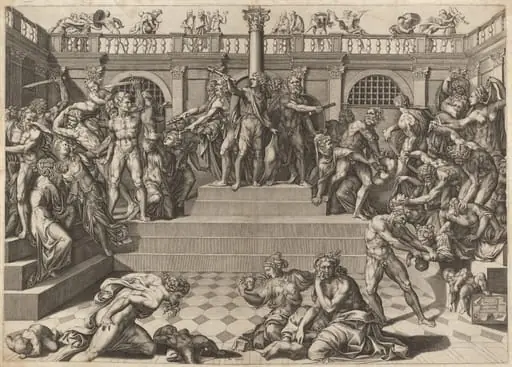 The Massacre of the Innocents
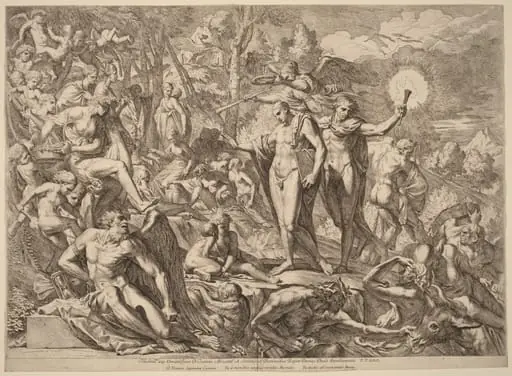 Parnassus
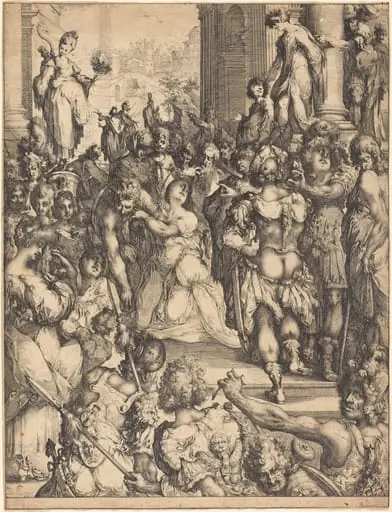 Martyrdom of Saint Lucy
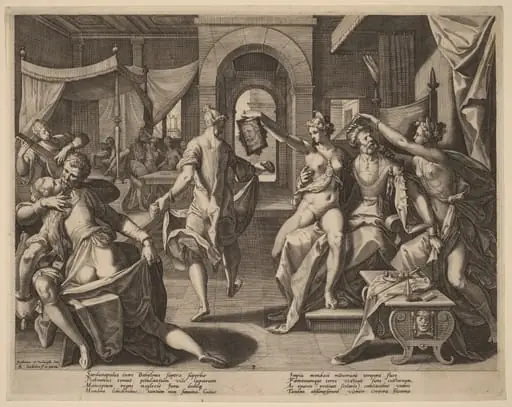 Sardanapalus among the Concubines
 Bacchus and Ariadne
 Jupiter and the Gods Asking Helios to Resume Control of the Chariot
 The Martyrdom of Saints Peter and Paul
 The Daughters of Niobe
 The Golden Age
 Envy Driven from the Temple of the Muses