Artwork
Vertumnus and Pomona
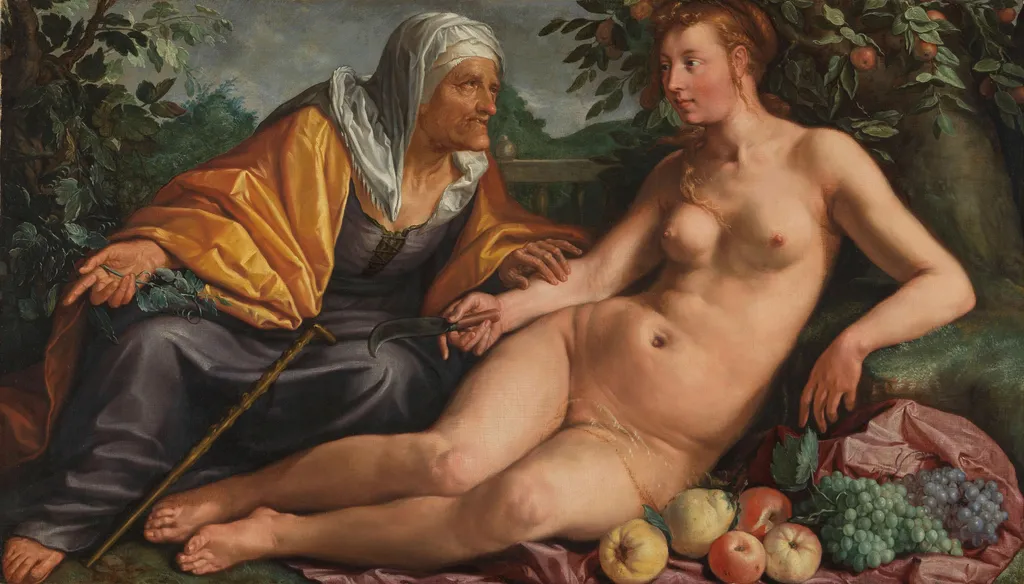
Vertumnus and Pomona is an oil painting by the Early Baroque Italian artist Hendrick Goltzius. It dates from 1613 and is held in the collection of the Rijksmuseum.
About this work
Hendrick Goltzius signed this large canvas in 1613. The Roman god Vertumnus, disguised as an old woman, leans close to the nude Pomona beneath an apple tree in her walled garden. A pruning knife glints in her hand; his walking stick hints at his real identity. The Rijksmuseum acquired the work in 1906.
Subject & Meaning
The work shows Vertumnus in disguise as an elderly figure carrying an assistive cane and billhook, while Pomona reclines half-nude amid fruit trees and vines.
The painting depicts the mythological story of Vertumnus and Pomona from Ovid's Metamorphoses. Vertumnus, the god of seasons, disguises himself as an old woman to gain access to the garden of the wood nymph Pomona, whom he desires. The work shows Vertumnus in disguise as an elderly figure carrying an assistive cane and billhook, while Pomona reclines half-nude amid fruit trees and vines.
The abundance of apples, grapes, and pears symbolizes fertility and the seasonal bounty over which Vertumnus presides. The theme of disguise and transformation underscores the narrative of courtship through guile, ultimately representing the union of nature’s cycles with human desire.
Technique & Style
This work is executed in oil paint on canvas, with dimensions of 90 by 149.5 cm. The medium allows for rich, translucent layering and subtle gradations of flesh tones, especially in the depiction of Pomona’s nudity and the elderly Vertumnus’s disguised form. Goltzius employs a polished, detailed handling to render a variety of textures: the softness of skin, the glossy surfaces of grapes and apples, the folds of drapery, and the rough bark of tree trunks. The composition is balanced between the reclining Pomona and the standing Vertumnus, with the garden setting, balustrade, and sky providing depth.
The formal qualities reflect a Mannerist sensibility in the elongated proportions and elegant poses, while the naturalistic details of fruit and foliage ground the mythological scene in tangible reality. The painting remains in the collection of the Rijksmuseum and shows typical aging for an early 17th-century canvas.
Overview
Hendrick Goltzius completed Vertumnus and Pomona in 1613, signing and dating this substantial oil painting. The work, measuring 90 by 149.5 centimeters, depicts an episode from Ovid's Metamorphoses. It portrays the god Vertumnus, disguised as an elderly woman, as he attempts to woo the reclusive nymph Pomona. This canvas is now part of the collection at the Rijksmuseum, where it is cataloged as SK-A-2217.
History & Provenance
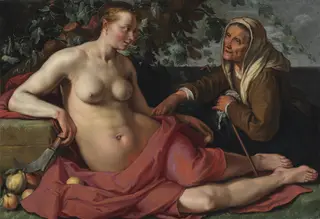
This large oil painting was created by Hendrick Goltzius in 1613, bearing the artist's signature and date. The Rijksmuseum acquired Vertumnus and Pomona in 1906, adding it to its extensive collection of Dutch art. The museum's holdings already included a smaller copper version of the same subject, painted by Jan Tengnagel in 1617, indicating the theme's enduring appeal in the period.
Context
The subject of Vertumnus and Pomona, particularly with the god in disguise, became the most frequently depicted mythological theme in the northern Netherlands during the seventeenth century. This popularity was largely fueled by the widespread availability of illustrated editions of Ovid's Metamorphoses. Goltzius's rendition, drawing inspiration from earlier prints by artists like Jan Saenredam after Abraham Bloemaert, significantly contributed to this trend, establishing a visual precedent for subsequent interpretations of the tale.
Artist & collection
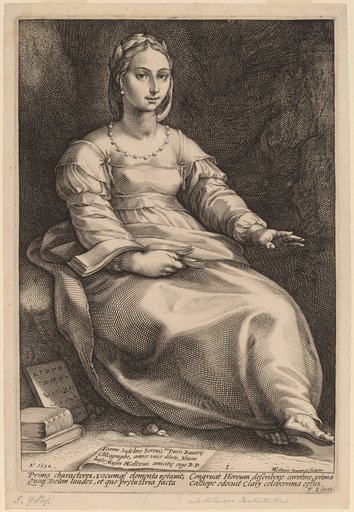
Artist
Hendrick Goltzius (German: , Dutch: ; né Goltz; January or February 1558 – 1 January 1617) was a German-born Dutch printmaker, draftsman, and painter.