Artwork
Mäda Primavesi (1903–2000)
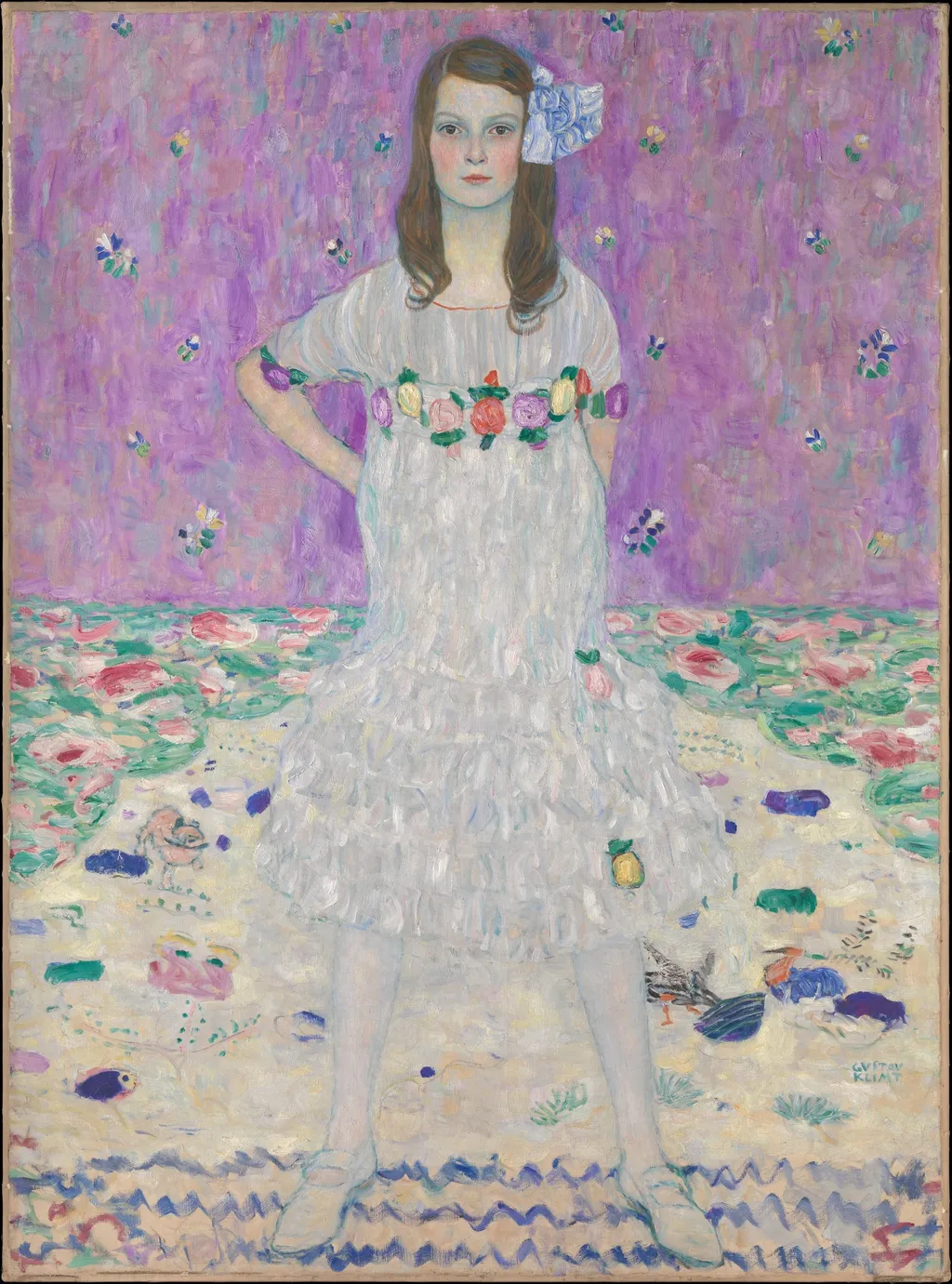
Mäda Primavesi (1903–2000) is an oil painting by the Vienna Secession artist Gustav Klimt. It dates from 1912 and is held in the collection of the Metropolitan Museum of Art.
About this work
Subject & Meaning
The work was commissioned by her father Otto Primavesi and later passed through private hands before entering the Metropolitan Museum of Art.
The portrait depicts Geltrude Mäda Primavesi, a nine-year-old girl from a Viennese bourgeois family, rendered by Gustav Klimt in 1912. She stands in a frontal pose, clothed in a white dress embroidered with multicolored flowers associated with Emilie Flöge. Above her head a lilac-coloured sky is juxtaposed with a lower zone filled with stylised floral and exotic animal motifs, creating a fairy-tale ambience that underscores the sitter's innocence and privileged status.
The composition's direct gaze conveys confidence, while the decorative elements reflect Klimt's fascination with ornamental symbolism. The work was commissioned by her father Otto Primavesi and later passed through private hands before entering the Metropolitan Museum of Art.
Technique & Style
Mäda Primavesi is an oil painting on canvas executed by Gustav Klimt in 1912, measuring 149.9 by 110.5 cm. The composition presents a full-length, frontally posed portrait of the nine-year-old sitter, her arms concealed behind her back with the right bent at the hip and her legs slightly parted but firmly planted. She wears a white dress, stockings, and shoes accented with a bow, the garment associated with Emilie Flöge and embellished with colored flowers. Klimt divided the background into two distinct zones: an upper lilac field and a lower register densely populated with floral and exotic animal motifs, producing a fairy-tale atmosphere intensified by the child's penetrating gaze. Klimt produced numerous sketches and variants before arriving at the final composition.
History & Provenance
Gustav Klimt created the portrait of Mäda Primavesi in 1912, producing numerous sketches and variants for the work. The painting was commissioned by the sitter's father, Otto Primavesi. Following its creation it entered a documented ownership chain that included Hugo Bernatzik and Jenny Steiner before being acquired by the Metropolitan Museum of Art in New York, where it carries the accession number 64.148. The available sources do not record specific exhibition history or dates of public display.
Context
Critical scholarship on Mäda Primavesi emphasizes its role within Gustav Klimt's late portraiture, noting the painting's blend of intimate child representation with the ornamental spatial division characteristic of his work of this period. Art historians observe that the work reflects Klimt's association with fashion designer Emilie Flöge, whose floral dress contributes to the decorative background that merges a lilac upper plane with a patterned lower field. The composition's fairy-tale atmosphere and the sitter's direct gaze have been linked to the influence of Symbolist and Art Nouveau currents, positioning the portrait as a bridge between figurative tradition and modernist experimentation.
Overview
Gustav Klimt's 1912 oil portrait, Mäda Primavesi, depicts the ten-year-old daughter of banker Otto Primavesi standing amidst a field of stylized flowers. The composition places the figure centrally against a flat, deep purple background that contrasts with the vibrant green and floral patterns of her white dress. Klimt renders the child with a solemn, direct gaze, her right hand resting on her hip while her left arm hangs loosely, creating a pose that balances youthful stillness with a sense of poised maturity.
The garment is decorated with intricate, colorful floral motifs and green leaves concentrated around the neckline and hem, characteristic of the artist's integration of decorative surface patterns with figurative representation. Painted during the final decade of Klimt's life, this work exemplifies his mature style, merging the symbolic density of his earlier golden period with a more naturalistic approach to the human form. It stands as a significant example of his portraiture, capturing the transition from the ornamental excess of the Vienna Secession to a more grounded, yet still highly stylized, realism.
The painting remains a key document of early 20th-century Austrian art, illustrating Klimt's unique ability to fuse the decorative arts with high portraiture.
Own this work as a print
Artist & collection
Artist
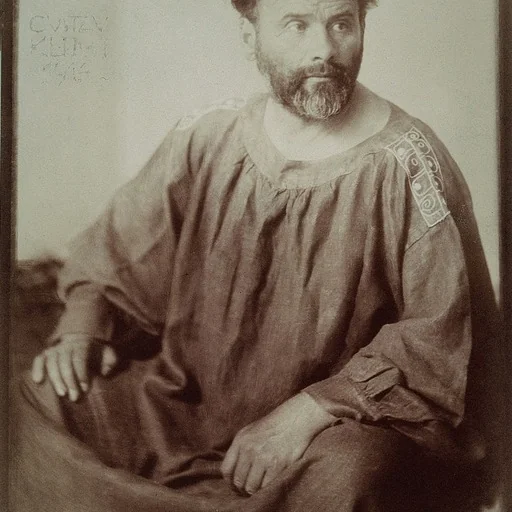
Gustav Klimt was an Austrian symbolist painter and a founding member of the Vienna Secession movement.