Artwork
The Farnesian Hercules
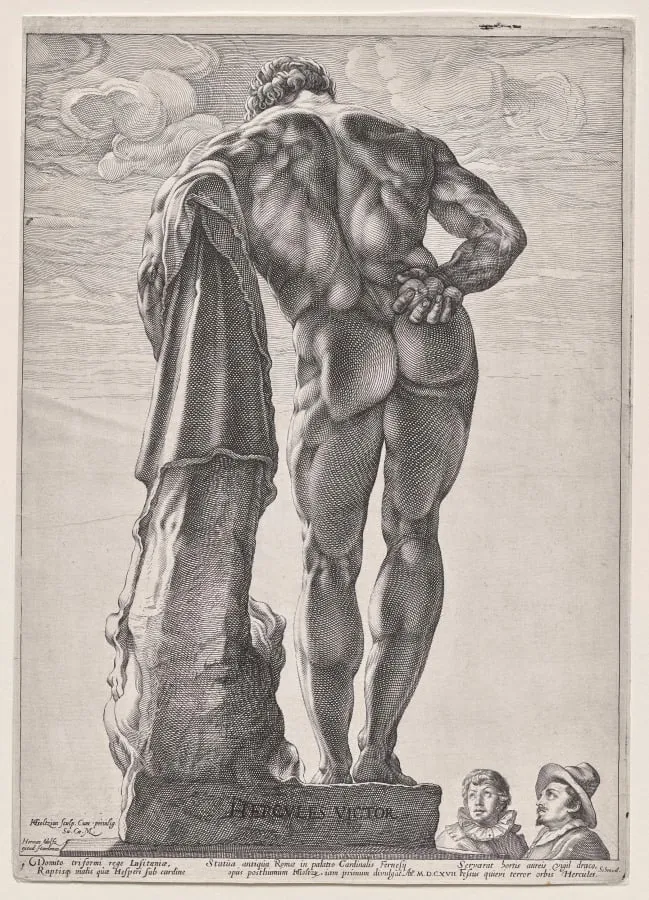
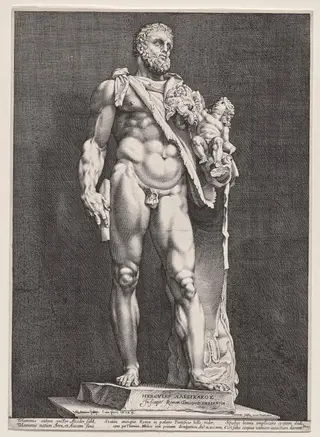
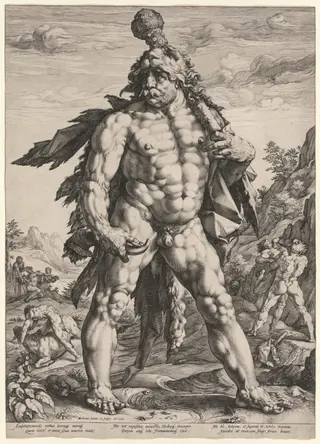
The Farnesian Hercules is a print by the Renaissance artist Hendrick Goltzius. It dates from 1592 and is held in the collection of the Cleveland Museum of Art.
- Accession no.
- 2022.137
- Credit line
- Severance and Greta Millikin Purchase Fund
About this work
Overview
Hendrick Goltzius, a Dutch engraver of the late Renaissance, produced a print of the Farnese Hercules after a study trip to Italy. Completed in 1591 upon his return to Haarlem, the work presents the ancient marble statue from a low, rear perspective, emphasizing its monumental scale and dramatic lighting.
Subject & Meaning
The image captures the massive, muscular back of Hercules, reclining on his club with a lion’s skin draped over one arm. By viewing the figure from below, Goltzius conveys the awe inspired by encountering the celebrated ancient monument, highlighting its heroic presence.
Technique & Style
Goltzius employed deep incised lines to render strong chiaroscuro, carving pronounced shadows that give the marble a three‑dimensional quality. The contrast between darkened areas and illuminated highlights accentuates the twisting torso and makes the figure appear to emerge from the paper.
History & Provenance
During his Italian sojourn Goltzius made on‑site sketches of the statue, which he later transformed into this engraving. Contemporary Dutch viewers identified the two small figures in the foreground as a self‑portrait of Goltzius and his stepson, the engraver Jacob Matham.
Context
The print reflects the broader Renaissance practice of studying classical sculpture directly in Italy to inform Northern European art. Goltzius’s focus on the Farnese Hercules aligns with the period’s fascination with antiquity and the heroic ideal embodied by the mythic hero.
Artist & collection
Artist
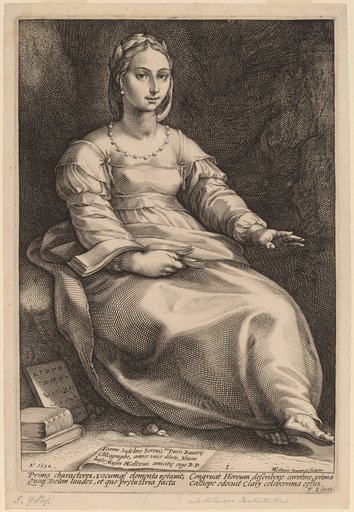
Hendrick Goltzius (German: , Dutch: ; né Goltz; January or February 1558 – 1 January 1617) was a German-born Dutch printmaker, draftsman, and painter.

![The Farnese Hercules, seen from behind [plate 4], by François Perrier](https://artifactworldgallery.com/img/francois-perrier--the-farnese-hercules-seen-from-behind-plate-4--075576b9459929be-w320.webp)
![The Farnese Hercules, three-quarter view turned to left [plate 3], by François Perrier](https://artifactworldgallery.com/img/francois-perrier--the-farnese-hercules-three-quarter-view-turned-to-left-plate--b0564bebaad016fa-w320.webp)
![The Farnese Hercules, front view [plate 2], by François Perrier](https://artifactworldgallery.com/img/francois-perrier--the-farnese-hercules-front-view-plate-2--cedb2cb031c3391b-w320.webp)