Artwork
The Blossoming of Aaron's Rod
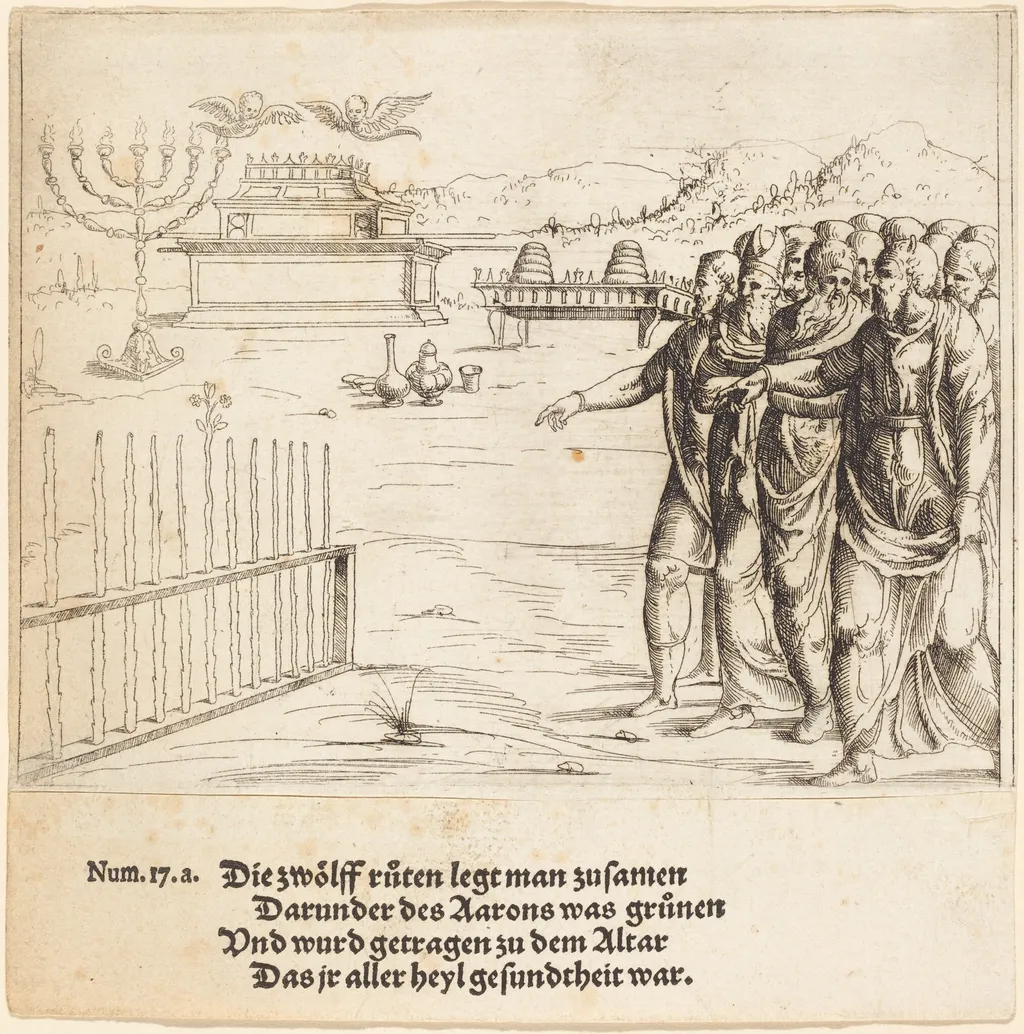
The Blossoming of Aaron's Rod is an ink print by the Renaissance artist Augustin Hirschvogel. It dates from 1528 and is held in the collection of the National Gallery of Art.
About this work
Overview
Created in 1528 by the German artist Augustin Hirschvogel, this etching depicts a biblical episode from the Book of Numbers.
Created in 1528 by the German artist Augustin Hirschvogel, this etching depicts a biblical episode from the Book of Numbers. Hirschvogel, known for his precise linear technique and interest in landscape, produced this small-scale print during a period when religious narratives were frequently rendered with meticulous detail. The work exemplifies his skill in translating complex scenes into the delicate medium of etching.
Subject & Meaning
The scene illustrates the moment when Aaron’s rod, placed before the Tabernacle, miraculously blossoms as divine confirmation of his priestly authority. Three figures in robes gesture toward the tree, while two cherubs hover above a temple structure. The sprouting rod on a small table, alongside ritual vessels, underscores the theme of sacred selection. The composition directs attention to the supernatural event as the central theological moment.
Technique & Style
Hirschvogel employed fine, controlled etching lines to model form and texture, creating subtle gradations of light and shadow. The landscape elements, trees, fence, and distant architecture, are rendered with careful attention to spatial depth, reflecting the Danube School’s interest in naturalistic settings. The delicate rendering of the blossoming rod contrasts with the rigid geometry of the temple, enhancing the miraculous nature of the scene.
History & Provenance
This etching was produced during Hirschvogel’s active years in Nuremberg, a center of printmaking in early 16th-century Germany. Though few records of its early ownership survive, it aligns with the broader circulation of religious prints among educated patrons. Hirschvogel’s reputation as both artist and cartographer likely contributed to the print’s dissemination and technical credibility.
Context
In the decades before the Reformation, biblical imagery remained central to German print culture, even as theological debates intensified. Artists like Hirschvogel blended devotional subjects with emerging landscape traditions, catering to audiences seeking both spiritual meaning and visual refinement. The Danube School’s focus on nature and atmosphere influenced how sacred stories were visually framed during this transitional period.
Legacy
Hirschvogel’s etching contributed to the evolution of religious printmaking by integrating detailed naturalism with narrative clarity. His technical precision influenced later engravers, though his broader oeuvre remains less widely studied than that of contemporaries like Dürer. The work endures as an example of how small-scale prints could convey complex theological ideas with quiet authority.
Own this work as a print
Artist & collection
Artist
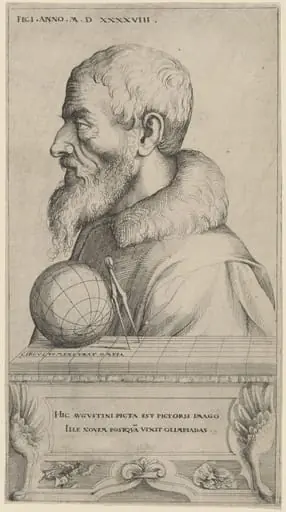
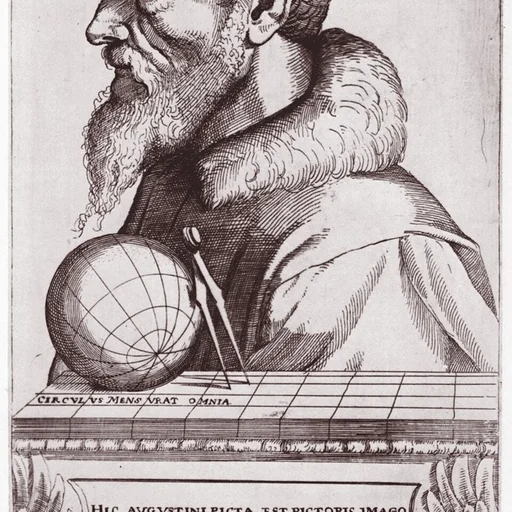
Augustin Hirschvogel (1503 – February 1553) was a German artist, mathematician, and cartographer known primarily for his etchings.