Movement
Danube school
Danube school is an art movement of the 1500–1540 period. The gallery holds 2 works in this movement. Browse Danube school paintings, portraits, pictures and artworks from the world's public-domain museum collections.
The Danube school (German *Donauschule*) was a current of painting and printmaking that flourished in the first third of the sixteenth century in Bavaria and Austria, concentrated in the towns of the Danube valley and above all in Regensburg. It belongs to the wider Northern Renaissance, yet it was never a formal academy or workshop: the term is one of convenience, applied retrospectively to a loose circle of artists who shared a sensibility rather than a teacher. What unites them is a sudden, intense feeling for the wooded river landscape of central Europe, which they raised from incidental backdrop to the true subject of art.
Visually, the school is defined by its rapturous treatment of nature. Biblical, historical, and saintly subjects are set amid dense fir forests, jagged rocks, ruined castles, and water, the whole often dissolved in mist and a charged, glowing light. Colour is expressive rather than descriptive, and the figures—indebted to the heightened emotion of Matthias Grünewald—can verge on the proto-expressionist. The painters broke with the cool, enamel-smooth finish of earlier Netherlandish-influenced work in favour of a freer, more painterly handling, showing little of the Italianate classicism then spreading across Europe. Many were also gifted etchers and engravers, and they were among the first Europeans in roughly a millennium to produce pure landscapes wholly free of figures.
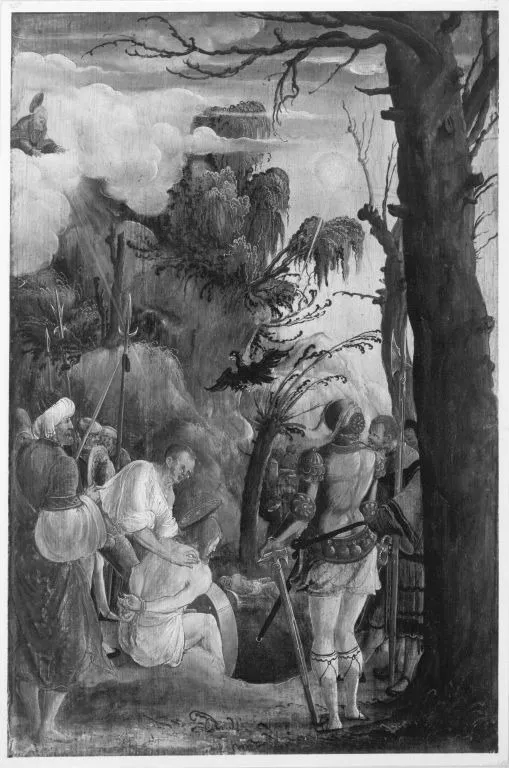
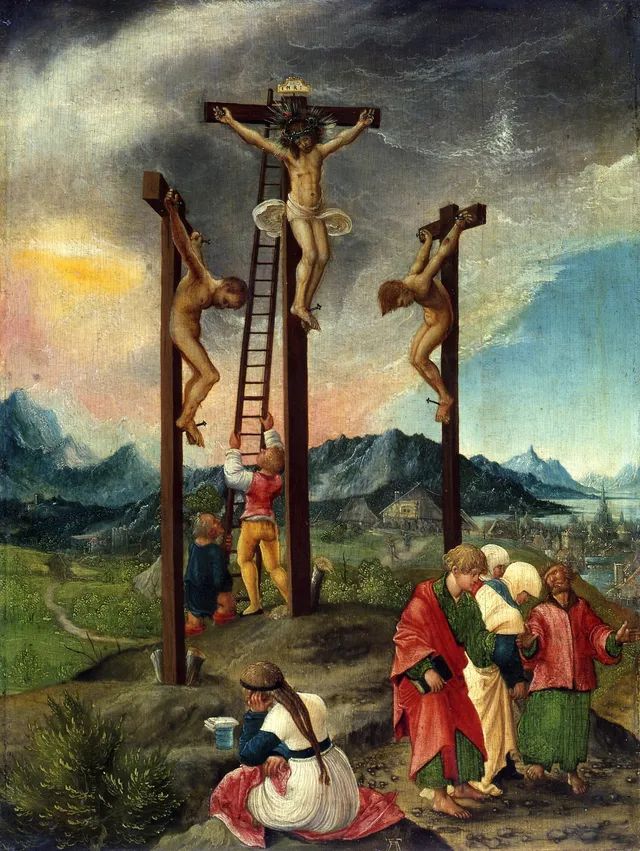
Its principal masters were Albrecht Altdorfer (c. 1480–1538), a leading citizen of Regensburg; Wolf Huber; and the young Lucas Cranach the Elder, whose Vienna years around 1500–1504 gave the movement an early impetus before he departed for Wittenberg. Altdorfer is the central figure. His *Danube Landscape near Regensburg* (c. 1528) is among the earliest independent landscapes in Western art, while *The Battle of Alexander at Issus* (1529, now in the Alte Pinakothek, Munich), commissioned by Duke William IV of Bavaria, sets a teeming clash of armies beneath a vast, cosmic sky. His religious panels, including the *Martyrdom of St Florian* and the *Christ on the Cross between the Two Thieves* held in this collection, fold sacred drama into the same enveloping wilderness.
Though short-lived as a coherent moment, the Danube school had a lasting legacy: it effectively invented autonomous landscape as a European genre, anticipating the "world landscape" tradition and, more distantly, the mood-laden nature painting of German Romanticism. Its lyrical naturalism stands in productive contrast to the measured humanism of Dürer and the Italian Renaissance, marking one of the most original episodes of sixteenth-century German art.
Works
Frequently asked questions
What is Danube school?
Danube school is an art movement. An early-16th-century German and Austrian movement centered on the Danube valley that pioneered landscape painting as an independent subject.
When did Danube school take place?
Danube school dates from 1500–1540.
Where can I see Danube school works?
Danube school works in the collection are held by Bavarian State Painting Collections and Gemäldegalerie Berlin.