Artwork
Calverley Crescent, Tunbridge Wells
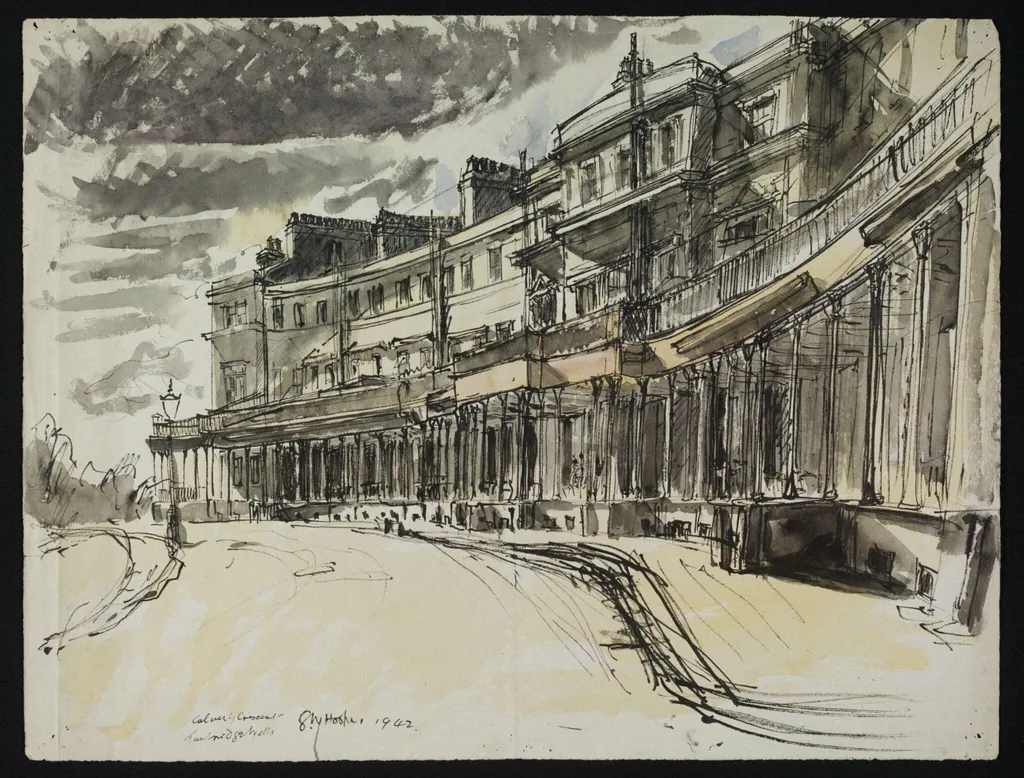
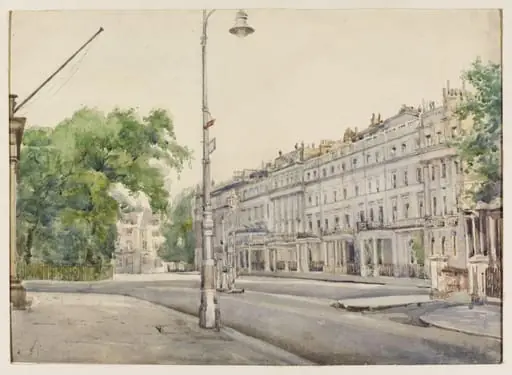
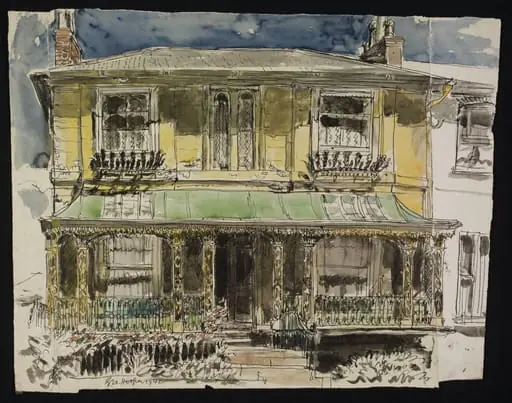
Calverley Crescent, Tunbridge Wells is a watercolor work on paper by the Social Realist artist George W. Hooper. It dates from 1942 and is held in the collection of the Victoria and Albert Museum. This 1942 watercolour by George W.
About this work
Dark clouds fill the sky, and the whole scene looks drawn quickly in ink and watercolor.
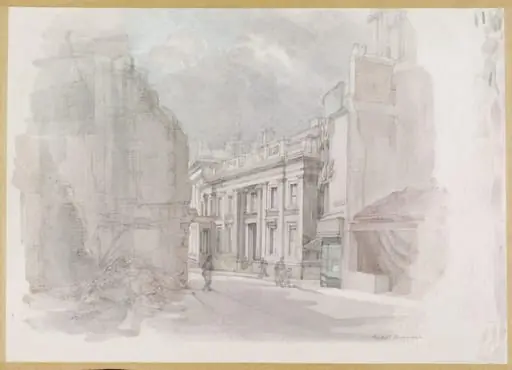
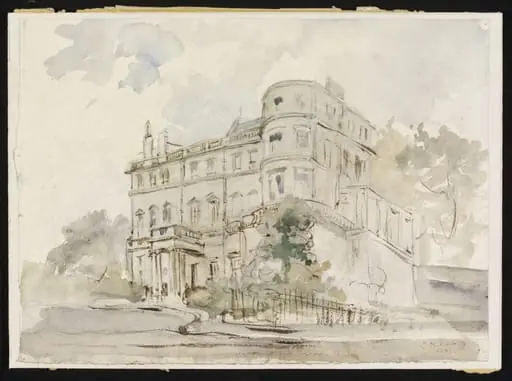
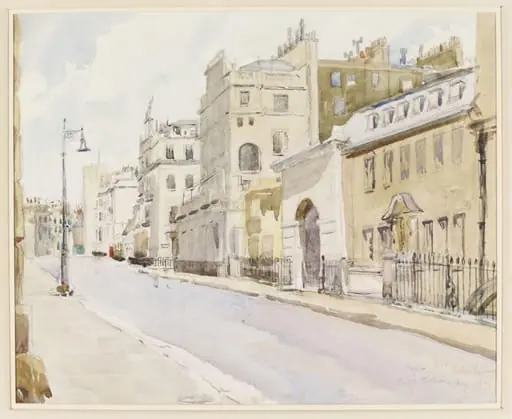
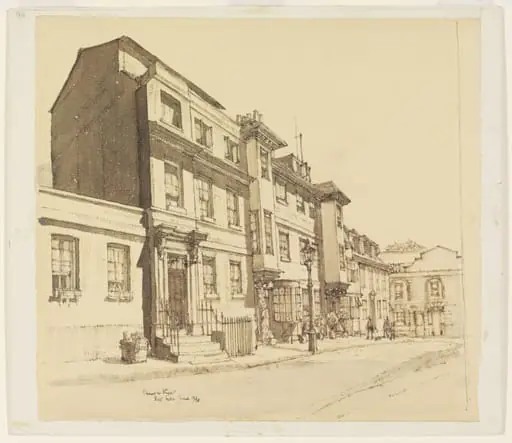
This sketch shows a row of tall, pale buildings with big windows and balconies. The street in front is empty except for a few parked cars and a lamppost. Dark clouds fill the sky, and the whole scene looks drawn quickly in ink and watercolor.
The artist signed it in 1942, calling it Calverley Crescent, Tunbridge Wells. The loose, sketchy lines make the buildings feel alive, almost like a quick snapshot.
Look up Victoria and Albert Museum to see more of this artist’s work.
Overview
This 1942 watercolour by George W. Hooper captures Calverley Park Crescent in Tunbridge Wells, a row of early 19th-century terraced houses. Executed in ink and watercolour, the work is part of the Recording Britain project, a wartime initiative to visually archive the nation’s landscapes. The piece reflects a moment of urgent documentation, prioritizing immediacy over polish, and bears the artist’s signature and date.
Subject & Meaning
The scene portrays a quiet, residential street lined with uniform townhouses, their balconies and large windows suggesting Georgian elegance. An empty road, a solitary lamppost, and parked cars imply a pause in daily life. The overcast sky and swift brushwork convey a sense of transience, aligning with the project’s aim to preserve ordinary places at risk during wartime upheaval.
Technique & Style
Hooper employed rapid, angular ink lines to define architectural forms, layered with translucent watercolour washes to suggest light and shadow. The loose, energetic strokes avoid detail, instead capturing the essence of the buildings and atmosphere. The contrast between pale facades and dark clouds heightens the composition’s dramatic tension, reflecting a sketchbook immediacy rather than studio refinement.
History & Provenance
Created in 1942, the work was commissioned as part of the Recording Britain scheme, overseen by Sir Kenneth Clark and funded by the Pilgrim Trust. Administered by the Ministry of Labour and National Service, the project enlisted artists to record vulnerable or vanishing landscapes. This watercolour entered the collection of the Victoria and Albert Museum, where it remains as part of a broader archive of wartime visual documentation.
Context
During the Second World War, the Recording Britain project sought to safeguard cultural memory amid threats of bombing and urban change. Artists like Hooper were dispatched across the country to depict rural and urban scenes deemed emblematic of national identity. This work reflects a broader effort to affirm continuity through art, even as the nation faced disruption.
Legacy
The Recording Britain collection endures as a significant historical record of mid-20th-century English landscapes. Hooper’s contribution, with its brisk execution and atmospheric tone, exemplifies the project’s commitment to capturing place through personal, unidealized observation. His works, including this one, continue to inform understanding of Britain’s architectural heritage during a period of profound change.
Artist & collection
Artist
George W. Hooper painted quiet scenes of everyday places in watercolor. In 1942 he showed Tunbridge Wells’ curved Calverley Crescent and an old tomb at Bletchingly Church, Surrey, both in soft strokes of color. He…