Artwork
Horatius Cocles Defending the Sublician Bridge (cassone panel)
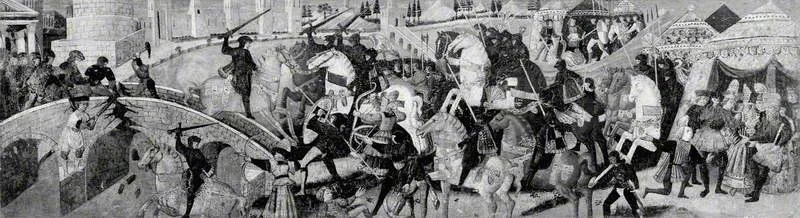
Horatius Cocles Defending the Sublician Bridge (cassone panel) is an unspecified painting by the Early Renaissance artist Unknown. It dates from 1450 and is held in the collection of the Victoria and Albert Museum. The work, titled Horatius Cocles Defending the Sublician Bridge, is a painted panel that captures a moment of intense combat.
About this work
Overview
The work, titled Horatius Cocles Defending the Sublician Bridge, is a painted panel that captures a moment of intense combat. Central to the composition is a lone figure on a bridge, sword aloft, confronting a cluster of armed men. Around them the bridge teems with fleeing civilians and engaged soldiers, all set beneath a chaotic urban skyline.
Subject & Meaning
The scene depicts the legendary Roman hero Horatius Cocles as he holds the Sublician Bridge against invading forces, a narrative drawn from early Roman historiography. By emphasizing the solitary defender amid a mass of attackers, the image underscores themes of civic duty, personal sacrifice, and the defense of the Republic against external threats.
Technique & Style
The artist employs a pronounced chiaroscuro, juxtaposing deep shadows with bright highlights to model forms and heighten tension. Bold outlines delineate figures, while a vivid palette of reds, blues, and earth tones energizes the composition. This combination of strong line work and dramatic lighting creates a sense of depth and immediacy.
History & Provenance
The panel is a cassone decoration, originally intended for a marriage chest in the Italian Renaissance. Such narrative scenes were popular for their moral exempla, linking the virtues of the bride and groom to heroic antiquity. The piece later entered museum collections, though specific ownership records remain sparse.
Context
During the Renaissance, classical legends were frequently revived to convey contemporary ideals of honor and patriotism. The story of Horatius resonated with humanist scholars who admired Roman virtues, and its visual treatment aligns with the period’s interest in dynamic, theatrical compositions.
Legacy
The painting exemplifies how Renaissance artisans integrated classical storytelling with emerging artistic techniques. Its dramatic use of light and line influenced later depictions of heroic subjects, contributing to the visual vocabulary that would shape Baroque narrative art.
Artist & collection

 Domestic Scene
 Giacomo and Cardinal Marco, investing Andrea, Abbot of San Zeno, with his Benefice
 The Nymph of Fontainebleau
 Portrait of a Woman
 Madonna and Child with Saints in the Enclosed Garden
 Venus and Minerva
 Family Group of Four on Sofa
 Wall painting from Room H of the Villa of P. Fannius Synistor at Boscoreale