Artwork
Budd Doble Driving Goldsmith Maid at Belmont Driving Park
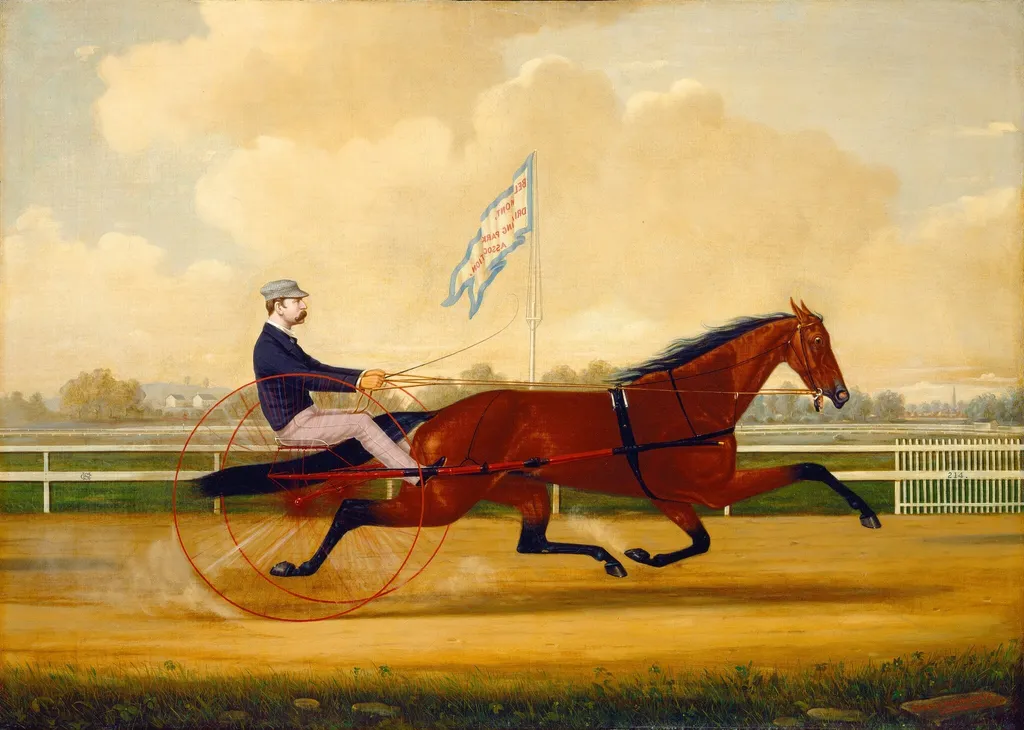
Budd Doble Driving Goldsmith Maid at Belmont Driving Park is an oil painting by the American Impressionist artist Charles S. Humphreys. It dates from 1876 and is held in the collection of the National Gallery of Art. Charles S.
- Inscription
- Inscribed:on lower fence rail, left: CSH (in monogram); on lower fence rail, right: 214.; lower right: CHAS. S. HUMPHREYS. / Camden, N.J. 1876; on banner in reverse: BELMONT. / DRI[V]ING PARK / ASSOC[IA]TION.
About this work
This painting shows a harness race at Belmont Driving Park. Two brown horses pull a red sulky with a driver in a top hat. The track is grassy, the sky is clear.
This was painted in 1876. It’s one of the few surviving scenes of early harness racing. The figures are small but full of life.
Check out more American sporting art at the National Gallery of Art, Washington.
Technique & Style
The formal composition captures the motion of the figures in a realistic yet lively manner, typical of late 19th‑century American genre scenes.
The work is an oil on canvas painting created in 1876. It measures 66 cm in height by 91.6 cm in width and depicts a scene at Belmont Driving Park. The formal composition captures the motion of the figures in a realistic yet lively manner, typical of late 19th‑century American genre scenes.
The surface handling shows careful brushwork that defines both the atmospheric background and the detailed figures, contributing to a balanced, narrative‑driven visual style.
History & Provenance
Created in 1876, the oil on canvas painting depicts the horse Goldsmith Maid driven by Budd Doble at Belmont Driving Park. The work was originally recorded as originating from New York State before entering the collection of Robert Carlen in Philadelphia. It was sold in 1957 to Edgar William and Bernice Chrysler Garbisch, who subsequently donated the piece to the National Gallery of Art in Washington, D.C., in 1971.
The painting is held by the National Gallery of Art, Washington, D.C., where it is accessioned as 1971.1.1. It was previously in the collection of Edgar William and Bernice Chrysler Garbisch, who acquired it in 1957 from Robert Carlen, Philadelphia. The work entered the National Gallery of Art in 1971 as a gift from the Garbischs.
Context
The painting is part of the National Gallery of Art's collection in Washington, D.C., having entered the museum through a 1971 gift from Edgar William and Bernice Chrysler Garbisch, who acquired it in 1957 from the Carlen Gallery in Philadelphia. It was created in 1876 by Charles S. Humphreys, who specialized in genre scenes depicting leisure activities. The work reflects Humphreys' interest in contemporary American life, particularly horse racing and sporting events at venues such as Belmont Park.
Legacy
The painting is held in the National Gallery of Art collection in Washington, D.C., where it was gifted in 1971 by Edgar William and Bernice Chrysler Garbisch. Its provenance traces back to New York State, with a documented sale in 1957 to the collectors before its acquisition by the museum.
The work is recognized as an example of 19th-century American genre painting, reflecting the era's interest in leisure scenes and regional equestrian culture. Though specific critical commentary on its influence is not detailed in the available records, its inclusion in a major national collection underscores its significance as part of the documented artistic output of Charles S. Humphreys.
Technical attributes recorded in the institutional catalog include an oil on canvas medium with dimensions of 66 centimeters in height and 91.6 centimeters in width, consistent with the painting's creation in 1876.
Overview
Charles S. Humphreys completed this oil on canvas in 1876. The work captures a moment at Belmont Driving Park, depicting a harness race with two brown horses pulling a red sulky. A driver in a top hat steers the vehicle across a grassy track beneath a clear sky. The composition is modest in scale but conveys the energy of the event.
Subject & Meaning
The scene focuses on a competitive harness race, a popular pastime in late‑19th‑century America. By portraying the horses, sulky, and driver together, the painting emphasizes the coordination between animal and rider, while the open, sunlit setting underscores the sport’s outdoor, communal character.
Own this work as a print
Artist & collection


 The Trotter
 Portrait of a Gentleman in a Carriage
 Two Dapple-Gray Horses Exercising (Deux chevaux gris pommele que l'on promene)
 Two Dappled Horses Exercising
 George Franklin Archer and the Archer Residence
 The Neigh of an Iron Horse
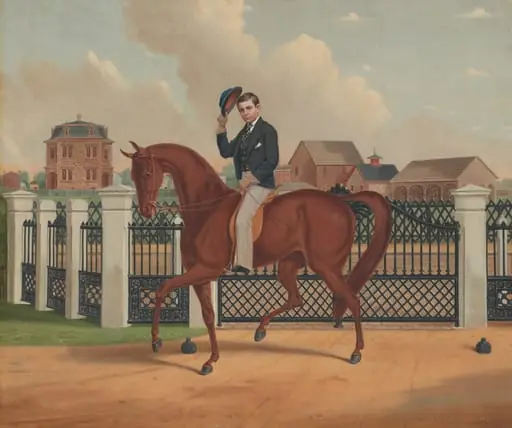 George Franklin Archer and the Archer Residence
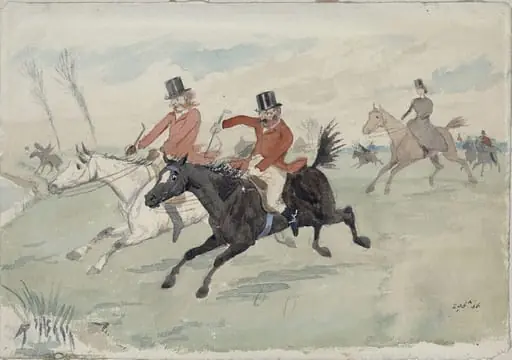 The Rivals
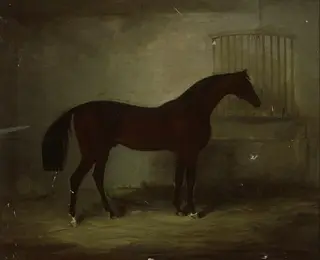 Buscot Buck in stable
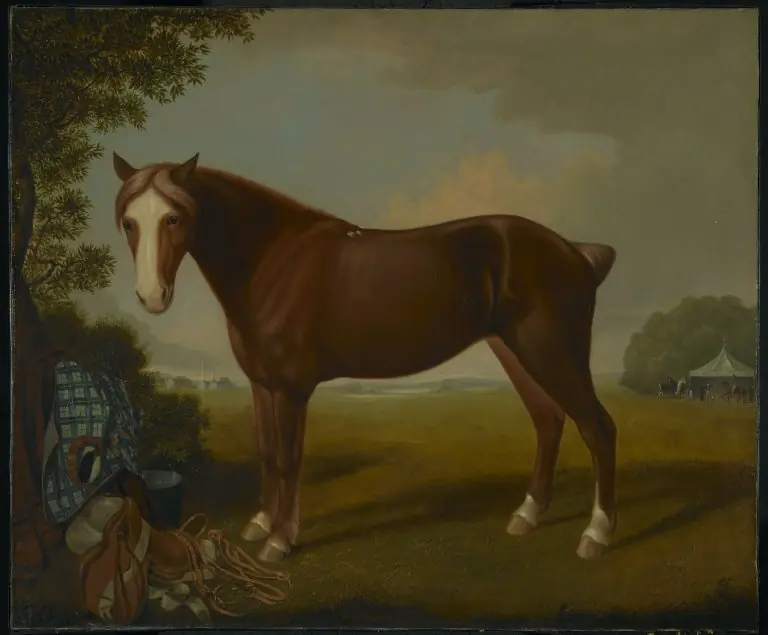 Portrait of a Horse
 Horses in freedom
- Ride