Artwork
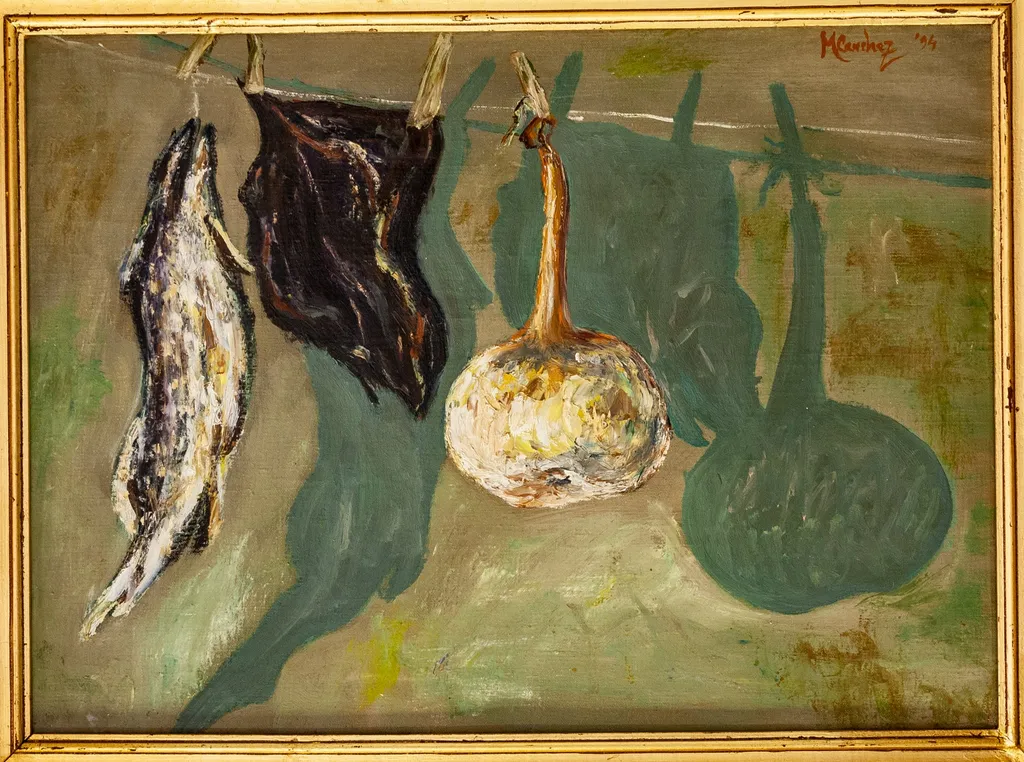
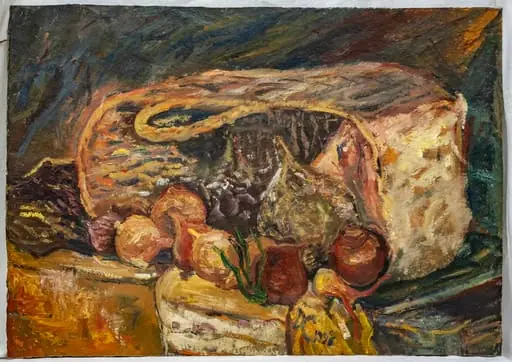
În lucrare sunt compuse, spre stânga, trei elemente: un pește, o cârpă și o cătrună; agățate cu clești de o sârmă de rufe. Obiectele sunt iluminate din stânga lăsându-și umbrele pe un plan în dreapta. Cromatica este dominată de nuanțe de verde la fundal și accente brun, galben și alb la obiecte. Există o semnătură și o datare în dreapta sus „MCerchez ‘94”.
În lucrare sunt compuse, spre stânga, trei elemente: un pește, o cârpă și o cătrună; agățate cu clești de o sârmă de rufe. Obiectele sunt iluminate din stânga lăsându-și umbrele pe un plan în dreapta. Cromatica este dominată de nuanțe de verde la fundal și accente brun, galben și alb la obiecte. Există o semnătură și o datare în dreapta sus „MCerchez ‘94”. is an unspecified painting by Monica Cerchez Chirnoagă. It is held in the collection of the Gavrila Simion Eco-Museum Research Institute Tulcea. This painting presents three ordinary objects, a fish, a crumpled cloth, and a gourd, suspended from a wire against a greenish background.
About this work
Overview
This painting presents three ordinary objects, a fish, a crumpled cloth, and a gourd, suspended from a wire against a greenish background.
This painting presents three ordinary objects, a fish, a crumpled cloth, and a gourd, suspended from a wire against a greenish background. The composition is sparse and deliberately unadorned, focusing attention on the textures and spatial relationships of the items. Strong directional lighting casts sharp shadows, enhancing the sense of volume and isolation.
The work is signed and dated 'MCerchez '94' in the upper right corner, anchoring it to a specific moment in the artist’s practice.
Subject & Meaning
The selection of mundane, domestic items, each associated with food, laundry, or storage, suggests a quiet meditation on everyday life. Their arrangement, neither symbolic nor narrative, invites contemplation of their physical presence rather than their function. The absence of context or human trace amplifies their anonymity, transforming the ordinary into a subject worthy of formal study.
Technique & Style
The artist employs thick, tactile brushwork to render surface textures: the fish’s scales, the cloth’s folds, the gourd’s rough skin. Light enters from the left, creating high-contrast shadows that define form with clarity. The palette is restrained, greens dominate the background, while browns, yellows, and whites define the objects. This approach emphasizes materiality over atmosphere, aligning with a direct, unembellished visual language.
History & Provenance
The work is dated 1994 and bears the artist’s signature, indicating it was created during a period of personal exploration in Romanian contemporary art. No public record of prior ownership or exhibition is widely documented. Its modest scale and subject suggest it may have been a studio study, possibly part of a series examining still-life elements through a reductive, observational lens.
Context
Created in post-communist Romania, the work reflects a broader shift in visual culture toward introspective, non-ideological art. With state-sponsored symbolism fading, many artists turned to quiet, material-focused subjects. This painting’s emphasis on texture and light, without political or allegorical intent, aligns with a generation seeking artistic autonomy through formal precision and everyday observation.
Legacy
Though not widely exhibited, the painting exemplifies a quiet strain in Romanian painting that values observation over rhetoric. Its focus on ordinary objects under controlled lighting anticipates later interest in phenomenological art, where perception and materiality take precedence over narrative. It remains a quiet testament to the dignity found in the overlooked.
Artist & collection
Artist
Monica Cerchez Chirnoagă hung her laundry on the same line as her fish, literally.
Museum
Gavrila Simion Eco-Museum Research Institute Tulcea
Continue through works from the same source collection.