Artwork
The Bridge at La Cava, Kingdom of Naples
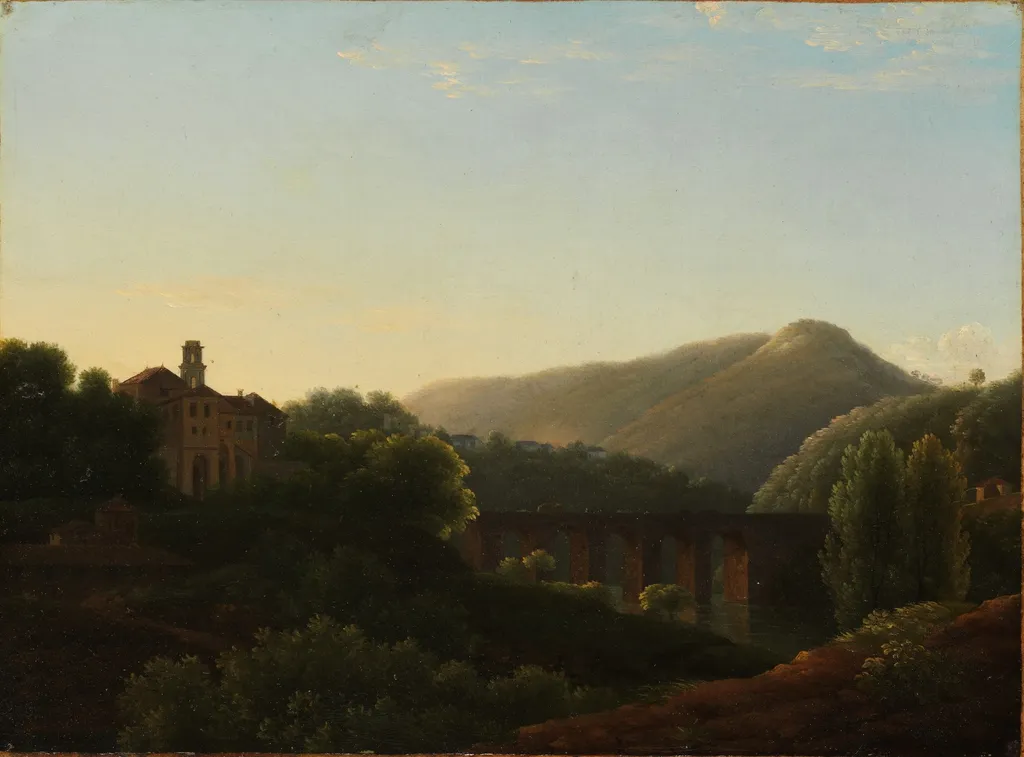
The Bridge at La Cava, Kingdom of Naples is an unspecified painting by the French Romanticist artist Jean-Joseph-Xavier Bidauld. It dates from 1812 and is held in the collection of the Metropolitan Museum of Art.
About this work
History & Provenance
The work depicts a bridge within a landscape setting, consistent with Bidauld's genre specialization during this period.
Jean-Joseph-Xavier Bidauld created the landscape painting titled The Bridge at La Cava, Kingdom of Naples in 1812. While specific details regarding the original commission or the immediate ownership chain following its completion are not provided in the available records, the work's inception is established in that year. The painting eventually entered the collection of the Metropolitan Museum of Art, where it is currently housed. The work depicts a bridge within a landscape setting, consistent with Bidauld's genre specialization during this period.
The painting is held by the Metropolitan Museum of Art in New York, where it is inventoried as 1975.1.211. It was accessioned in 1975. No further exhibition history is recorded in the cited sources.
Legacy
The Bridge at La Cava, Kingdom of Naples, painted by Jean-Joseph-Xavier Bidauld in 1812, is classified as a landscape that depicts a bridge within a picturesque Neapolitan setting. Its inclusion in the Metropolitan Museum of Art's collection reflects its place in the study of early nineteenth-century landscape art and its role in documenting Italian scenery. The work's formal composition and subject matter situate it within Bidauld's contribution to the landscape genre.
Overview
Jean-Joseph-Xavier Bidauld's painting, The Bridge at La Cava, Kingdom of Naples, completed in 1812, exemplifies the French Romanticism movement. This oil on canvas depicts a serene natural vista centered around an architectural feature, reflecting the artist's dedication to landscape subjects. The work is currently housed in the collection of The Metropolitan Museum of Art, representing a key aspect of early 19th-century French art.
Subject & Meaning
The painting captures a tranquil village scene nestled within a valley, where a stone bridge gracefully arches over a small stream. A church with a prominent bell tower stands to the left, complementing the soft, distant hills under a pale blue sky. The composition evokes a sense of calm and peace, emphasizing the harmonious relationship between human structures and the surrounding natural environment, a common theme in Bidauld's landscapes.
Technique & Style
Bidauld employed a gentle application of light to articulate the forms of the trees and buildings, making them subtly distinct against the backdrop of the hills. The palette features muted greens and browns, which blend seamlessly into the natural setting, contributing to the overall subdued and peaceful mood. This approach to color and illumination underscores the artist's focus on rendering atmospheric and realistic landscape views, characteristic of his developing style.

Own this work as a print
Artist & collection

Artist
Jean-Joseph-Xavier Bidauld (10 April 1758 – 20 October 1846) was a French painter.



 Ideal Landscape with a Sacrifice to the Goddess Flora
 A Bridge near Sorrento
 An Aqueduct Near a Fortress
 Italian Landscape
 Lake Nemi, sunset
 Italian Landscape
 Italian Landscape (Le Paysage d'Italie)
 View near Naples
 View of Montesarchio
 Landscape with a Draftsman
 View of Saint-Cloud, Near the Seine
- View of the Bridge and Part of the Town of Cava, Kingdom of Naples