Artwork
Honfleur
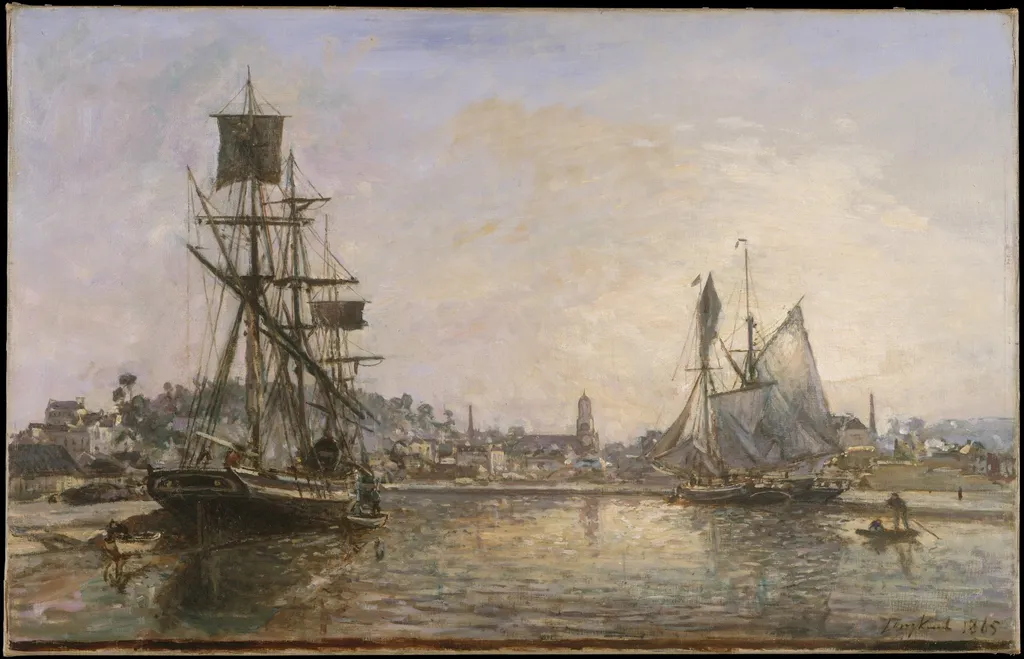
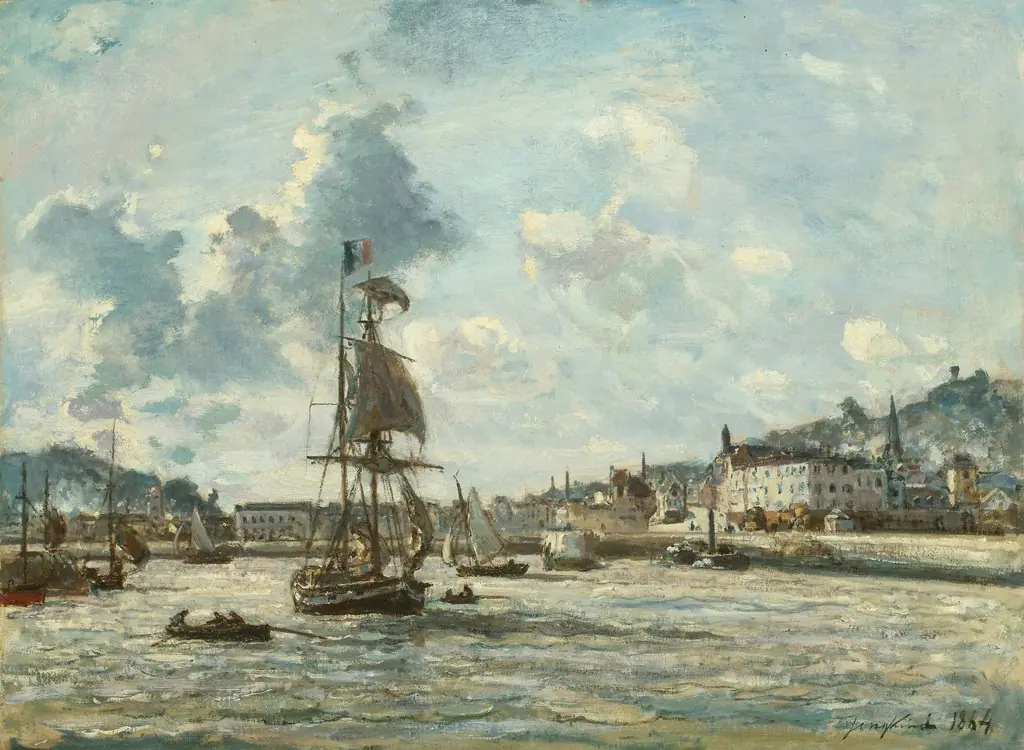
Honfleur is an oil painting by the Impressionist artist Johan Jongkind. It dates from 1865 and is held in the collection of the Metropolitan Museum of Art.
About this work
Subject & Meaning
Jongkind, known for his harbor scenes, treats the ship as both a documentary record of the locale and an emblem of its economic life.
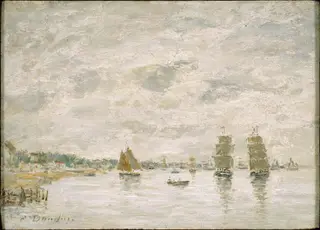
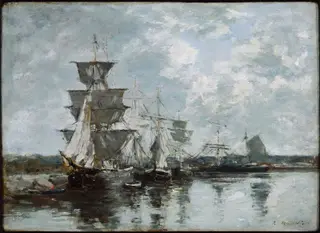
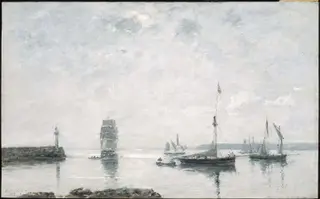
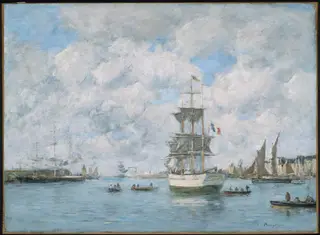
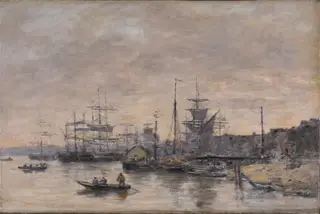
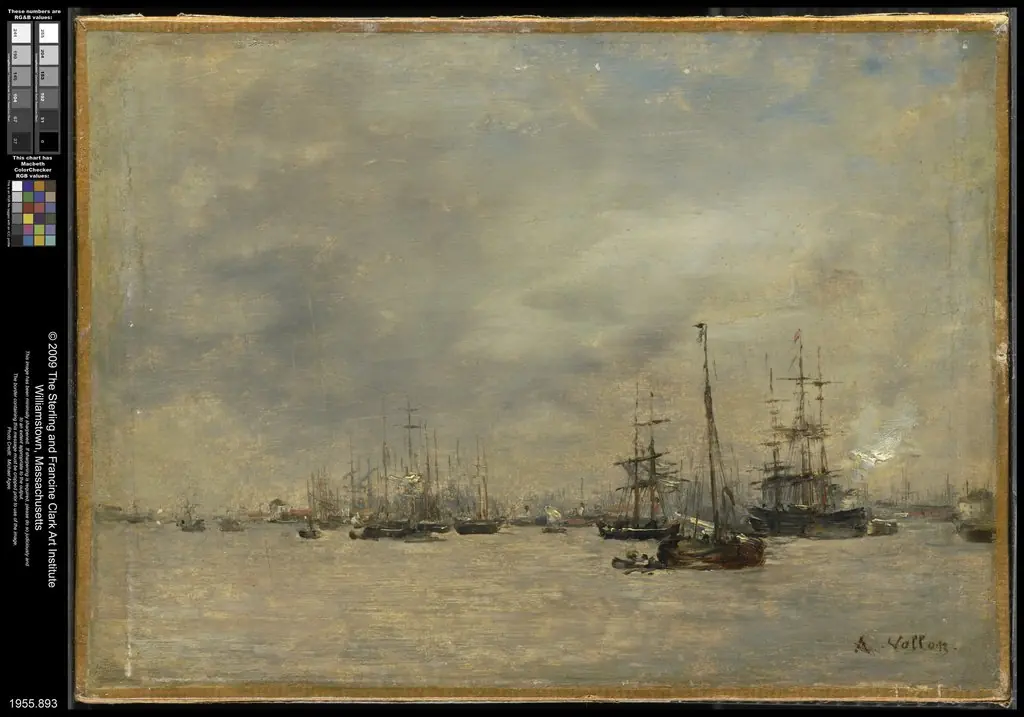
Johan Jongkind's 1865 oil painting "Honfleur" depicts a ship, according to the subject cataloguing for the work. The title refers to the Normandy port town of Honfleur, a long-favored subject among nineteenth-century French painters for its working harbor, maritime traffic, and luminous coastal light. By naming the town and picturing a vessel, the canvas situates the viewer at the water's edge, evoking the rhythms of seafaring trade that defined the port's identity.
Jongkind, known for his harbor scenes, treats the ship as both a documentary record of the locale and an emblem of its economic life.
The wide, horizontal format of the canvas (81.6 cm across by 52.1 cm high) suits a panoramic harbor view, allowing the vessel and its surroundings to be read as a vignette of port activity rather than a portrait of a single craft.
Technique & Style
Johan Jongkind painted Honfleur in 1865 using oil paint on canvas, a technique characteristic of his early Impressionist approach. The work measures 52.1 cm in height by 81.6 cm in width and depicts a ship, reflecting the artist’s focus on maritime subjects and atmospheric effects. Executed with loose brushwork and careful handling of light, the painting exemplifies Jongkind’s contribution to the development of plein-air painting and his influence on later Impressionist artists.
The canvas support provides a stable yet flexible surface that allows for both precise detail in the rigging and broader, expressive strokes in the sky and sea. The handling of pigment emphasizes subtle tonal variations, while the formal composition balances structural clarity with a sense of immediacy, aligning with the stylistic qualities observed in the Metropolitan Museum of Art’s collection.
These characteristics underscore the painting’s significance within Jongkind’s oeuvre and its role in bridging 19th-century Dutch marine painting and the emerging Impressionist movement.
History & Provenance
The painting Honfleur by Johan Jongkind, created in 1865, is part of the Metropolitan Museum of Art's collection and is cataloged under the accession number 1983.245. It has been exhibited at the museum, including participation in the 1983 exhibition "European Paintings: A Century of Collecting" and subsequently featured in various thematic displays of 19th-century French art within the institution.
Overview
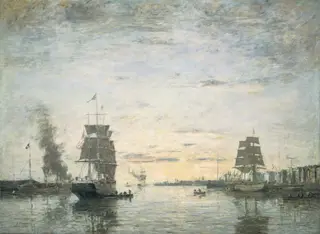
Johan Jongkind’s 1865 oil painting Honfleur portrays a tranquil harbor scene in the French port town of Honfleur. Two vessels dominate the composition, their masts and sails rendered with a light touch against a calm sea. In the distance, modest town structures, trees, and a church spire emerge in muted blues and grays, establishing a serene, atmospheric view.
Context
Jongkind, a Dutch artist active in France, was known for marine subjects and for experimenting with freer painting methods. Honfleur exemplifies his role as a precursor to Impressionism, bridging traditional Dutch landscape traditions with the emerging emphasis on light, atmosphere, and spontaneous execution that would define the movement in the following decades.
Own this work as a print
Artist & collection
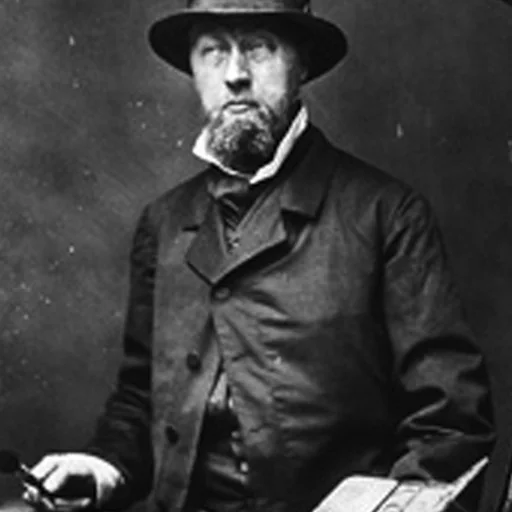
Artist
Johan Barthold Jongkind (Dutch pronunciation:; 3 June 1819 – 9 February 1891) was a Dutch painter and printmaker. He painted marine landscapes in a free manner and is regarded as a forerunner of impressionism.