Artwork
Members of the City Troop and Other Philadelphia Soldiery
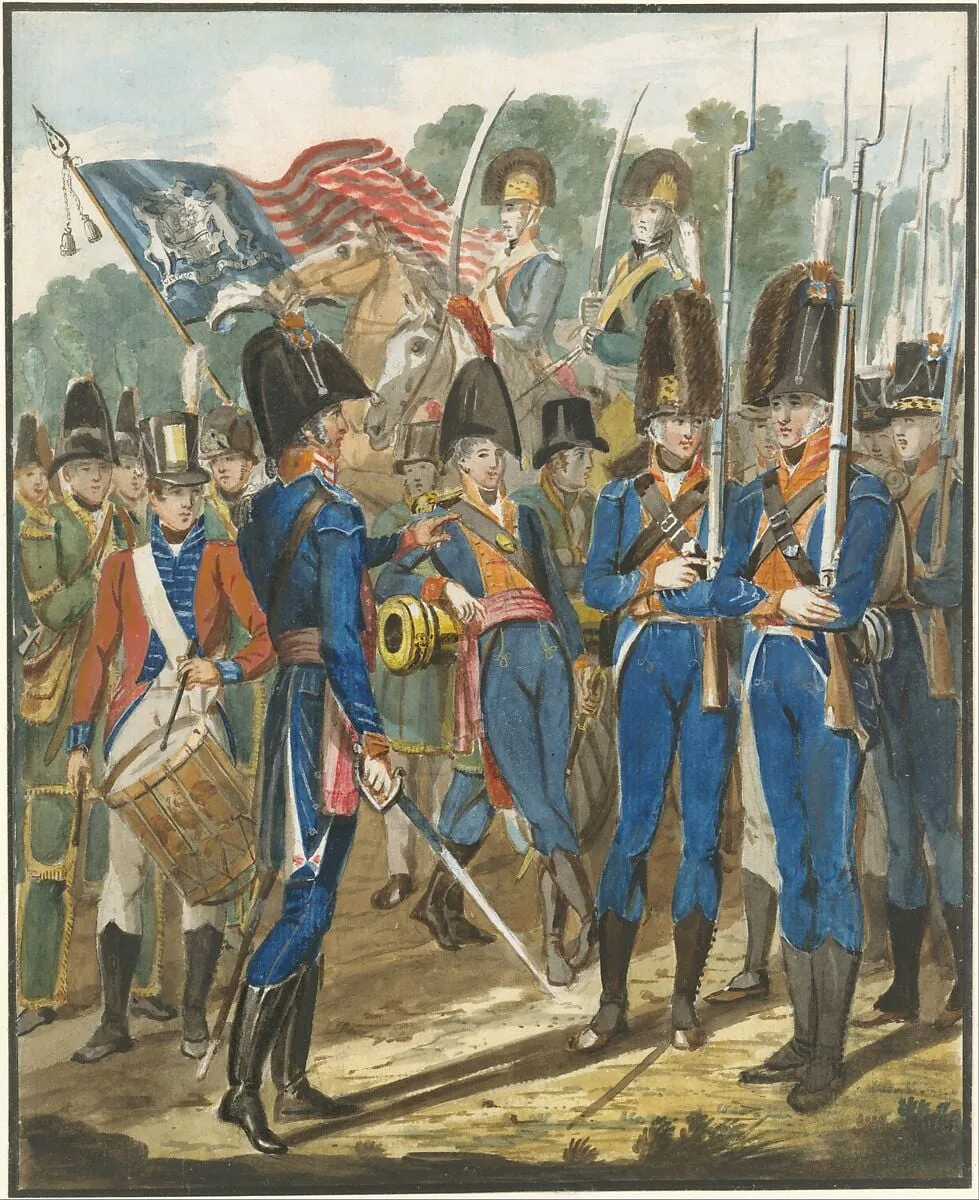
Members of the City Troop and Other Philadelphia Soldiery is a watercolor work on paper by the American Folk Art artist John Lewis Krimmel. It dates from 1811 and is held in the collection of the Metropolitan Museum of Art.
About this work
This painting is rare because it shows Philadelphia’s local militia in 1813, not professional soldiers.
You see a row of soldiers on horseback, some holding flags, others with swords or muskets. Their uniforms are bright, red coats, blue pants, polished boots. A few men stand on foot, watching.
This painting is rare because it shows Philadelphia’s local militia in 1813, not professional soldiers. The artist sketched them quickly, almost like a snapshot, which was unusual for the time. The loose, watery brushstrokes make the scene feel alive, not stiff.
If you like this, look up other works about soldiers, firearms, swords, horses, flags.
Subject & Meaning
The watercolor portrays members of Philadelphia’s City Troop alongside other local soldiery, assembled as a militia genre scene. Figures are shown with muskets, bayonets, swords, and a drum, while a horse and a flag appear in the composition. These elements, arms, percussion instrument, equine mount, and national banner, function as icons of martial readiness, civic duty, and patriotic pride characteristic of early‑American militia imagery.
By gathering the troop’s soldiers and their equipment in a single view, Krimmel emphasizes the communal identity and preparedness of the city’s citizen‑soldiers in the post‑Revolutionary era.
Technique & Style
The work is executed in watercolor, gouache, and graphite on a white laid paper support, a combination typical of early American genre scenes that emphasizes linear definition alongside translucent washes. Krimmel’s handling of the militia figures employs fine graphite outlines to delineate uniforms and weaponry, while layered watercolor and gouache create muted tonal gradations that suggest both the immediacy of sketch and the finish of a finished picture.
The composition balances precise detail, such as the bayonet, drum, and flag, with a loose, atmospheric background, reflecting the documentary intent of the genre scene and the artist’s interest in civic identity. The piece measures approximately 22.9 × 18.4 cm, as recorded in the Metropolitan Museum of Art catalogue.
History & Provenance
Members of the City Troop and Other Philadelphia Soldiery was created in 1811 by the American artist John Lewis Krimmel. Executed in watercolor, gouache, and graphite on white laid paper, the work depicts a troop of Philadelphia soldiers with horses, drums, flags, and weaponry. It entered the collection of the Metropolitan Museum of Art, where it is recorded under accession number 42.95.21.
The sources do not provide information about any earlier ownership, commission, or subsequent provenance beyond its current location at the Met.
Legacy
The painting is part of the Metropolitan Museum of Art’s collection and is exhibited in The American Wing, where its status as a genre scene depicting Philadelphia militia has been used to illustrate early American military culture.
Its detailed rendering of symbols such as bayonets, drums, and flags provides a contemporary visual record of militia dress and equipment, and its placement in a prominent museum has made it a reference point in studies of early American visual culture, reinforcing its lasting scholarly reputation.
Overview
John Lewis Krimmel's "Members of the City Troop and Other Philadelphia Soldiery," created around 1811, is a watercolor, gouache, and graphite work on white laid paper. This genre scene captures a lively moment featuring local military figures from Philadelphia. It offers a glimpse into the appearance and activities of the city's non-professional military units, distinguishing it from depictions of regular army forces. The artwork is housed in The American Wing.
Context
This artwork holds particular historical value for its depiction of Philadelphia's local militia around 1813. Unlike common portrayals of professional military forces, Krimmel chose to focus on citizen soldiers, offering a unique visual document of non-regular troops in the early American republic. This choice provides insight into the social and military structures of the time, highlighting the role of local defense units within the community.
Artist & collection

Artist
John Lewis Krimmel (May 30, 1786 – July 15, 1821), sometimes called "the American Hogarth," was North America's first painter of genre scenes.

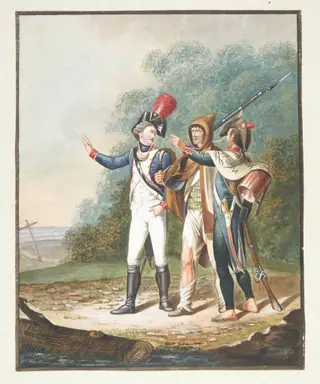 Tre franske soldater på en vej
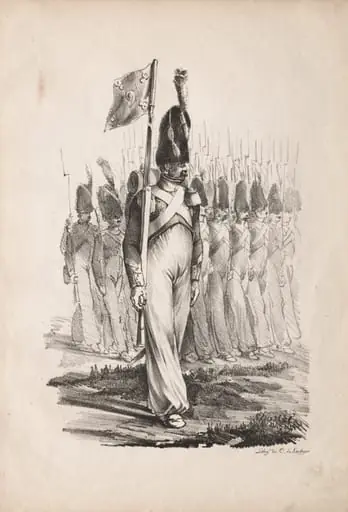 Military Costumes: Carabiners Sargent, General Guide
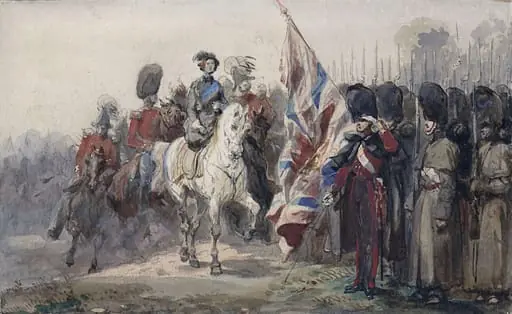 Queen Victoria at a review in Cobham
 A View of Somerset
 Guards at a Review in Windsor Park
 The History of the United States
 Carabinier
 A Party of Life Guards
 The Battle of Würzburg in 1796
 William V of Orange
 La Batalla de Almansa
- Officers at Cobham Camp