Artwork
Dean Swift
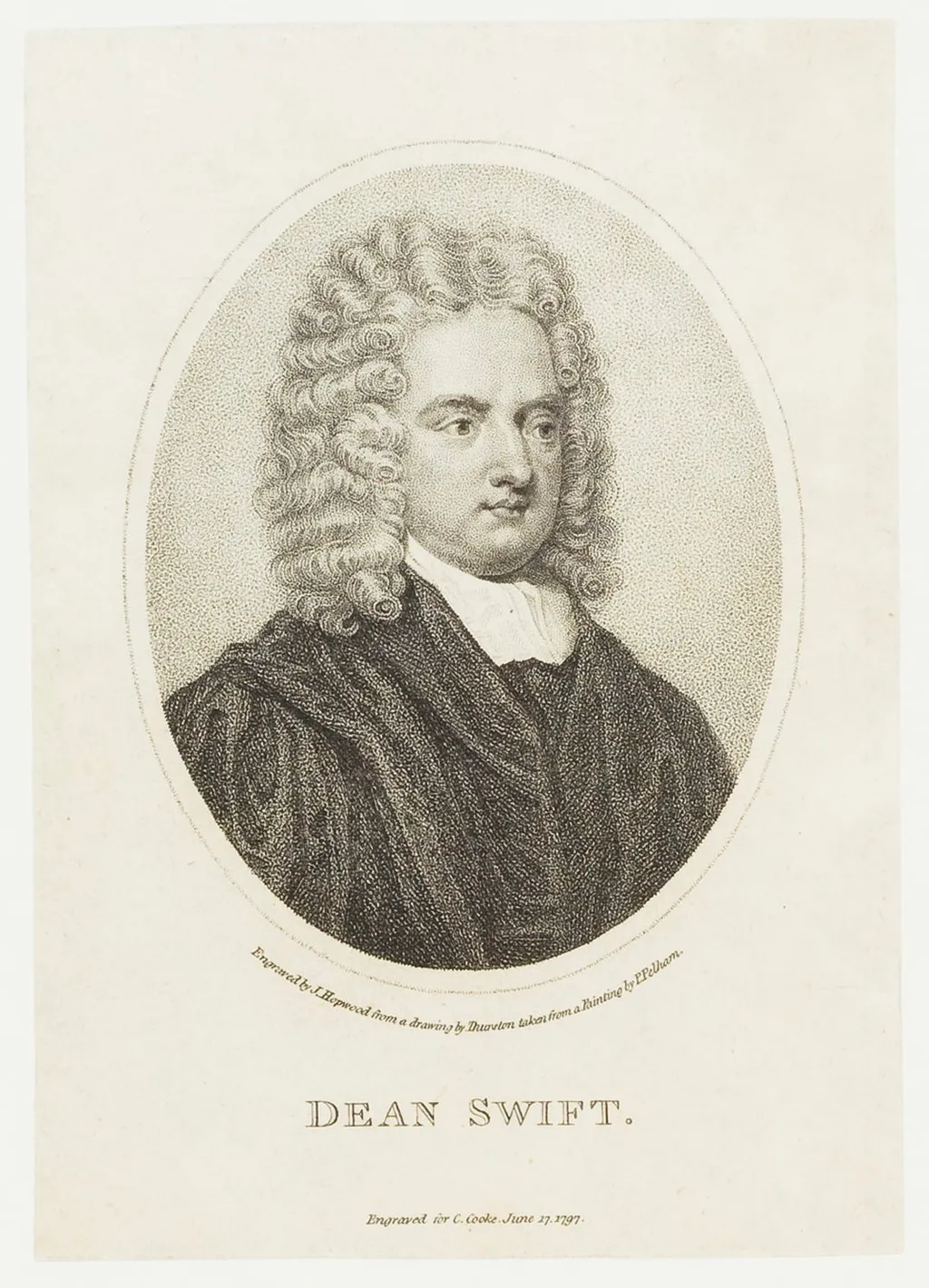
Dean Swift is a drawing by the Romanticist artist John Thurston. It dates from 1797 and is held in the collection of the Catholic University of Leuven.
About this work
This shows a serious man in a dark coat and white wig. A small label under his chin reads "DEAN SWIFT." He looks tired, almost cross.
The drawing started as a painting by P. Pelham. An engraver named J. Hopwood turned it into this print in 1797. Cooke published it the same year.
Check out more portraits by the artist at Museum of Ethnography.
Overview
This print depicts Jonathan Swift, the Anglo-Irish satirist and clergyman, rendered as a somber, middle-aged man in a dark coat and powdered wig.
This print depicts Jonathan Swift, the Anglo-Irish satirist and clergyman, rendered as a somber, middle-aged man in a dark coat and powdered wig. Created in 1797, it is an engraving by J. Hopwood based on a drawing by Thurston, which itself derived from an earlier painting by P. Pelham. The image was published by C. Cooke, who commissioned the work for distribution. The portrait carries no decorative flourish, emphasizing restraint and intellectual gravity.
Subject & Meaning
The portrayal of Swift conveys weariness and sternness, aligning with his public reputation as a sharp-tongued critic and moralist. His furrowed brow and tight lips suggest introspection or irritation, reinforcing associations with his literary persona. The minimal labeling, only his title and name, avoids embellishment, directing focus to his expression rather than status symbols. This visual tone reflects the 18th-century ideal of the learned man, burdened by thought and duty.
Technique & Style
The image is a line engraving, a precise method requiring fine incisions on a metal plate to transfer tonal variation. Hopwood’s handling emphasizes texture in the wig and fabric, using controlled hatching to suggest depth without shading. The composition is tightly framed, eliminating background detail to isolate the figure. This restrained style was typical of portrait prints intended for mass reproduction, prioritizing clarity over artistic flourish.
History & Provenance
The portrait originated as a painting by P. Pelham, later adapted into a drawing by Thurston, and finally engraved by J. Hopwood in 1797. It was published by C. Cooke, a London print seller known for distributing literary portraits. The chain of reproduction reflects the common practice of translating painted likenesses into affordable prints for public consumption. No record indicates the original painting’s current location, but the engraving survives in multiple institutional collections.
Context
In 1797, Swift had been dead for over seventy years, yet his legacy as a writer and thinker remained potent in British intellectual circles. Portraits like this were circulated to reinforce cultural memory, particularly during a period of political upheaval when his satirical voice was frequently invoked. The print’s modest scale and commercial origin suggest it was meant for private study or scholarly collections rather than public display.
Legacy
This engraving contributed to the standardized visual identity of Swift in the 19th century, influencing later depictions in textbooks and biographies. While not artistically innovative, its widespread reproduction helped cement his image as a stern, cerebral figure. The work’s endurance lies not in its aesthetic originality, but in its role as a durable conduit of literary memory across generations.
Artist & collection
Artist
John Thurston (1774–1822) was a British printmaker and illustrator. Thurston began his artistic career as a copper plate engraver, working for James Heath. Then he took up book illustration, and soon totally devoted…