Artwork
The Palisades
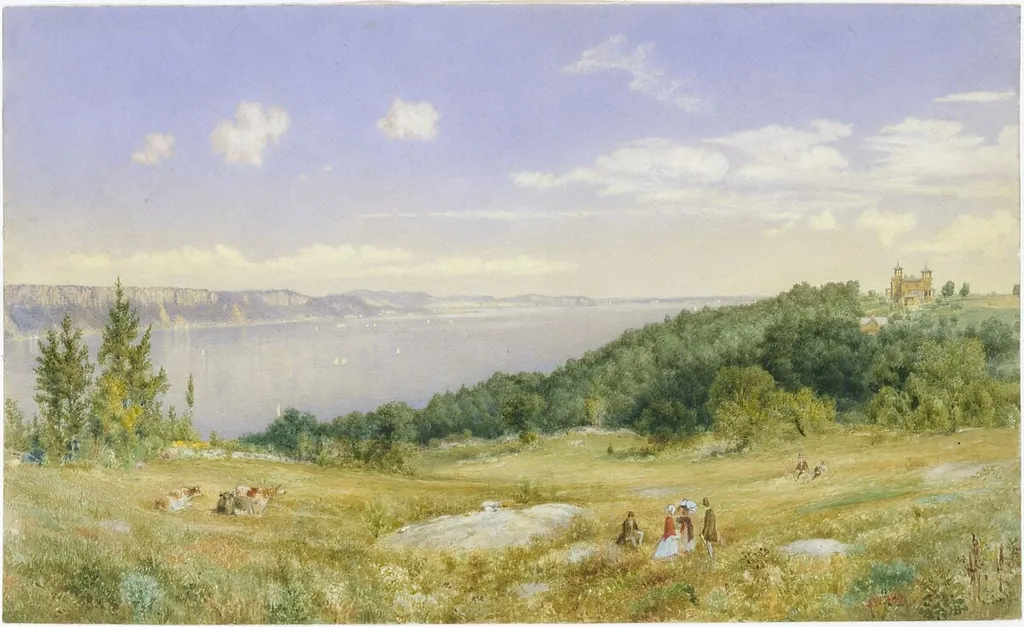
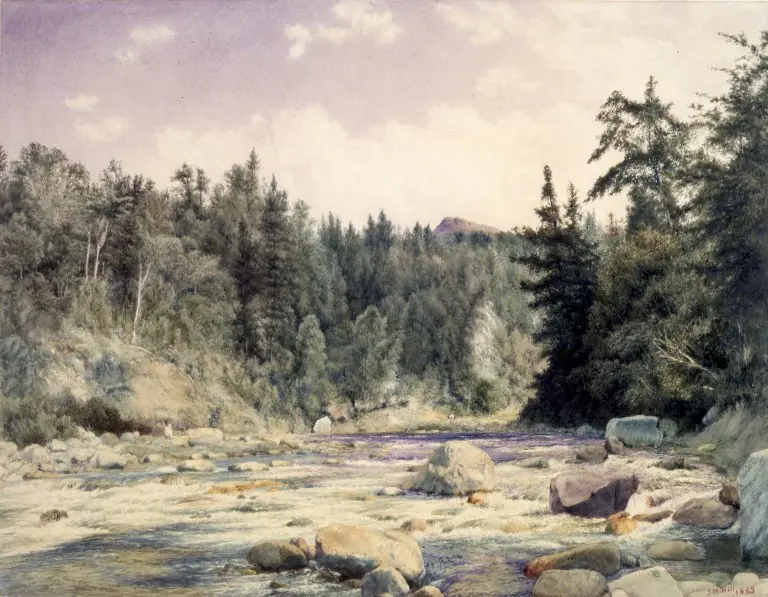
The Palisades is a watercolor work on paper by the Hudson River School artist John William Hill. It dates from 1870 and is held in the collection of the Metropolitan Museum of Art.
About this work
Technique & Style
Executed in a delicate wash technique, the work employs subtle tonal gradations and precise line work characteristic of John William Hill's mature style.
The Palisades is an 1870 watercolor and gouache painting on white wove paper, depicting a landscape. Executed in a delicate wash technique, the work employs subtle tonal gradations and precise line work characteristic of John William Hill's mature style. The support, a smooth paper surface, enhances the transparency of the pigments, allowing fine atmospheric effects to emerge.
The composition balances detailed foreground foliage with expansive sky, creating a cohesive visual rhythm. The painting's condition remains stable, with no noted flaking or pigment alteration, reflecting careful handling and archival preservation.
History & Provenance
John William Hill painted The Palisades in 1870 using watercolor and gouache on white wove paper, a technique documented in its classification within The American Wing as a landscape painting. The work entered the Metropolitan Museum of Art's collection, where it remains on view, with provenance linked to its original creation and subsequent institutional acquisition. Dimensions of 24.4 cm by 41 cm reflect the physical measurements recorded at accession.
The painting's creation history is anchored to 1870, with no documented earlier date or alternative authorship in the sources. Its ownership chain is singular, moving directly from the artist to the Metropolitan Museum of Art, establishing a clear institutional stewardship since acquisition.
The Palisades is held in the collection of the Metropolitan Museum of Art, where it is classified within the institution's American Wing.
No specific inventory or accession number is recorded in the available sources, and no exhibition history is documented for the work.
Overview
Created circa 1870 by John William Hill, this work presents a tranquil riverside vista rendered in watercolor and gouache on white wove paper. The composition opens onto a verdant hillside speckled with trees and distant figures, beyond which a broad expanse of water reflects a pale sky and a far‑off cliff.
Subject & Meaning
The painting captures a peaceful moment in a natural setting, emphasizing the harmony between land, water, and sky. The modest human presence suggests a contemplative relationship with the environment, inviting viewers to consider the quiet beauty of an unspoiled landscape.
Context
Hill, a British‑born artist who settled in America, was active during the mid‑nineteenth century when the Hudson River School promoted detailed, idealized depictions of nature. Influenced by John Ruskin and American Pre‑Raphaelite circles, his later work shifted toward meticulous landscape rendering, as seen in this piece.
Artist & collection

Artist
John William Hill or often J.W. Hill (January 13, 1812 – September 24, 1879) was a British-born American artist working in watercolor, gouache, lithography, and engraving. Hill's work focused primarily upon natural…


 Landscape, Hyde Park, New York
 Lago Avernus
 The Lakes at Laven near Silkeborg
 View of Hamilton and Lake Ontario from Dundas
 Londonderry Harbour
 Cliffs at Newport, Rhode Island
 Drake's Island, Plymouth Sound
 Loch Long, Argyllshire
 Study from Nature
 Die Mündung des Bosporus (Yoros Kalesi)
 Autumn Morning on the Potomac
- Trees Profiled against the Sky