Artwork
Últimos momentos de Fernando IV el Emplazado
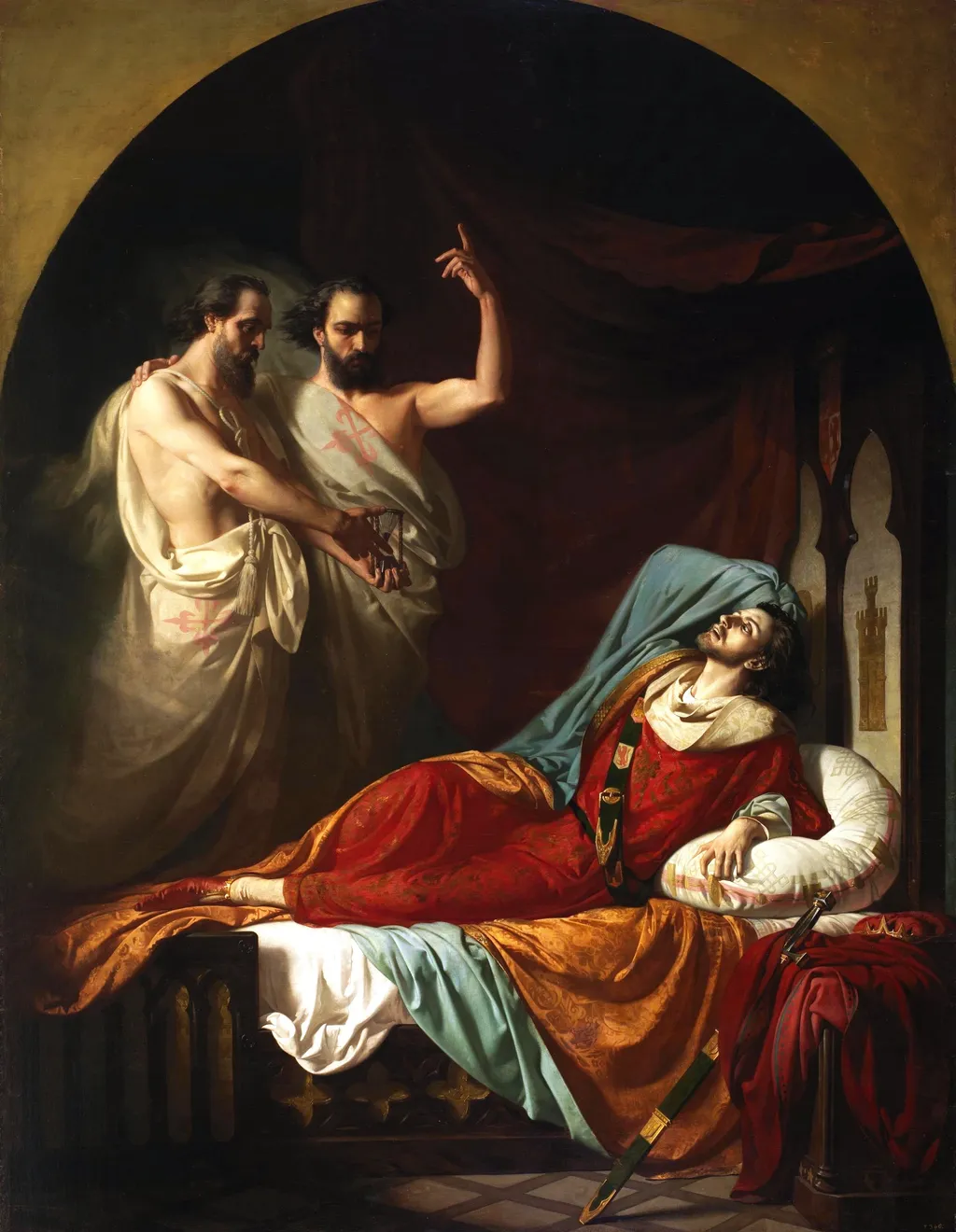
Últimos momentos de Fernando IV el Emplazado is an oil painting by José Casado del Alisal. It dates from 1860 and is held in the collection of the Museo del Prado.
About this work
Subject & Meaning
Its presence transforms the intimate chamber into a stage of cosmic reckoning, linking the king's physical decline to the fulfillment of the brothers' curse.
The painting depicts the legendary final moments of King Ferdinand IV of Castile, who died in Jaén on 7 September 1312, exactly thirty days after the execution of the Carvajal Brothers. According to medieval chronicles, the Carvajal Brothers, knights of the Order of Calatrava condemned for the murder of the king's favorite Juan de Benavides, summoned Ferdinand IV to appear before God within thirty days as retribution for their unjust death. The work visualizes the king's deathbed scene, where the symbolism centers on this supernatural summons to divine judgment. A key iconographic element is the hourglass, which materializes the countdown of the thirty-day plazo issued by the Carvajal Brothers. Its presence transforms the intimate chamber into a stage of cosmic reckoning, linking the king's physical decline to the fulfillment of the brothers' curse. The painting thus embodies the medieval legend that earned Ferdinand IV the epithet "el Emplazado" ("the Summoned"), representing the moral consequences of royal injustice and the medieval belief that earthly power remained accountable to divine tribunal.
Technique & Style
The painting Últimos momentos de Fernando IV el Emplazado is executed in oil on canvas. The work measures 318 cm in height by 248 cm in width. It depicts the final moments of King Ferdinand IV of Castile, showing him in his bedroom surrounded by the Carvajal brothers, an hourglass, and symbolic elements of mortality. The composition is formal and narrative, emphasizing historical drama through chiaroscuro lighting and precise anatomical rendering typical of 19th‑century academic painting. The brushwork is smooth, with a restrained palette of earth tones that heightens the somber mood. The canvas bears the surface texture of a traditional support, handled with a restrained impasto that preserves fine detail in facial expressions and drapery. Its condition is stable, having been conserved for display in the Palacio del Senado since 1881.
The painting was awarded a first‑class medal at the 1860 Exposición Nacional de Bellas Artes, reflecting contemporary appreciation for its technical skill and historical subject matter.
History & Provenance
Últimos momentos de Fernando IV el Emplazado is an oil on canvas painting created in 1860 by José Casado del Alisal. The work was first exhibited at the Exposición Nacional de Bellas Artes de 1860, where it received a first-class medal, and the same year it was purchased by the Spanish State for 45,000 reales through a royal decree of 20 December 1860 for the Museo del Prado collection. In 1862 the canvas traveled to the Exposición Universal de 1862 in London and returned to Spain in early 1863. By 1881, pursuant to a royal decree of 8 January 1881, the painting was transferred as a deposit from the Prado to the Senate of Spain and has been displayed there ever since. It was also shown in 1892 in the History of Painting section of the Exposición Nacional de Bellas Artes alongside works by Antonio Gisbert, Eduardo Cano and Francisco Pradilla. Contemporary reproductions appeared in El Museo Universal (1860), El Museo Literario (1865) and La Ilustración de España (1886). The Prado holds the work, but its physical location has been the Palacio del Senado since 1881.
The painting Últimos momentos de Fernando IV el Emplazado is held in the Palacio del Senado in Madrid, where it has been displayed since 1881 on long‑term deposit from the Museo del Prado (source 1; source 2; source 4). The work entered the Spanish state collection in 1860 after winning a first‑class medal at the Exposición Nacional de Bellas Artes, and was acquired by Royal Order of 20 December 1860 for 45,000 reales (source 3; source 4). It was later shown at the 1862 Universal Exhibition in London, returned to Spain in early 1863, and exhibited in 1876 at the Galería de Bellas Artes in Philadelphia before being formally transferred to the Senate by Royal Order of 8 January 1881 (source 3; source 4). A preparatory sketch is held by the Provincial Council of Palencia, and the painting was featured in the 1892 section “Historia de la Pintura” of the Spanish National Exhibition of Fine Arts alongside works by Gisbert, Cano and Pradilla (source 3; source 4).
Context
Casado del Alisal presented the canvas at the 1860 Exposición Nacional de Bellas Artes alongside Un prisionero and Semíramis en el Infierno del Dante, where it received one of five first-class medals and was acquired by the Spanish state for 45,000 reales. The work was subsequently shown at the 1862 Universal Exhibition in London, at a 1876 exhibition at the Philadelphia Gallery of Fine Arts, and in the History of Painting section of the 1892 Exposición Nacional de Bellas Artes, where it appeared alongside historical canvases by Antonio Gisbert, Eduardo Cano, and Francisco Pradilla. Contemporary criticism was highly laudatory, and the painting was reproduced as an engraving in El Museo Universal (1860), El Museo Literario (1865), and La Ilustración de España (1886). The composition belongs to the mid-nineteenth-century Spanish school of history painting devoted to medieval Castilian subjects, a vein also pursued by Gisbert, whose 1863 depiction of María de Molina presenting Fernando IV at the Cortes of Valladolid was inspired by the same historical milieu, and by Salvador Martínez Cubells, who in 1867 painted La muerte de los Carvajales directly on the Carvajal legend.
Legacy
Últimos momentos de Fernando IV el Emplazado has exerted lasting influence on Spanish historical painting through its dramatic portrayal of royal martyrdom and institutional legacy. The work earned Casado del Alisal a first-class medal at the 1860 Exposición Nacional de Bellas Artes and was acquired by the Spanish state the same year for 45,000 reales (source 3). It entered the Museo del Prado collection but has been displayed since 1881 in the Palacio del Senado as a loaned piece (source 4). The painting traveled internationally, appearing in the 1862 Universal Exposition in London and later in a 1876 Philadelphia exhibition before its permanent transfer to the Senate (source 3). Contemporary reproductions in periodicals such as El Museo Universal (1860), El Museo Literario (1865) and La Ilustración de España (1886) further disseminated its image (source 3). The artwork's narrative, depicting Ferdinand IV’s death thirty days after the execution of the Carvajal brothers, became emblematic of 19th-century Spanish historical consciousness, reinforcing popular memory of the monarch’s ‘Ajourned’ epithet and the political tensions of his reign (source 2).
Own this work as a print
Artist & collection

- The Death of Belisarius' Wife
 The Death of Saint Louis
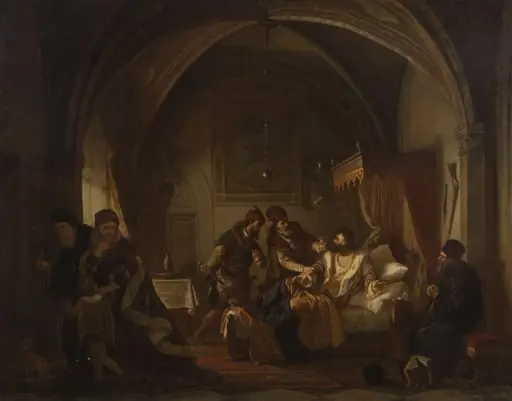 Moartea lui Alexandru Lăpușneanu
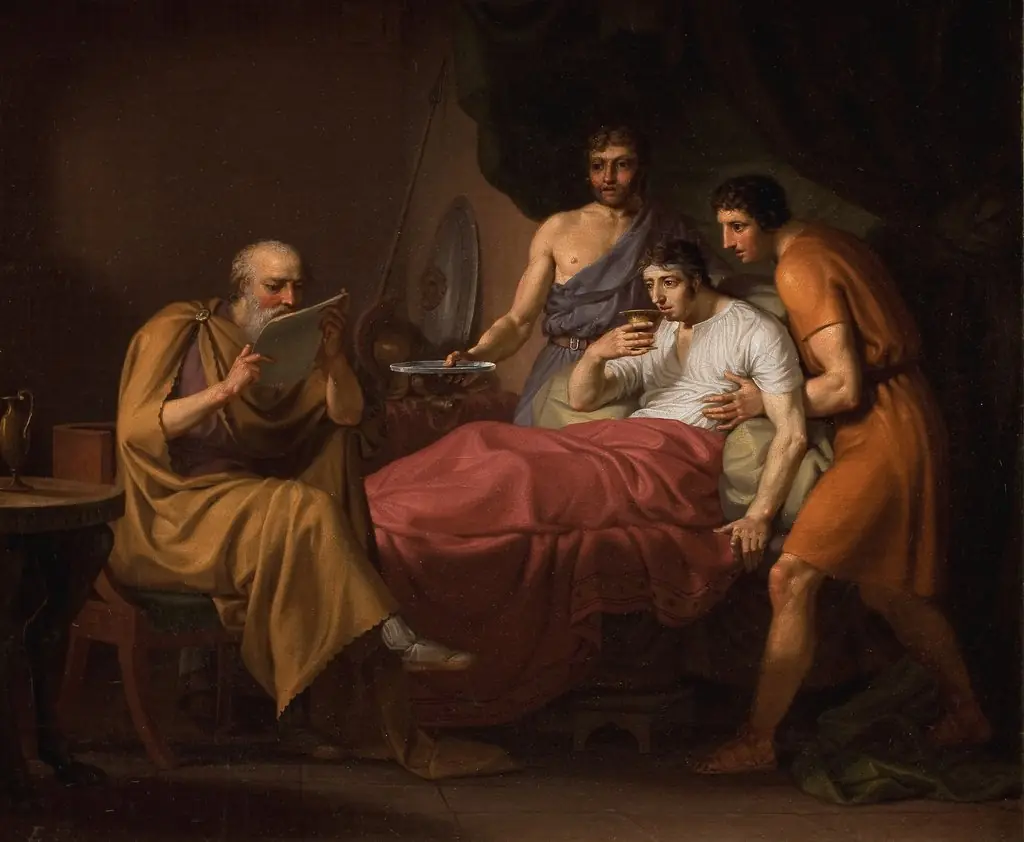 Alexander den Store på sygelejet
 Alexander the Great on his Sickbed
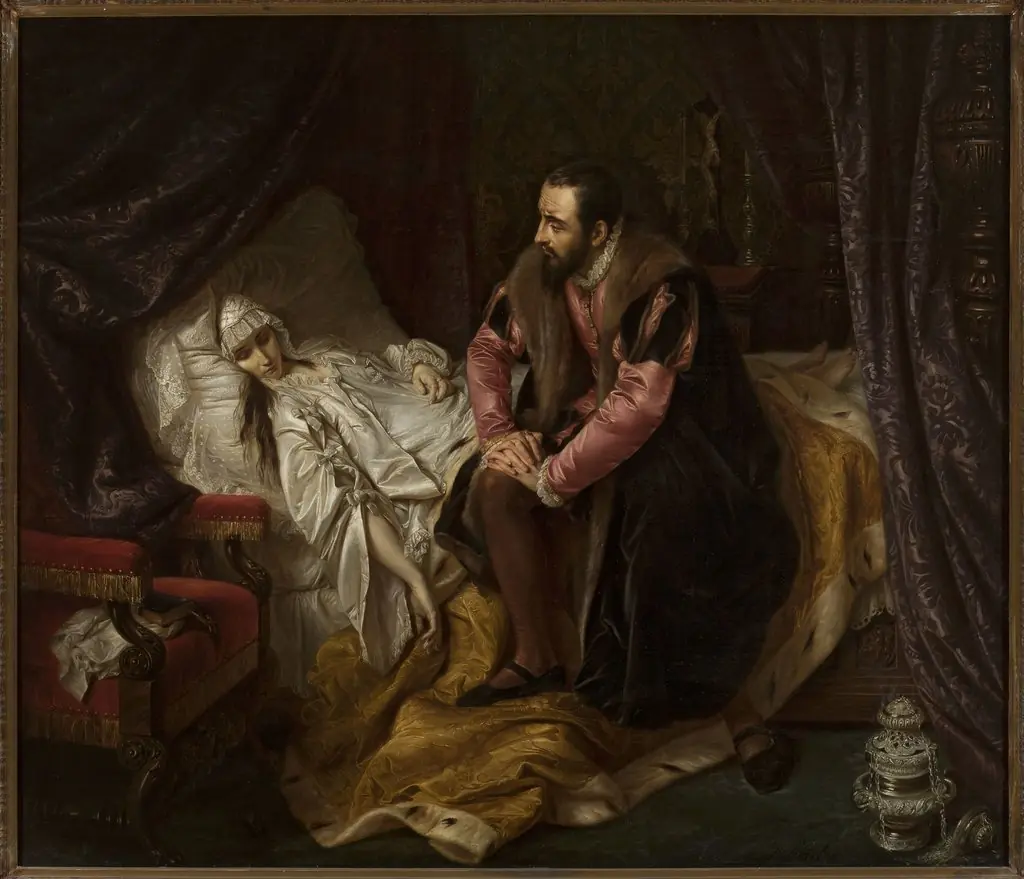 Death of Barbara Radziwiłł
 The Death of Leonardo da Vinci in the Arms of François I
 Andromache mourning killed Hector
 Jacob blesses the sons of Joseph
 Felipe III de Francia moribundo bendiciendo a sus hijos
 Death of Dido
 Terugkeer van Scipio's zoon