Artwork
Cavalry Scene
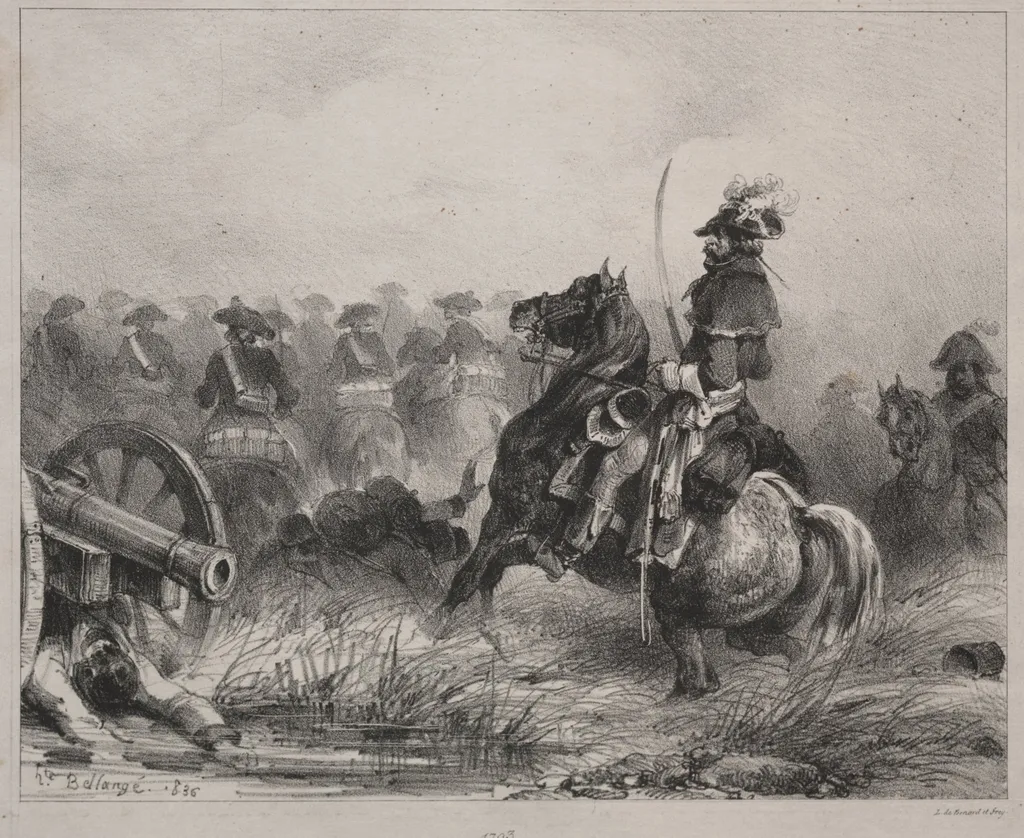
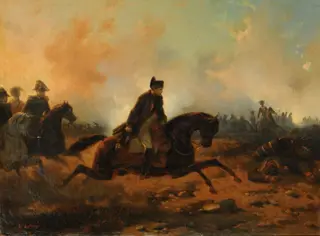
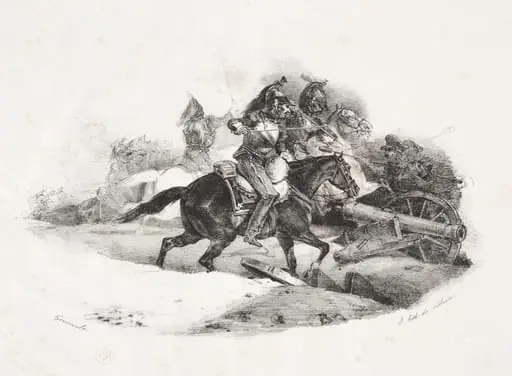
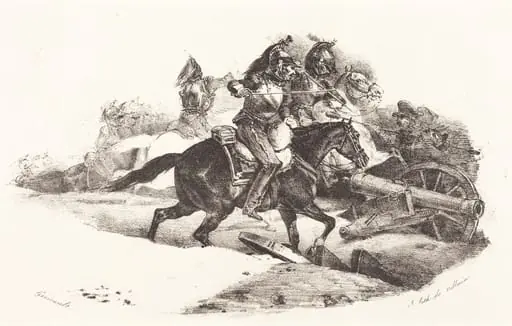
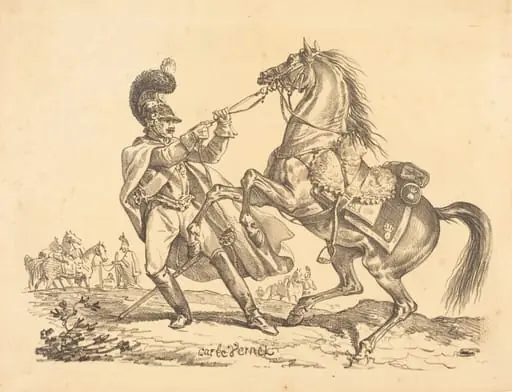
Cavalry Scene is a print by the Romanticist artist Joseph-Louis-Hippolyte Bellangé. It dates from 1836 and is held in the collection of the Cleveland Museum of Art.
- Accession no.
- 1941.192
About this work
Overview
Bellangé, trained under Antoine-Jean Gros, turned to battle scenes after the Napoleonic Wars, drawing on firsthand observation and historical memory.
Created in 1836 by French artist Joseph-Louis-Hippolyte Bellangé, this print captures a moment of cavalry action during a period when military themes dominated his output. Bellangé, trained under Antoine-Jean Gros, turned to battle scenes after the Napoleonic Wars, drawing on firsthand observation and historical memory. The work belongs to a series of prints that translate his painted compositions into graphic form, intended for broader public circulation.
Subject & Meaning
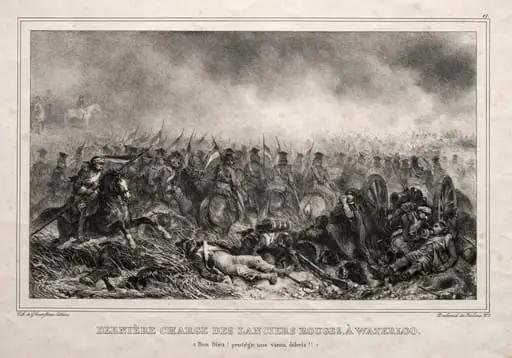
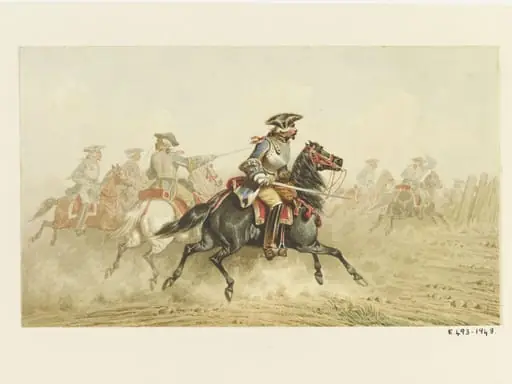
The scene centers on a rearing horse and rider in the foreground, surrounded by other mounted troops and a distant cannon. No specific battle is identified, but the composition evokes the chaos and momentum of 19th-century cavalry charges. The figures are rendered with urgency, emphasizing motion over individual identity.
The absence of clear narrative markers suggests a generalized representation of military intensity rather than a documented event.
Technique & Style
Bellangé employed dynamic linework and contrasting tones to convey movement and depth. The use of chiaroscuro heightens the drama, with dark shadows anchoring the foreground figures against lighter, receding backgrounds. The horses’ musculature and the angular positioning of limbs suggest rapid motion, while the loose handling of the terrain and distant elements provides spatial depth without detailed realism. The print’s texture reflects the influence of Romantic-era graphic traditions.
History & Provenance
The print was produced during Bellangé’s most active period as a reproductive artist, following his success with large-scale battle paintings. It likely circulated as part of a portfolio of military subjects, popular among collectors and institutions interested in contemporary warfare imagery. No documented early ownership is recorded, but its survival in multiple museum collections indicates sustained interest in his graphic work during the 19th century.
Context
Bellangé’s work emerged in a France still processing the legacy of the Napoleonic Wars. Military imagery was culturally significant, serving both as commemoration and spectacle. While Romantic painters like Delacroix emphasized emotional intensity, Bellangé focused on the mechanics and rhythm of combat, aligning with a growing public appetite for accurate, if dramatized, depictions of soldierly life.
Legacy
Bellangé’s prints, including this cavalry scene, contributed to the visual documentation of 19th-century military life. Though less celebrated than his contemporaries, his graphic output preserved the aesthetics of battle for a wider audience. His technique influenced later military illustrators and helped bridge the gap between academic painting and mass-produced imagery in the pre-photographic era.
Own this work as a print
Artist & collection

Artist
Joseph-Louis-Hippolyte Bellangé
Joseph Louis Hippolyte Bellangé (17 January 1800 – 10 April 1866) was a French battle painter and printmaker.