Artwork
Mary Magdalene Saint Peter of Verona Saint Catharine of Sienna and Blessed Margaret of Hungary
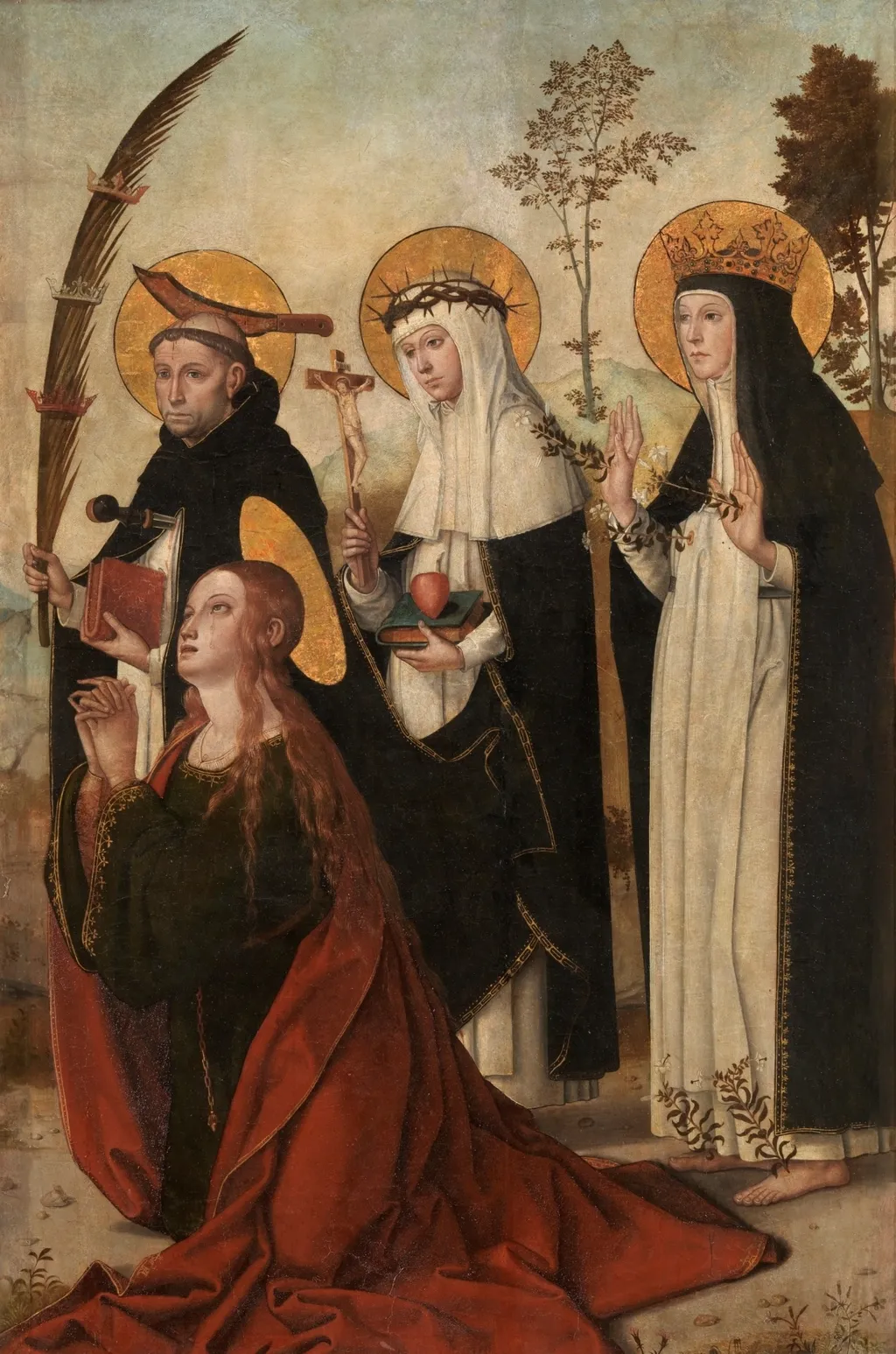
Mary Magdalene Saint Peter of Verona Saint Catharine of Sienna and Blessed Margaret of Hungary is a mixed painting by the Early Renaissance artist Juan de Borgoña. It dates from 1515 and is held in the collection of the Museo del Prado.
About this work
Subject & Meaning
Mary Magdalene is identified by a book, a traditional attribute that signals her role as a penitent and bearer of divine wisdom.
The composition unites four saintly figures, Mary Magdalene, Saint Peter of Verona, Saint Catherine of Siena, and Blessed Margaret of Hungary, arranged to emphasize their collective hagiographic narrative. Mary Magdalene is identified by a book, a traditional attribute that signals her role as a penitent and bearer of divine wisdom. Saint Peter of Verona bears a martyr’s palm and a knife, denoting his Dominican martyrdom, while Saint Catherine of Siena is marked by a stigmatic ring and a book, highlighting her theological authority.
Blessed Margaret of Hungary is distinguished by a crown and a lily, symbols of her royal lineage and purity. Together the saints embody themes of repentance, martyrdom, mystical experience, and royal virtue, collectively representing the Dominican order’s intercessory role within the devotional practices of the early sixteenth century.
Technique & Style
Executed in 1515 by Juan de Borgoña, this religious work employs a mixed technique applied to a wooden panel support. The painting measures 156 cm in height and 107 cm in width. As part of the Museo del Prado collection, the piece features iconographic elements including a book, consistent with its depiction of saints such as Mary Magdalene, Saint Peter of Verona, Saint Catharine of Sienna, and Blessed Margaret of Hungary.
The formal approach aligns with early sixteenth-century Spanish religious art, utilizing the durability of panel painting to sustain the detailed representation of these figures.
History & Provenance
The polyptych featuring Mary Magdalene, Saint Peter of Verona, Saint Catharine of Sienna, and Blessed Margaret of Hungary was created by Juan de Borgoña in 1515. Executed in a mixed technique on panel, the work measures 156 cm in height and 107 cm in width. The painting depicts religious figures and includes a book among its iconographic elements.
It is currently held in the collection of the Museo del Prado, where it is cataloged as inventory number P003110.
The painting Mary Magdalene, Saint Peter of Verona, Saint Catharine of Sienna and Blessed Margaret of Hungary by Juan de Borgoña is held in the collection of the Museo del Prado in Madrid. The work carries the museum's inventory number P003110. It is cataloged as a mixed technique painting on panel created in 1515. The provided sources do not contain information regarding specific past or future exhibitions of this artwork.
Legacy
The painting's legacy is anchored in its continued presence at the Museo del Prado, where it remains part of the museum's collection and is studied within the context of early 16th-century Spanish religious art. Its mixed technique on panel, depicting Saint Mary Magdalene, Saint Peter of Verona, Saint Catherine of Siena, and Blessed Margaret of Hungary, reflects the intricate devotional imagery characteristic of the period. The work's attribution to Juan de Borgoña has been reinforced through scholarly analysis, contributing to broader understanding of Castilian painting traditions.
Overview
Created in 1515 by Juan de Borgoña, this mixed‑technique panel presents four saints arrayed on a red cloth. The central figure kneels with a book, while the others stand, bearing a cross, a heart, and clasped hands. All are rendered with calm expressions, golden halos, and a subdued palette that emphasizes their sanctity.
Context
During the early sixteenth century, Spanish patrons favored devotional panels that combined local piety with the compositional harmony of Italian Renaissance models. Borgoña’s training in Burgundian and Italian traditions enabled him to meet these tastes, producing works that merged detailed landscape or drapery backgrounds with orderly, reverent figures.
Own this work as a print
Artist & collection
Artist
Juan de Borgoña (c. 1470–1536), was a High Renaissance painter who was born in the Duchy of Burgundy, probably just before it ceased to exist as an independent state, and was active in Spain from about 1495 to 1536. His…

 Stairway to Heaven
 The Assumption of Mary
 The Annunciation
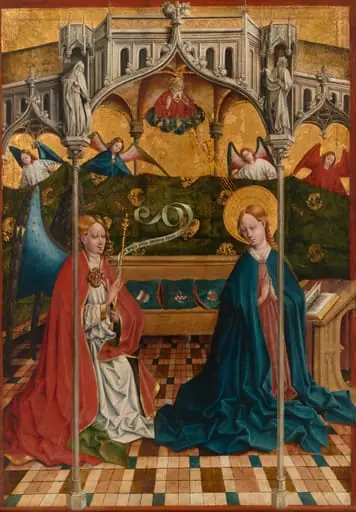 The Annunciation
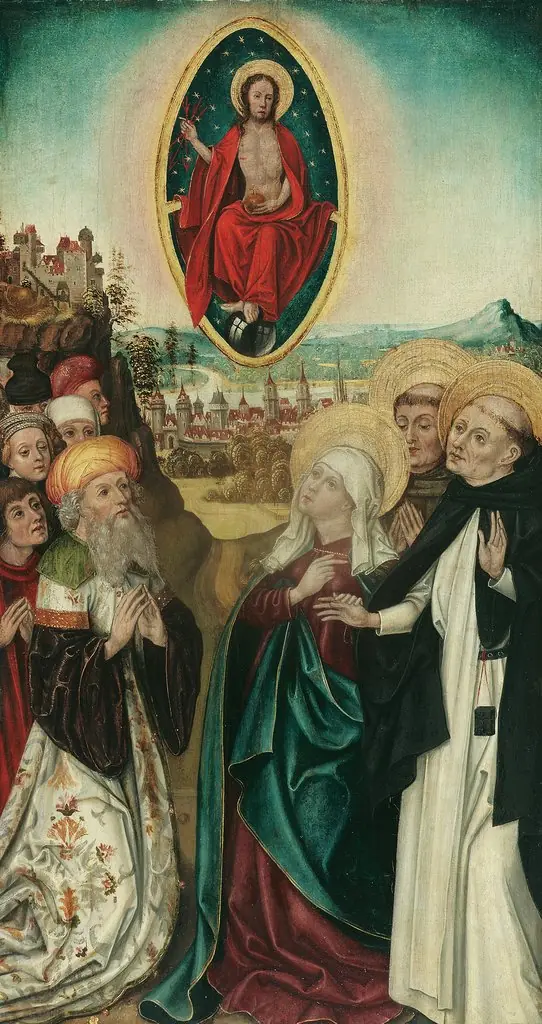 Vision des hl. Dominikus von Christus mit den drei Lanzen
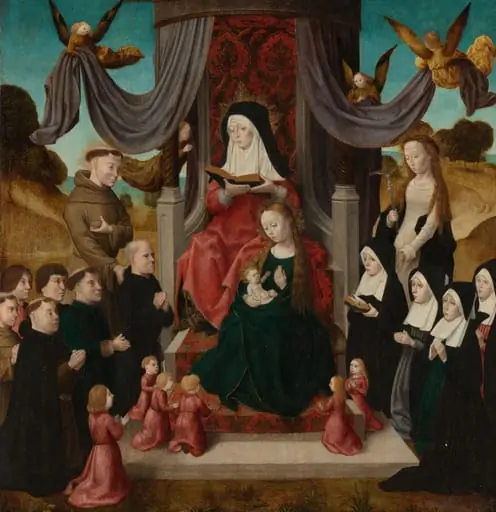 Virgin and Child with Saint Anne and Saints Francis and Lidwina, with Donors (Anna Selbdritt)
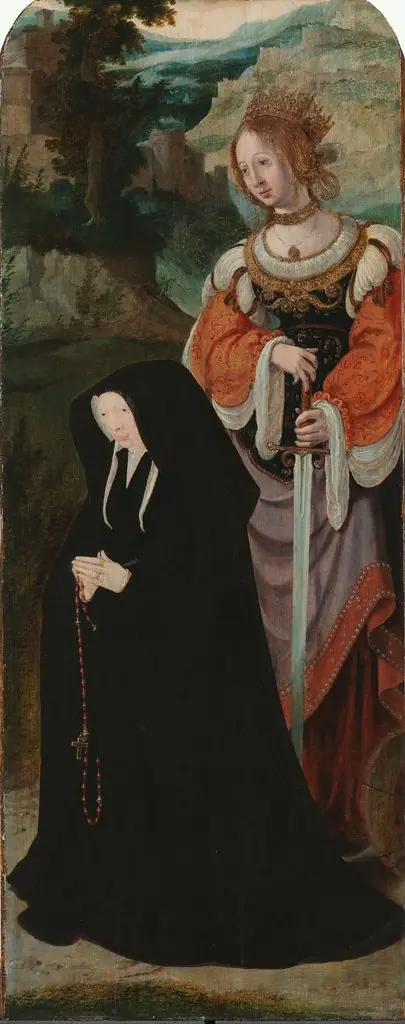 Wing of Lazarus tritptych with donor and Saint Catharine
 König David, Salomo und Maria Rückseite: Enthauptung Johannes d. T. (Nachfolger)
 Christ's Bath
 Saint Gertrude of Nivelles and an Augustinian Canoness
 The Visitation
- The Calling of Saint Catherine of Sienna