Artwork
Still Life with Game Fowl,Vegetables and Fruits
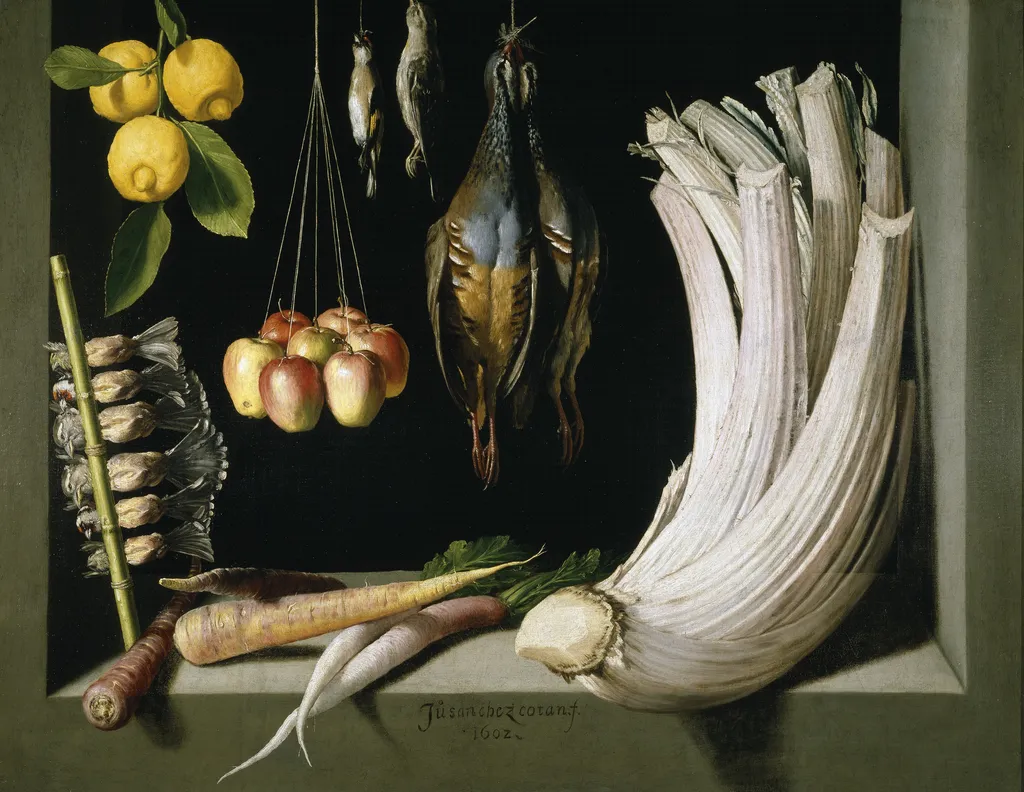
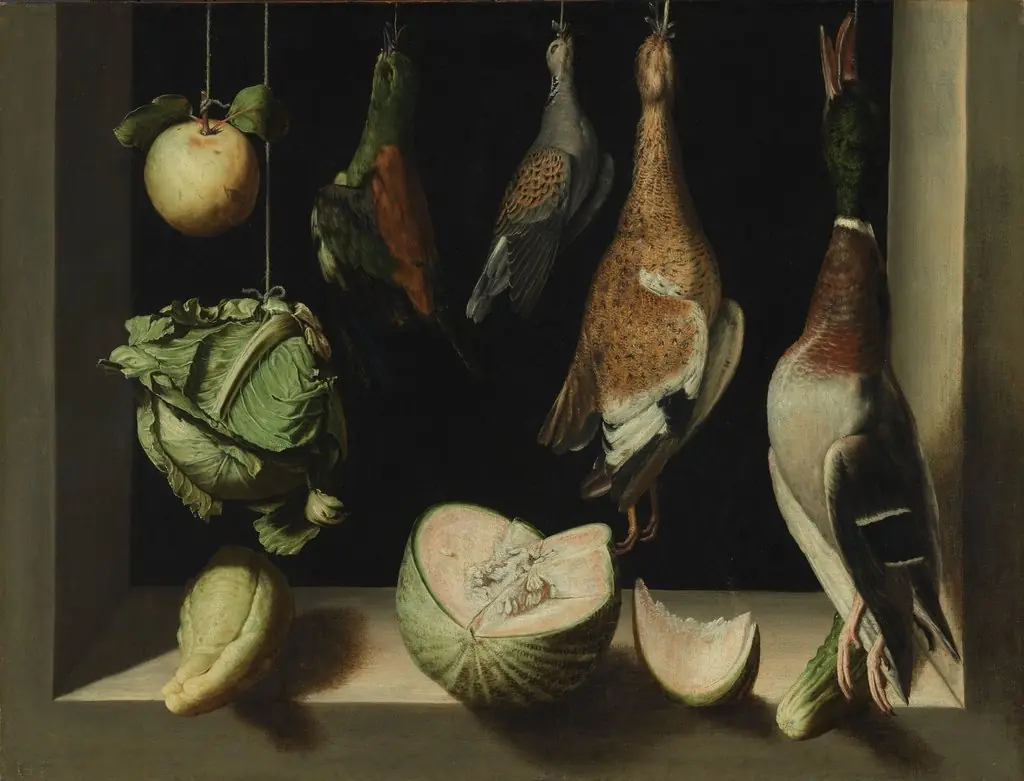
Still Life with Game Fowl,Vegetables and Fruits is an oil painting by the Early Baroque Italian artist Juan Sánchez Cotán. It dates from 1602 and is held in the collection of the Museo del Prado.
About this work
Subject & Meaning
The painting depicts an arrangement of hunted game birds and produce displayed within a geometric window-like niche set against a deep black background.
The painting depicts an arrangement of hunted game birds and produce displayed within a geometric window-like niche set against a deep black background. On the lower ledge rest two serins, two goldfinches, and two sparrows perched on a cane, alongside three carrots, two radishes, and a large white cardoon (thistle) that anchors the right side of the composition. Hanging above on the upper sill are three lemons, seven apples, a goldfinch, a sparrow, and two red partridges.
The work is also known as the "Bodegón del cardo" for the prominent thistle, and the cardoon and birds recur as motifs in other Cotán still lifes. The austere ordering of the elements, emphasized by lateral lighting that models volume and shadow, has been read as a meditation on sobriety over material wealth, suited to quiet contemplation. Its unusual density of objects, atypical for an artist who favored sparse compositions, makes it a defining example of the Baroque still life genre.
Technique & Style
Executed in 1602, the work is an oil painting on canvas measuring 68 cm in height by 88.2 cm in width. The composition features game birds, vegetables, and fruits arranged within a geometric frame against a completely black background, a technique used to emphasize the volume and texture of the objects. Illuminated by lateral light, the elements create naturalistic shadows that enhance the trompe-l'œil effect of the items appearing to protrude from the shelf.
Stylistically, the piece is recognized as a key example of early European Baroque still life, noted for its unusual complexity and abundance compared to the artist's typically simpler compositions. The arrangement combines realism with a sense of spatial suggestion and sobriety, establishing the work as a prototype for the genre despite its crowded array of lemons, apples, carrots, radishes, a large thistle, and various birds.
History & Provenance
Juan Sánchez Cotán painted Still Life with Game Fowl, Vegetables and Fruits in 1602, as confirmed by multiple sources. The work was created while the artist was in Toledo during his mature period, just one year before his transfer to Madrid and entry into the laic order of the Certosians, as noted in archival inventories from 1603. It was later owned by Infante Don Sebastián Gabriel, who was compelled to surrender it in 1835 due to his Carlist sympathies; it subsequently entered the Museo de la Trinidad before being returned to his heirs in 1861.
The painting remained in private hands until 1991, when the Museo del Prado acquired it using funds from the Villaescusa bequest and proceeds from a Velázquez exhibition. The Prado has held the work continuously since its acquisition.
Still Life with Game Fowl, Vegetables and Fruits is held in the collection of the Museo del Prado in Madrid. The painting entered the museum's holdings in 1991, acquired using funds from the Villaescusa legacy and proceeds from a Velázquez exhibition. Prior to this acquisition, the work belonged to the Infante Don Sebastián Gabriel until it was seized in 1835 due to his support of the Carlist cause.
It was transferred to the short-lived Museo de la Trinidad three years later but was returned to the Infante's heirs in 1861, remaining with the family until its purchase from Teresa Mariátegui.
An inventory record from 1603 cites the work, placing it during the artist's mature period in Toledo. While specific exhibition titles are not detailed in the provided records, the painting is noted as a key example of Baroque still life currently on display at the Prado.
Context
Juan Sánchez Cotán's Still Life with Game Fowl, Vegetables and Fruits (1602) exemplifies early European still life and demonstrates a sophisticated approach to composition and realism that influenced later artists. The work features unusual abundance of birds and vegetables arranged on a ledge against a black background, emphasizing volume and texture through side lighting. Its precise arrangement and minimalist aesthetic were noted by contemporaries and later scholars as a precursor to Baroque still life and a model for later works, including those by Diego Velázquez.
The painting entered the Museo del Prado collection in 1991 after being held by the Infante Don Sebastián Gabriel's heirs and subsequently acquired through the Villaescusa bequest and proceeds from a Velázquez exhibition.
Legacy
The painting is recognized as one of the earliest European still lifes and a foundational work of the Baroque bodegón genre. Its restrained composition, sober arrangement of elements, and use of lateral light against a black background have been cited as the prototype for later Baroque still life painting, with the work estimated to have served as a model for several subsequent compositions in the genre.
Its mastery is reinforced by its institutional trajectory: after passing through the collection of Infante Sebastián Gabriel, confiscation, the Museo de la Trinidad, and restitution to heirs, it entered the Museo del Prado in 1991 through the Villaescusa bequest, securing its place among the canonical holdings of Spanish still life painting.
Overview
Juan Sánchez Cotán’s 1602 oil painting, Still Life with Game Fowl, Vegetables and Fruits, presents a modest arrangement of everyday items on a darkened tabletop. The composition includes a suspended cluster of lemons, hanging red and green apples, a lifeless bird with outstretched wings, and a handful of root vegetables, carrots and a large white onion, set against an unadorned, shadowy backdrop.
Own this work as a print
Artist & collection