Artwork
Still Life with Cardoon, Francolin, Grapes and Irises
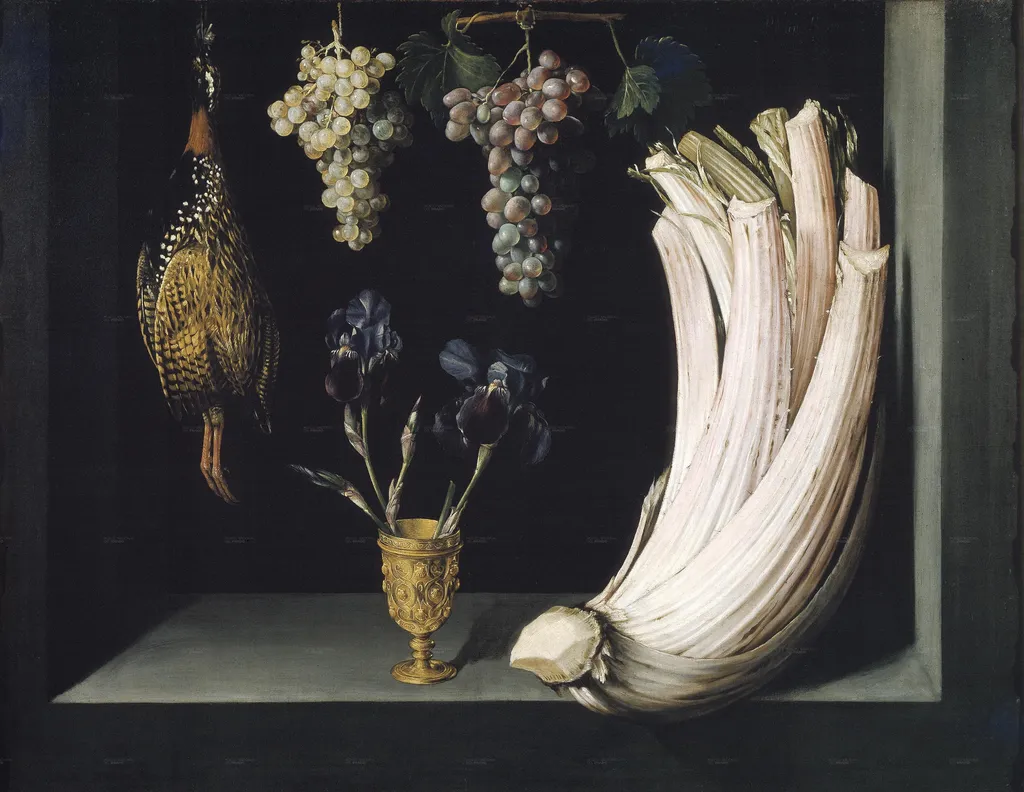
Still Life with Cardoon, Francolin, Grapes and Irises is an oil painting by the Spanish Baroque Tenebrist artist Felipe Ramírez. It dates from 1628 and is held in the collection of the Museo del Prado.
About this work
Subject & Meaning
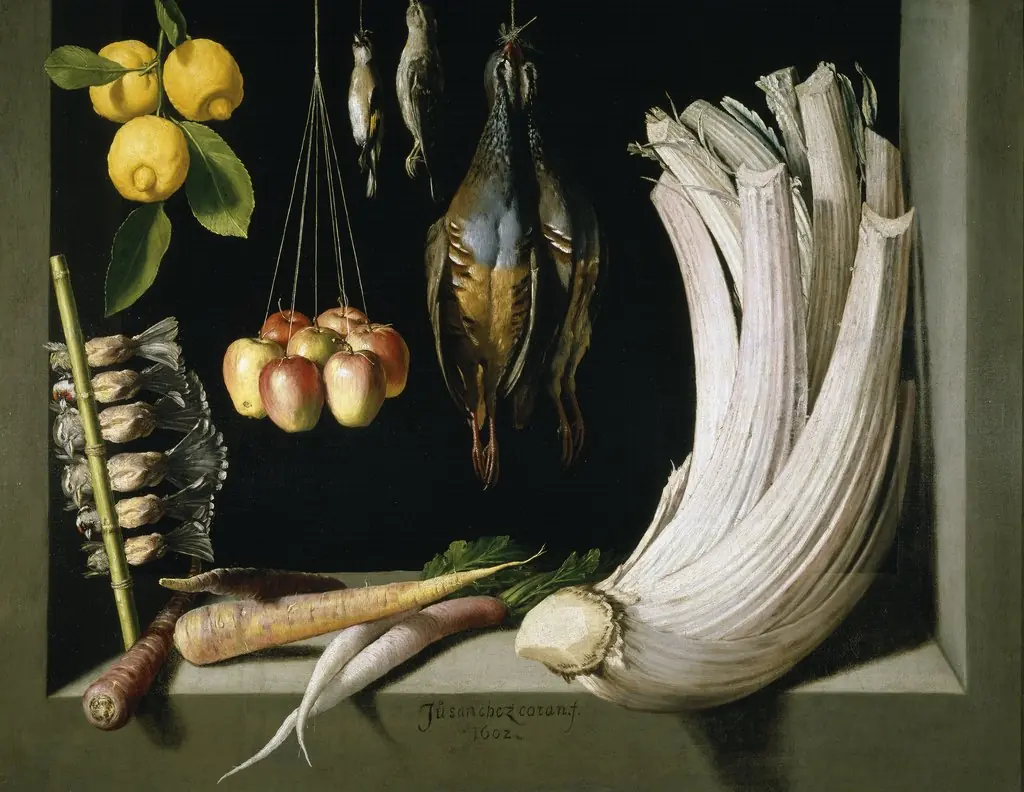
The painting arranges its subjects within the lower half of a stone niche, a compositional device inherited from Juan Sánchez Cotán's still-life models.
The painting arranges its subjects within the lower half of a stone niche, a compositional device inherited from Juan Sánchez Cotán's still-life models. A cardoon, copied in minute detail from Cotán's own hunting still life, curves across the foreground, while a dead francolin stands vertically, its upright posture set against the cardoon's arc. A gilded cup holds irises, a floral element foreign to Cotán's known oeuvre but consistent with reports that he also painted lost flower pieces.
Hanging grape clusters recall the work of Juan Fernández "el Labrador," who became celebrated for such motifs. The combination of game bird, fruit, vegetables, and flowers within a tenebrist niche produces a devotional still life typical of early seventeenth-century Spanish bodegón practice, in which natural objects are staged for contemplative rather than purely decorative effect.
Technique & Style
The work is executed in oil paint on canvas, a support typical of Spanish still-life painting of the early 17th century. The surface bears a fine, even brushwork that renders the textures of fruit, flower and bird with a restrained tenebrist lighting reminiscent of Juan Sánchez Cotán’s compositions. The artist’s handling of the cardoon’s spiny leaves and the delicate irises demonstrates a meticulous attention to botanical detail, while the francolin is rendered with a lighter touch that creates a subtle vertical counterpoint to the surrounding foliage.
Formal analysis notes the balanced triangular arrangement of elements and the restrained palette of earth tones punctuated by the bright gold of the flower vase, hallmarks of the bodegón tradition in Baroque Spain.
History & Provenance
The painting is signed and dated "Philipe Ramírez / fa. 1628," establishing both its creator and year of execution. It was first documented by the art historian Juan Agustín Ceán Bermúdez, who recorded having seen it in a private collection in Madrid.
The work resurfaced in 1936 when it was seized during the Spanish Civil War, at which time it belonged to the Vera collection in Torrelaguna. In 1940 it entered the Museo del Prado in Madrid, acquired with funds from the legacy of the Conde de Cartagena. The painting was later included in the exhibition "Rembrandt-Velázquez."
The painting is held in the Museo del Prado in Madrid, where it entered the collection in 1940. Its acquisition was funded by the legacy of the Count of Cartagena. Prior to this, the work was documented by Juan Agustín Ceán Bermúdez in a private Madrid collection and was seized during the Spanish Civil War in 1936 while belonging to the Vera collection in Torrelaguna. The artwork was included in the exhibition history of Rembrandt-Velázquez.
Context
Alfonso E. Pérez Sánchez characterized the painting as a work of "exceptional quality" that testifies to the longevity of the still-life models devised by Juan Sánchez Cotán in early seventeenth-century Toledo. Ramírez adopted Cotán's overall arrangement, placing the objects within a half-drawn fresquera (a larder niche), and replicated the tenebrist lighting and the figure of the cardoon in close imitation of the master's Still Life with Game, Vegetables and Fruit. The gilded cup with irises, by contrast, has no known parallel in Cotán's surviving oeuvre, though he is documented to have painted lost floral compositions.
The hanging grape clusters recall the work of Juan Fernández "el Labrador," who became celebrated for such motifs, while the francolin, treated with lighter handling, introduces a vertical counterpoint to the cardoon's curve.
The painting was discussed in the foundational literature on Toledan still life by Diego Angulo Íñiguez and Pérez Sánchez, and in Pérez Sánchez's catalogues of Spanish bodegones for the Museo del Prado. William B. Jordan's study of Cotán's bodegones and the Prado's 1995 exhibition La belleza de lo real further situated the work within the historiography of Spanish still-life painting.
Legacy
The painting has been cited as evidence of the enduring influence of Juan Sánchez Cotán's still-life models well into the 1620s, with Alfonso E. Pérez Sánchez describing it as a work of "exceptional quality" that perpetuates those earlier compositions. It is discussed in the standard literature on Spanish still-life painting, including Pérez Sánchez's catalogues of the Museo del Prado's bodegones and floreros, and Diego Angulo Íñiguez and Pérez Sánchez's study of Toledan painting of the first half of the seventeenth century.
The work entered the Museo del Prado in 1940 and was included in the museum's 1995 exhibition La belleza de lo real. Floreros y bodegones en el Museo del Prado 1600-1800, and later in the exhibition Rembrandt-Velázquez, securing its place in the canon of Spanish seventeenth-century still life.
Overview
Created in 1628 by Seville‑born painter Felipe Ramírez, this oil on canvas presents a modest arrangement of objects rendered with meticulous realism. The composition centers on a darkened shelf that holds a dead francolin, a cup of deep‑purple irises, a curved cardoon stalk, and two clusters of ripe grapes. The work belongs to the collection of Madrid’s Museo del Prado.
Own this work as a print
Artist & collection
Artist
Felipe Ramírez was a Spanish painter of Seville, active as a still-life painter during the 17th century.

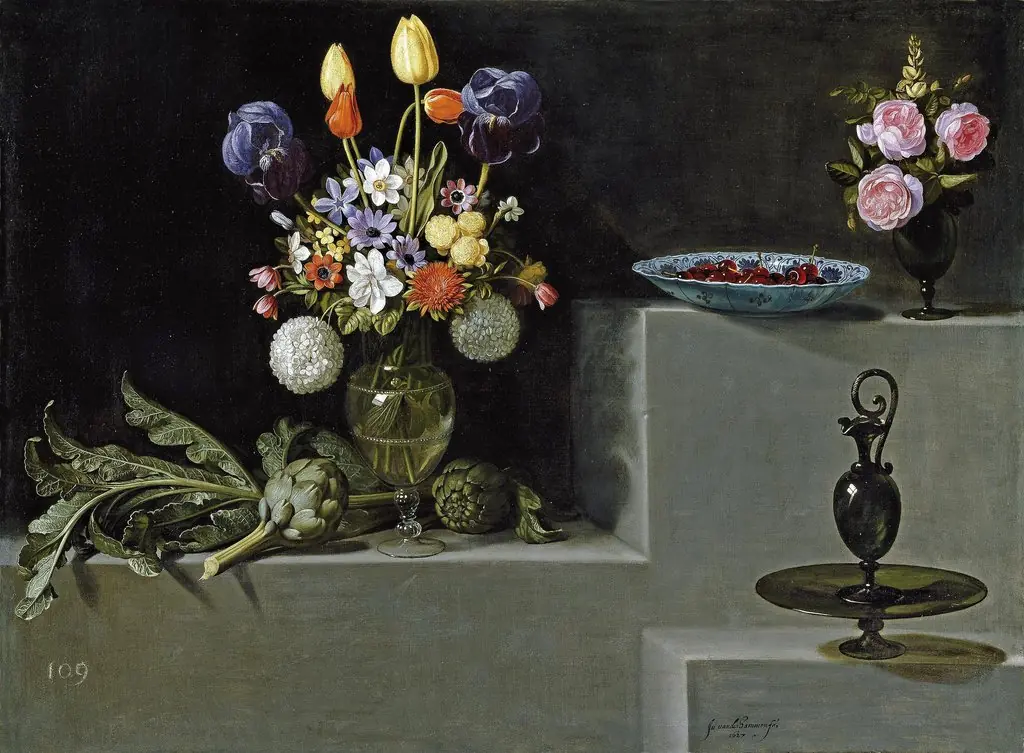
- Still life with Artichokes, Flowers and glass Vessels
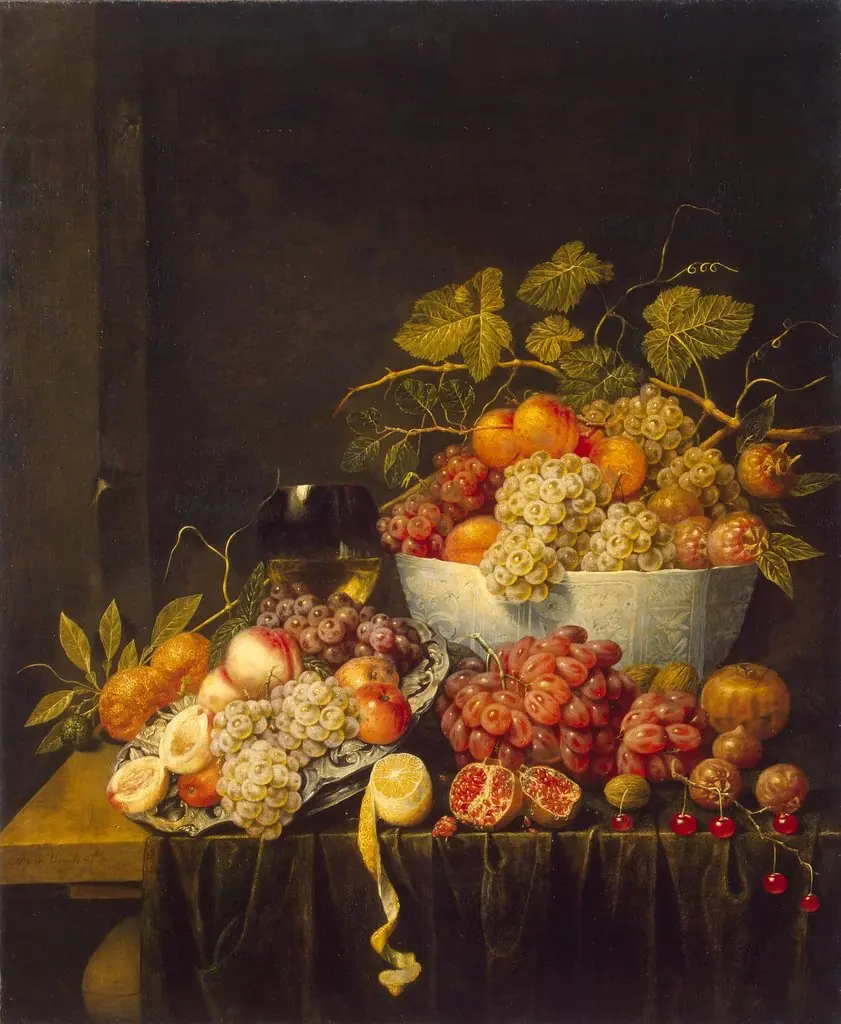 Still Life with Grapes
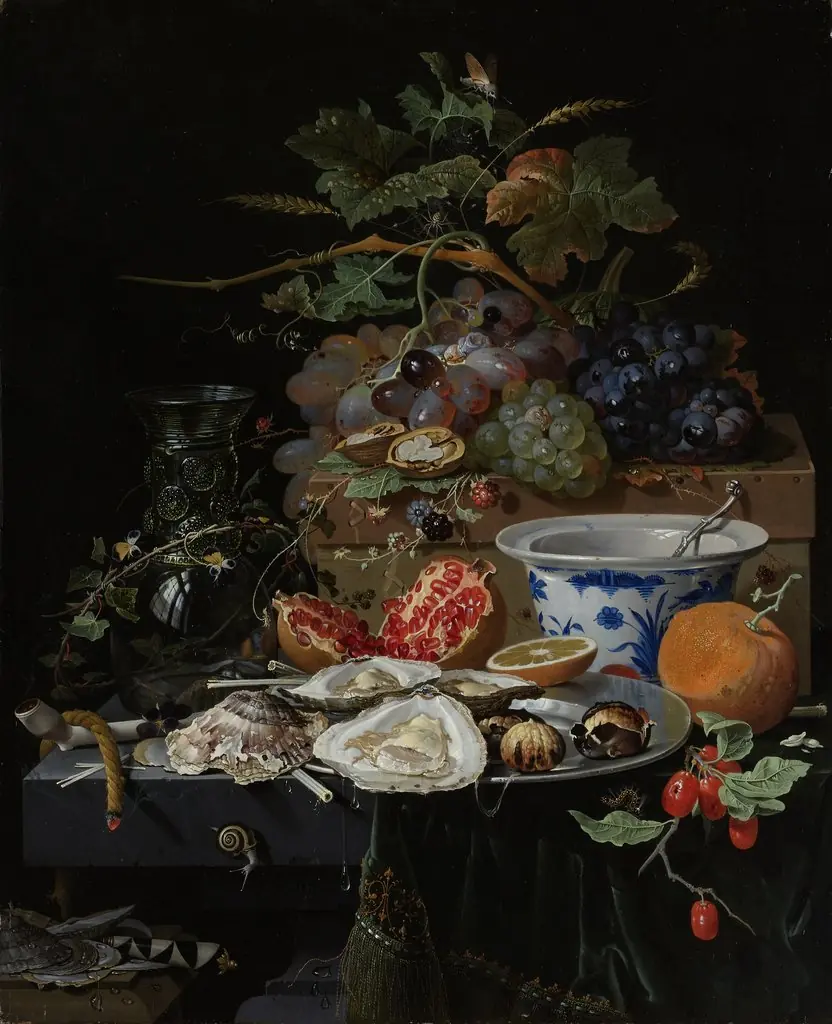 Still Life with Fruit, Oysters and a Porcelain Bowl
 Still Life with Fruits, Flowers and Animals
 Still life with fruit, wine glass and vase of flowers
 Still Life with Flowers, Grapes, and Small Game Birds
 Still Life with Bottles and Oysters
 Still Life with Grapes and Game